

“Great writers, especially novelists, do something really extraordinary in the sense of the way they observe life, but also comment on it,” observes A Talent for Murder star Helen Mirren. “Being an actor, you have to be a great fan of brilliant writing.”
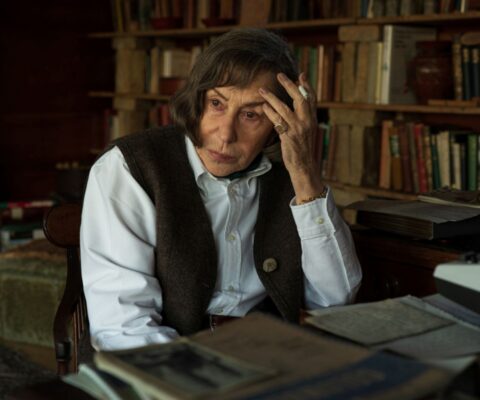
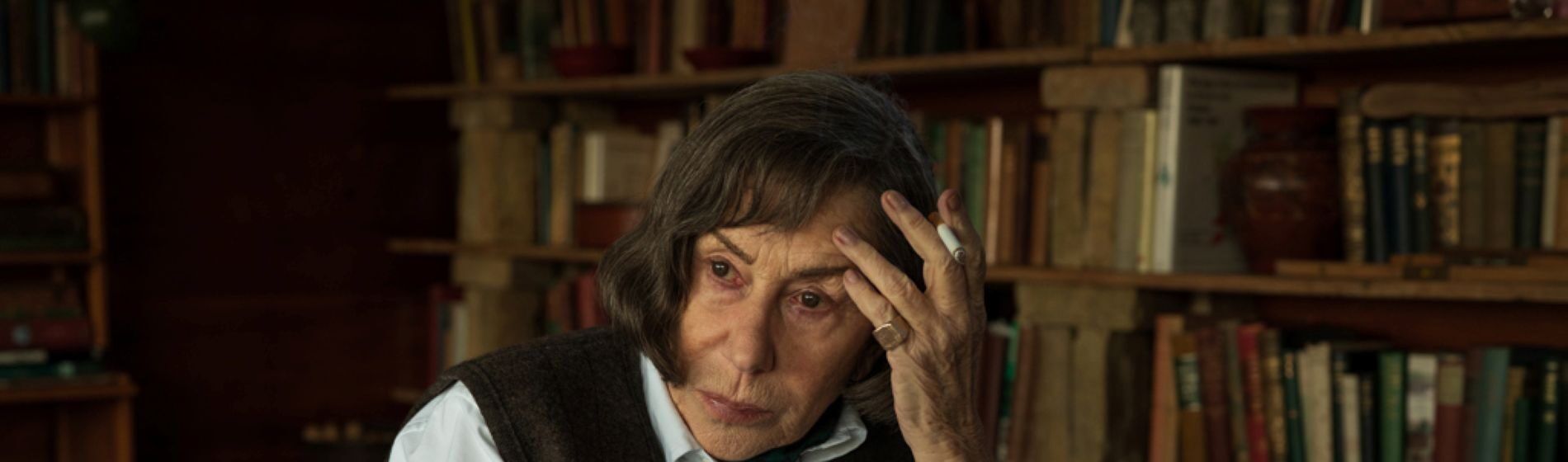
Mirren, speaking with That Shelf at the Toronto International Film Festival where A Talent for Murder premiered in September, finds a great meeting of the minds between acting and writing. The Oscar-winning legend portrays famed novelist Patricia Highsmith and dives into the mind of a literary genius. Best known for The Talented Mr. Ripley and its sequels, Strangers on a Train, and The Price of Salt (the inspiration for Carol), Highsmith herself is a juicy a character as Tom Ripley. The reclusive author gives Mirren one of her darkest characters yet. (Read Colin Biggs’ review of A Talent for Murder here.)
Mirren puts audiences into Highsmith’s juicy rich psychology as A Talent for Murder visits the author’s Swiss home, which is less a cottage and more like a bunker that shields her from her pesky neighbours. “If you imagine Patricia Highsmith talking to E! Entertainment or something, that would be an absolute anathema to her,” laughs Mirren.
To watch Mirren explore the wheels of Highsmith’s literary psychology offers a thrill. “Certain writers have that ability to almost write filmically,” says Mirren. “And I think in a way, Patricia Highsmith had that ability.” While Mirren plays a fictional take on Highsmith, as A Talent for Murder adapts Joanna Murray-Smith’s play Switzerland, her enigmatic take on the elusive and frosty writer reflects the rich body of work that Highsmith realised on the page and further creatives popularised through films.
A Talent for Murder picks up on the pesky popularity of Highsmith’s oeuvre. Her publisher, eager for another Ripley book to replenish the coffers, sends a young representative to woo her. Edward Ridgeway (Alden Ehrenrich) provides a young and impressionable man, much like the creations that Highsmith moulds in her novels. She toys with him as he visits her home and tries earnestly to persuade her to writer another Ripley. But Highsmith knows that she gives Ridgeway the jitters. She therefore makes a game of his brief stay. She teases him with breadcrumbs for creative murders that could easily be the fate of Ripley’s next victim. Rat poison in the scrambled eggs, say, or a fancy knife to the throat while he sleeps.
This Highsmith reflects the character as she exists in combative interviews and cynical worldviews. “She was not a very nice person at the end of her life at all, and we don’t shy away from that in the film,” admits Mirren. “One wants to pay respect to her genius and her brilliance, absolutely. But I think it would do her a disservice to try and smooth over the edges that she very much had.” Mirren adds that although A Talent for Murder offers a fictional scenario, she and director Anton Corbijn (Life) wanted to portray Highsmith as honestly as possible.
This honesty means that Ridgeway approaches his host cautiously during negotiations. Highsmith has a reputation for being a bigot and every kind of “ist” under the sun. She challenges Ridgeway’s sexuality and teases him to prove the measure of a man. That test partly comes by probing with his own capacity for murder. She really gets inside his head as the narrative breaks and Ridgeway leaves the home to pursue a romantic interest. As that story progresses, he fashions himself as a Ripley figure. He morphs from awkward outsider to suave jet-setter, but also stone cold killer. His time with Highsmith roughens him.
Mirren says that she could explore Highsmith’s dark side by contrasting her experience with the way the author’s worldview hardened as she aged. “I’ve gone the opposite direction in my attitude to life,” says Mirren. “She became very embittered, very private, isolated. It was a fascinating journey to go into her psychology and not her books, but her psychology.”
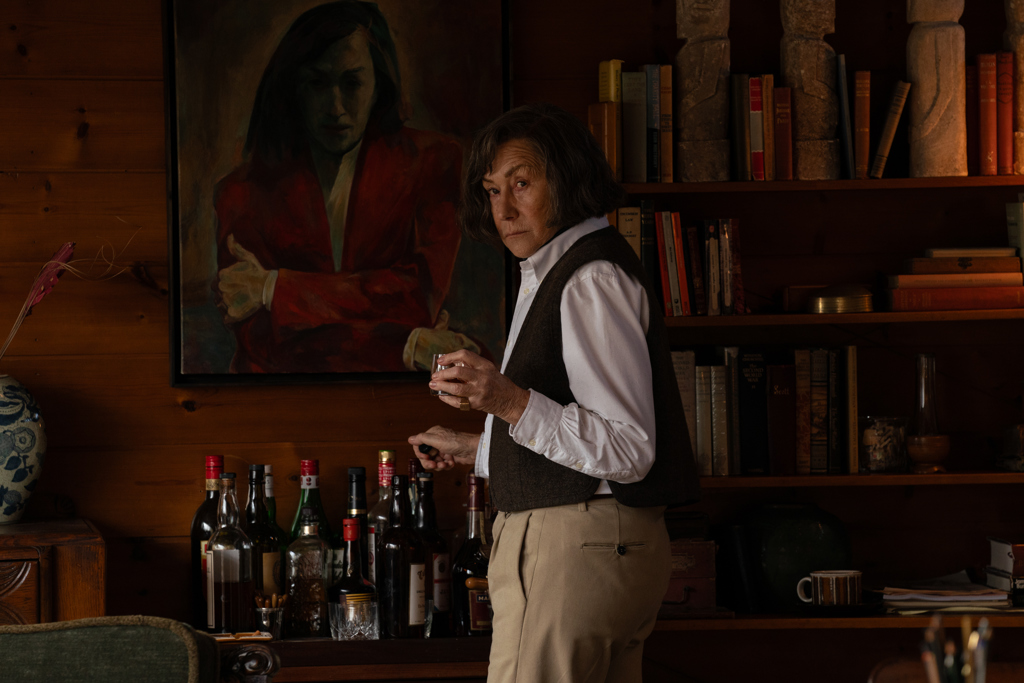
For Mirren, that dynamic gets to the heart of the character, but allows the performance to comment upon the society that shaped Highsmith. “So often when women are strong, they are called unkind or they’re called bitches or frigid or all of that crap,” says Mirren. “But I think Patricia Highsmith, in her misanthropy, decided she didn’t like any races. She didn’t like men or women. She just liked her snails. That was absolutely genuine, as you probably know. She didn’t engage in the community. She was the ultimate isolationist.” Naturally, her slimy snails make an appearance in Ridgeway’s bedroom.
Zeroing in on Highsmith’s isolationist mentality, Mirren gives insight as to how she got inside a very private mind. “One of the elements with Patricia, which is why I think she became so retracted and angry, was she fell madly passionately in love, obsessively in love, which is why part of the energy of her writing comes from the understanding of obsession,” says Mirren. “She would really fall madly in love and then almost inevitably be disappointed in one way or another. And she wasn’t loved by her mother.”
The scenes with Ridgeway’s Swiss sojourns echo this sentiment. He falls hard for a young woman (Slow Horses’ Olivia Cooke), or her money, and plots ways to off her guardian. Each time he returns to Highsmith, his plan coalesces as he confronts his own willingness to take a life. It’s something the author insists exists inside of everyone.
“I don’t think Patricia Highsmith is right about that,” observes Mirren. “She thought because she was like that, maybe everybody was like that.”
Mirren admits that if she could go back in time, she might bump off Genghis Khan or a certain Austrian, but mostly has altruistic motives with historical notorieties. “Get them out of the way before they cause the havoc,” she laughs. “It’s quite a long list, and I would say 99.9% of them are men.”
But Mirren says she enjoyed having Ehrenreich as a sparring partner. Surprisingly, she relates her dynamic with her co-star to her relationship with husband, director Taylor Hackford (Ray). She says that the dynamic of refusing to let things sit easily can fuel a relationship. “We challenge each other. We question each other, and we argue with each other,” she says. “He thinks I’m terribly argumentative because I disagree with him. I categorize it as having a discussion. But yes, absolutely. And I think wherever there’s a good marriage, there is that sort of, not combativeness, but an equal give and take in a good partnership.”
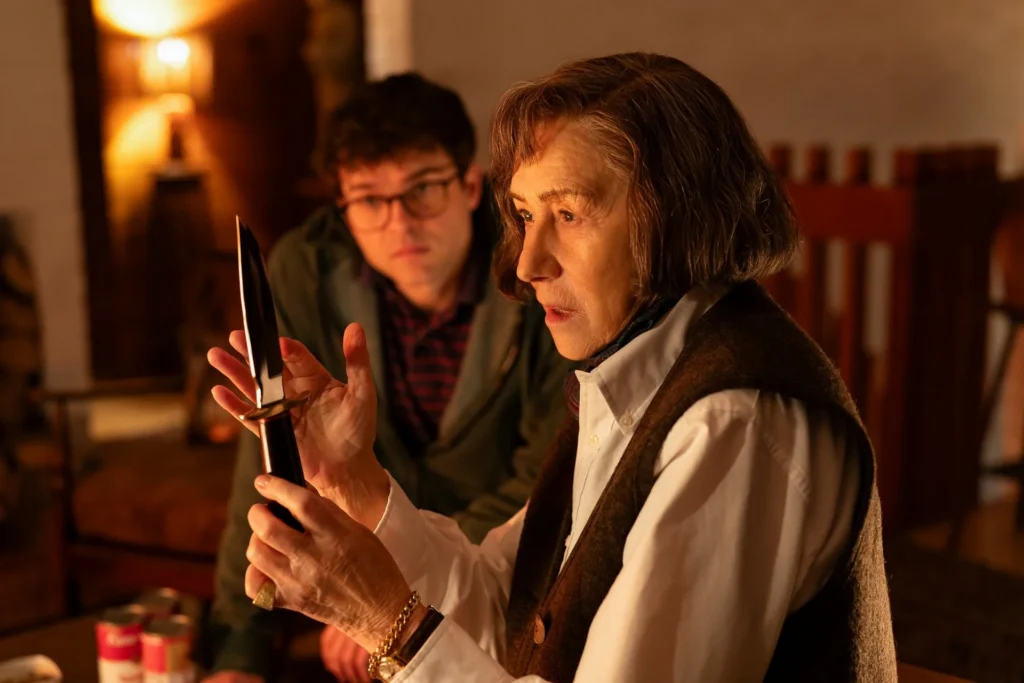
One can’t help but relate that dynamic and the Highsmith character with Mirren’s other dark screen persona: the scheming matriarch Maeve Harrigan in MobLand. I point out the ways that these dark characters complement each other, while also feeling distinct in Mirren’s body of work, and ask Mirren what delight there is in playing the baddie. She cracks a smile.
“The first thing when you’re playing a baddie is never to see them as the baddie,” says Mirren. “Obviously, they’re completely different characters. The gothic nature of Maeve Harrigan in MobLand, the extremity of the writing, I always compare it to Jacobian Tragedy. It has that Jacobian edge to it where everything is heightened and much more extreme than anything in real life.
“Patricia Highsmith’s very different,” Mirren continues. “For Patricia Highsmith, I had to really try to get into the absolute reality of who she was. There wasn’t a great deal of research material. There were a couple of interviews with her on television. Thank God there was quite a detailed interview with her on British television and that was very valuable, although she was younger then. And then there was another little tiny clip where she’s on an English TV show because she identified much more with Europe than she ever did with America and she felt more comfortable in Europe in general.”
Mirren says that finding clips of Highsmith walking was especially valuable, with learning a person’s movement being a trick she gleaned from police officers while researching Prime Suspect. But one clip was especially fun to inspire Highsmith’s combativeness without making her the baddie per se. “There’s an amazing piece where she’s on a panel and there’s a man on it whose daughter has been killed and she’s absolutely fascinated by this and asks incredibly inappropriate questions with a very straight face. And that was quite late on in her life, so that was very valuable,” Mirren says, also with a straight face.
“Any role you play, like playing the Queen, any historical character that the audience has seen and has an understanding of what they look like, you have to obey a certain amount of physical transformation. You can’t just roll up not looking like them.” Sometimes that also means embodying the shadows they carry.