


Meelad Moaphi’s feature film debut, His Father’s Son , premiered at the Canadian Film Festival (CFF), drawing praise for its authentic portrait of an Iranian -Canadian family and their struggles after an unexpected inheritance arrives. Moaphi’s film also won the Best Direction in a Feature and the Audience Award at the Reel Asian Film Festival . The film hasn’t gotten much press since, but this week’s theatrical release should rectify that. Promising filmmakers need all the help they can get in this I.P.-dominated market.
Amir (Alireza Shojaei) works tirelessly to make a name for himself on the culinary scene—long hours at the restaurant and on video shoots to build his following on Instagram. There isn’t enough time amid all of that to appease his parents. Every minute of his day is already accounted for. Conversely, Mahyar (Parham Rownaghi), his younger brother, floats through life. Farhad (Gus Tayari) and Arezou (Mitra Lohrasb) don’t scrutinize their youngest son; he can relish living a life of no expectations. It’s the sort of drama present in every family, but one that no one gives a second thought to. But when Amir’s parents receive news that a family friend from Iran has died, the fractures start to show.
Their lawyer, Saini, drops the news of Parviz’s death without further information. Only that Parviz left his inheritance solely to Mahyar. Farhad says the million dollars will be split between sons, but the damage is done . The influx of half a million dollars could boost Amir’s career prospects, but it’s clear that whatever Mahyar does for a living (the film is vague on this) pleases the family greatly . Why should he get the whole sum? Suspicious of Parviz’s motives, Amir uses a Niagara getaway to investigate more about their mysterious benefactor.
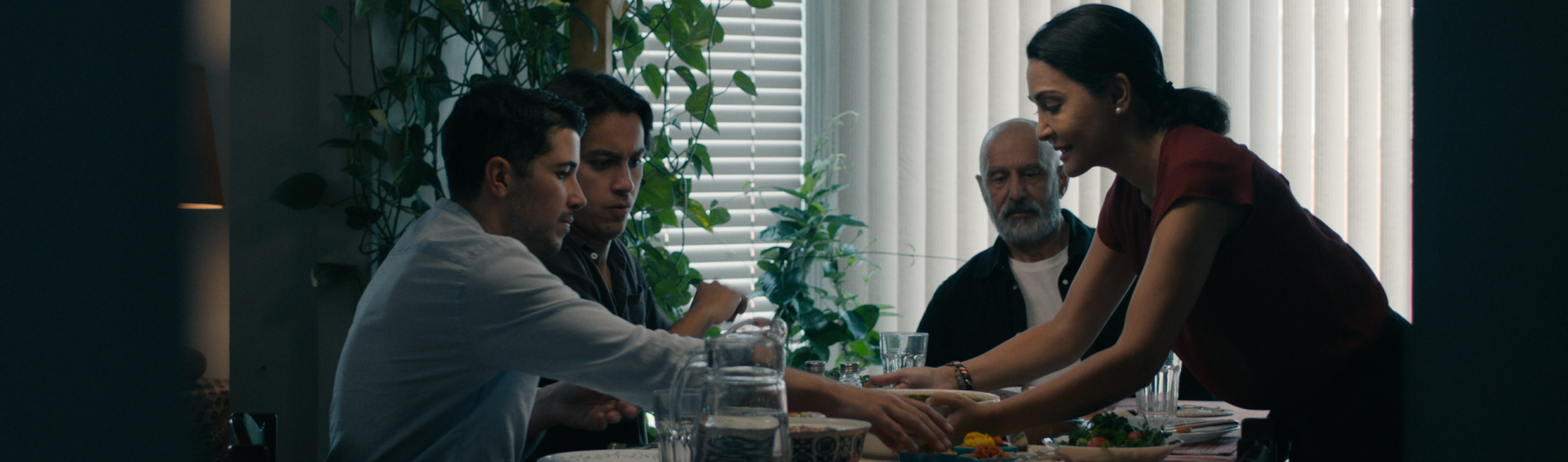
The film explores how each family member relates to one another, focusing on conversations that take place during meals. Arguably, the brothers’ altered relationship could be the main crux of the film, but the tension between Amir and Farhad drives the story.
Amir tries to live the dream outlined for all immigrants, but Farhad questions the security of a fickle career. Amir’s love for the culinary arts is obvious, and the camera lovingly lingers on each plate. His concern is about reputation and craft, not money. One would think a chef and a men’s clothing salesman could find a middle ground in aesthetics, but the two butt heads constantly. Arezou dotes on both her sons equally, but Farhad finds fault in almost everything. Amir doesn’t visit enough. Amir doesn’t highlight Persian-based dishes at work. His girlfriend isn’t Iranian. Worse yet, they’ve never event met her. That’s a deliberate choice on Amir’s part because Dina (Romina D’Ugo ) hasn’t left her husband yet.
In a revealing scene, Amir tries to convince Dina to stay after sleeping together, but she refuses. Amir’s possessiveness takes over then and we get a real look at Amir beneath the surface. It’s not until his carefully crafted life starts to fall apart that he seems like a flesh-and-blood human being. He spent so much time curating himself for every audience that there was no real ” him ” left. Shojaei plays this revelation as a fault exposed for the first time, instead of a pattern of predatory nature. It comes into play again later when Mahyar discloses a secret about Amir’s co-worker Joyce (Conni Miu).
One critique I have of His Father’s Son is that the scenes between Amir and Dina should have more weight. Unfortunately, as written, Dina isn’t much more than “ the girlfriend ” role. But the crux of His Father’s Son rests on the catharsis of understanding between father and son. With high expectations already crushing Amir, more insight into the ways he knows he has failed his parents would have been illuminating.
There are parallels between Farhad, Arezou, and Parviz that hit too close to home for our protagonist, too. Like any man who truly sees his father as a whole (detached from our child’s understanding of them), Amir realizes he and his father are more alike than they care to admit. And it’s the conversations that we don’t have that tell infinitely more about us than the ones we do. The family scenes are hard-hitting and a calling card for Moaphi’s ability to write interesting portrayals. I look forward to seeing what he can do with a larger canvas.
At a little less than 80 minutes long, His Father’s Son runs tight. Perhaps too tight. At times, it feels like the script skips steps to achieve emotional catharsis, yet Shojaei and Tayari imbue their characters with an impressive depth. The music, by Lucas Prokaziuk, adds an extra flourish to the proceedings, revealing emotions that the characters aren’t bold enough to share.
Moaphi plates something simple and understated, but by investing the audience in the ensemble, the film feels richer for it.