

In the fictional town of Hope Harbour, South Korea, the setting for filmmaker Na Hong-jin’s ( The Wailing, The Yellow Sea ) first film in a decade, Hope ( 호프 ), little of any consequence occurs. Except, of course, for the occasional alien invasion or a new species appearing, seemingly out of nowhere, with an angry disposition, claw-like fingers, and the combined strength of 10-12 able-bodied men.
When, inevitably, Bum-seok (Hwang Jung-min), Hope Harbour’s police chief, appears on the scene of an unusual case of roadkill (a bull of the bovine kind), he’s all swagger, an attitude reflecting his status as a small-town law enforcement officer and not the specific, intrinsic traits typical of a big- or small-screen action hero. He’s accustomed to the townspeople’s unexamined deference, earned or not. That deference to his badge and uniform extends to his second cousin, Sung-ki (Zo In-sung), the de facto leader of a hunting group, who discovers the relatively undisturbed remains of the rotting bovine unceremoniously deposited in the middle of the road.
Where Bum-seok initially sees a minor problem better handled by the town’s Parks and Rec department, Sung-ki throws out the suggestion that it might be something else, something worse, like a stray Siberian tiger that’s somehow managed to avoid the literal landmines and barbed-wire fencing separating North and South Korea along the DMZ (Demilitarized Zone). Both, it turns out, couldn’t be further from the literal or metaphysical truth. They, like anyone else in their respective position, immediately pivot to rational or seemingly rational explanations to explain who or, more likely, what may be responsible for the rotting roadkill.
Taking nominal charge, Bum-seok sends Sung-ki and his friends into the surrounding mountains to track down the bovine-slaughtering beast. Situation handled (or so he thinks), Bum-seok returns to the tiny hamlet where, as expected, nothing usually happens. This time, though, it does: Bum-seok returns to a town under siege, presumably from a monstrous interloper of unusual size and temperament. Said monster leaves a virtual path of destruction in its wake, including, but not limited to, upturned cars, gouged building facades, and the odd, dismembered or crushed citizen who foolishly attempted to engage the monster head-on or feet first.
In an undoubtedly brilliant filmmaking decision, albeit a decision that directly leads to diminishing returns as Hope enters its distended, over-indulgent second half, Na keeps the camera, and with the camera, the story, resolutely focused on Bum-seok as he first drives, walks, and eventually runs, shotgun in shaky hand, gun holstered, and his nerves becoming increasingly frayed. In a welcome twist on genre tropes, Bum-seok’s behaviour runs contrary to the usual expectations associated with action heroes. He’s far from ready to confront whatever’s running amok throughout the town.
Once his initial swagger disappears, Bum-seok stumbles, bumbles, and mumbles his way through the better part of the next hour, always a step or two behind the monster, occasionally joining one of the several makeshift militias that have formed to defend against the monster, and almost always alone again, the lone, sometimes last survivor, of another confrontation with the monster just out of sight, around a corner, or hidden behind a building.
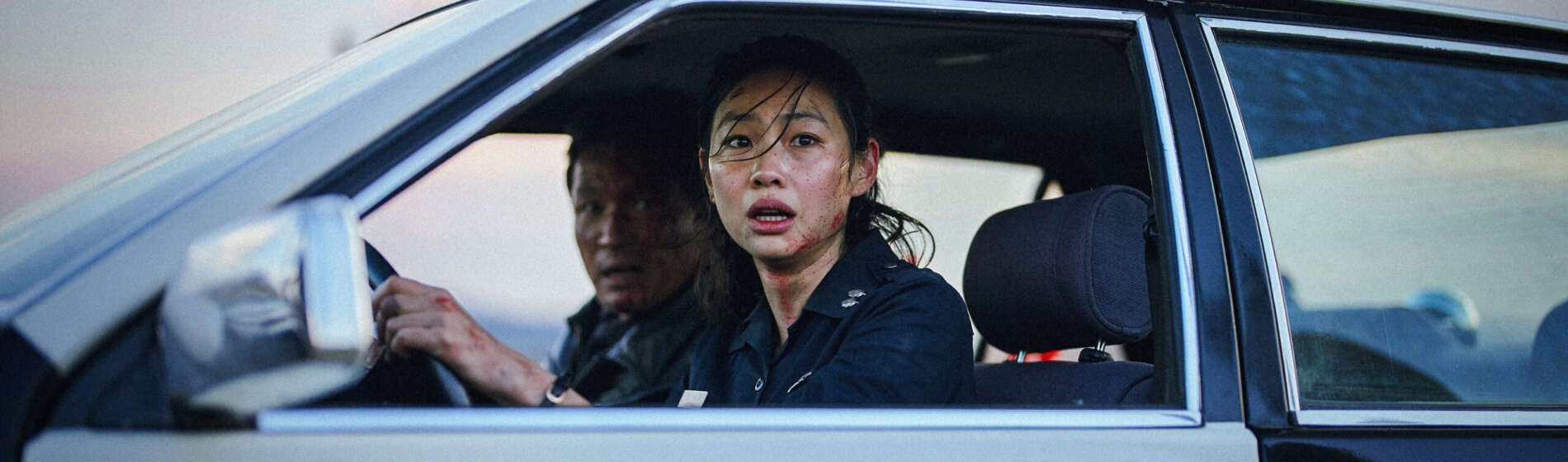
While the first sight of the monster-alien isn’t a disappointment, almost everything that follows is, but with one notable exception: the exhilarating arrival of Sung-ae (Jung Ho-yeon), a junior officer, who saves Bum-seok moments before he loses his life to the monster-alien’s wrath. Na gives Sung-ae the slightly hyperbolic, if still reverential, introduction usually saved for a heroic protagonist. She can drive with the skill of a Formula-1 racing car driver, often with just one hand, while firing any number of weapons from the window.
During the first hour, Hope periodically pops over to the B-storyline centred on Sung-ki and his friends as they casually stroll through a heavily forested area, exchange humorous, dude-bro banter, and pick up the occasional clue or carcass. Once Hope Harbour finds a new, if temporary, equilibrium, the two storylines converge into a final, all-out battle in, around, and outside the forest between the under-equipped humans on one side and the aliens on the other. In contrast to every other character in Hope , Sung-ki proves shockingly indestructible, taking all kinds of beatings, head-slaps, and slap-downs, briefly coughing up a mouthful of blood before catching his breath and rejoining the fight barely worse for wear. In terms of punishment received, he’s practically a comic-book or cartoon character in human form.
Na and his technical crew stage, execute, and edit it all with thrilling precision. Unfortunately, it’s also exhausting to the point of frustration. Too often, Na repeats story, character, and emotional beats, leaving the characters, and with them, the audience, to wonder why everyone hasn’t moved on to the next set piece or the next confounding revelation about the aliens: Who they are, how they got to Earth, and what they might want now that they’re here.
And with a bloated, overlong runtime approaching two hours and forty minutes (only four minutes shorter than the earlier, pre-final Cannes release), a jumbled, confused narrative seemingly the result of mid-production or post-production changes, and variable, sub-optimal, video-game-quality CGI, not to mention a rushed, sequel-ready ending that leaves far too many questions unanswered, it’s fair to wonder if, for all its positives, Hope simply got away from the ambitious, obviously gifted Na.