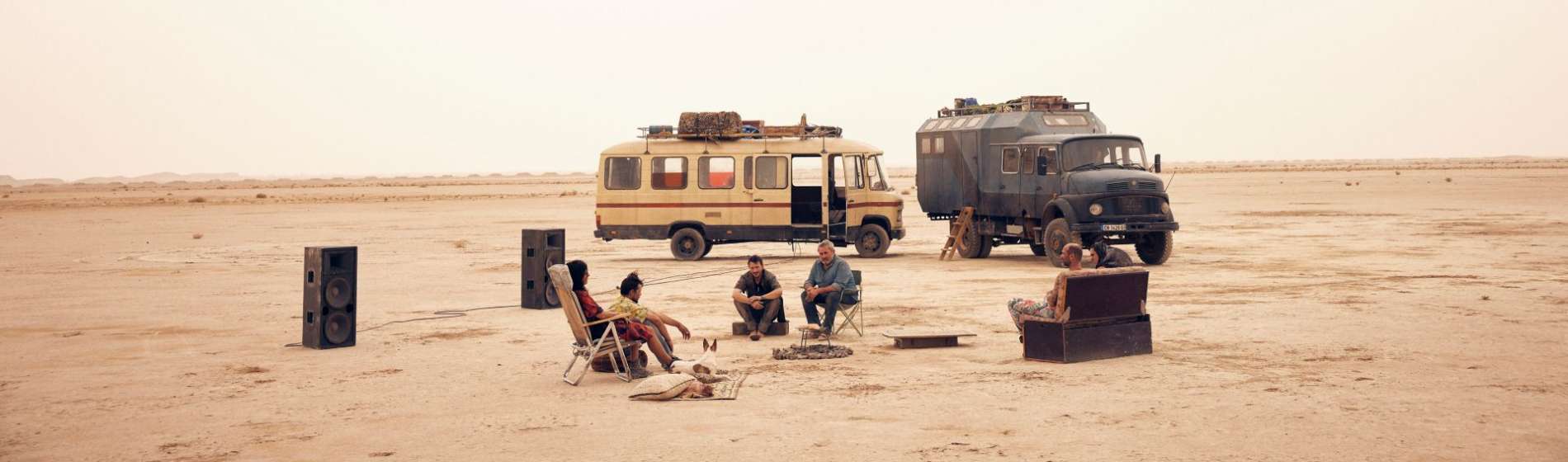


If there’s any film that cinephiles need to see in theatres this awards season, it’s SirÄt. The adrenaline-charged odyssey by Oliver Laxe recently won the Toronto Film Critics Association’s award for Best International Feature and scored two Golden Globe nominations , including in the same category. (Full disclosure: I’m a voting member in both groups.) The masterfully tense film inspires edge-of-your-seat viewing as a Spanish father, Luis (Sergi Lopez), winds up in the Moroccan desert searching for his missing daughter. His quest leads him to a group that throws massive raves in the desert. They’re like a techno oasis where lost souls find themselves absorbed and immersed in the hypnotic techno beats. SirÄt is a sonic boom of a movie and a singular, exhilarating film experience. ( Read Rachel West’s review of SirÄt here. )
The propulsive yet meditative score by Kangding Ray, also a Golden Globe nominee, enchants a viewer and invites one to enter the trance state that provides an escape for the ravers whom Luis encounters. But for all the bombastic of SirÄt ’s phenomenal score, the power comes in the jarring silence that punctuates the soundtrack as Luis’s odyssey goes to some very dark places. When the music cuts, SirÄt proves nerve-wrackingly tense.
Laxe, speaking with That Shelf via Zoom, likens the interplay between silence and music to an Olympic relay where runners pass the baton. “Sometimes images have their own music, their own sound, even if they’re silent,” Laxe explains. “Another time, the music and the sound gives depth to the music. The key thing was to find this sonar landscape and, as I always say, to make images that you can hear and making sounds that you can watch.”
Even when the party stops and Luis accompanies several nomadic ravers to their next stop on the circuit, where he hopes his daughter awaits him, SirÄt maintains the delicate interplay between techno beats and mystical reveries going on the soundscape. The trip includes a perilous journey up and down switchbacks with suspenseful sequences that recall The Wages of Fear to explosive twists of fate in the desert when war breaks out. But the nomads with whom Luis keeps company—Steff, Jade, Josh, TonÃn, and Bigui—share a productive philosophy: if the world’s going to shit, they might as well go out dancing.
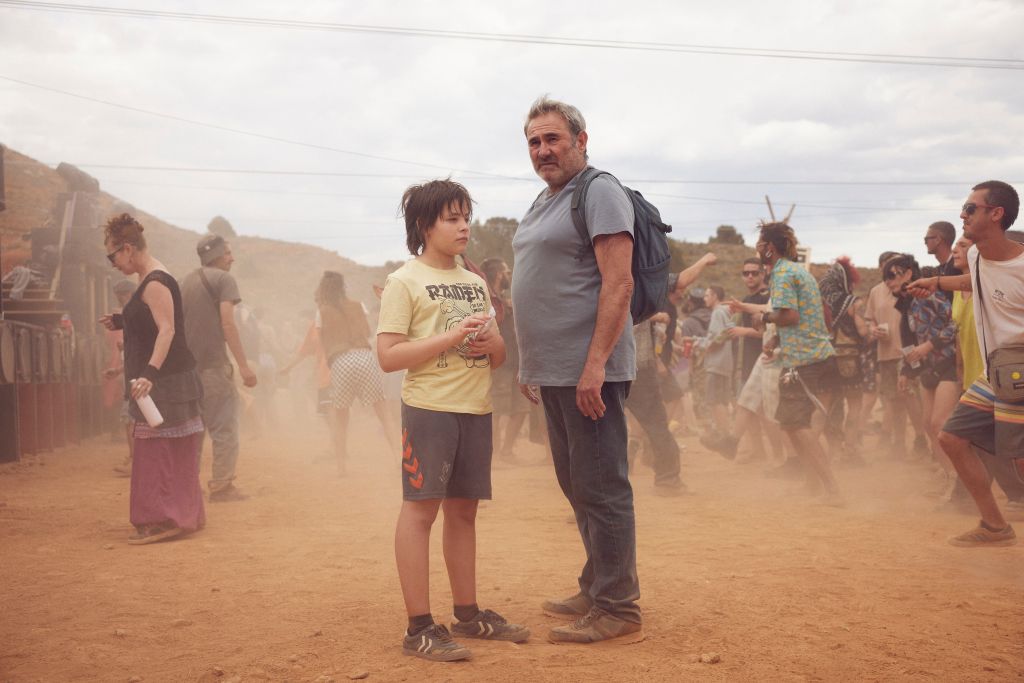
What’s especially impressive about SirÄt’s musically-attuned direction is that Ray designed the score before Laxe shot the film. Instead of composing in post-production, as workflow for movies usually goes, Laxe let the music guide the shoot.
“Obviously, I found a lot of things [while] editing thanks to the music, but the way I write a script is really atmospheric,” explains Laxe. “So with a strong place for music, because music is about atmospheres too. Working with Kangding Ray was a gift. He’s extremely talented and obviously I could go further thanks to him. I think it’s one of my zeniths as a filmmaker working with him. In a way, I’m a musician; in a way, Kangding Ray is a filmmaker. So both of us, when we were talking about textures, about the grain of the image, we were talking the same language.”
This feat is doubly impressive given that the co-stars alongside Lopez are all non-professional actors that Laxe sourced from the raver scene. They feel this music in their bones. Laxe confidently lets the players inhabit the space and move to the rhythms, finding dramatic power by observing people in fictional counterparts to their lived experiences.
“We worked on a dimension of the structure and the texture of the sound and of the image,” says Laxe. “And that’s why the image and the sound grasps you: you feel it. You feel it in the body, the image and the sound.”
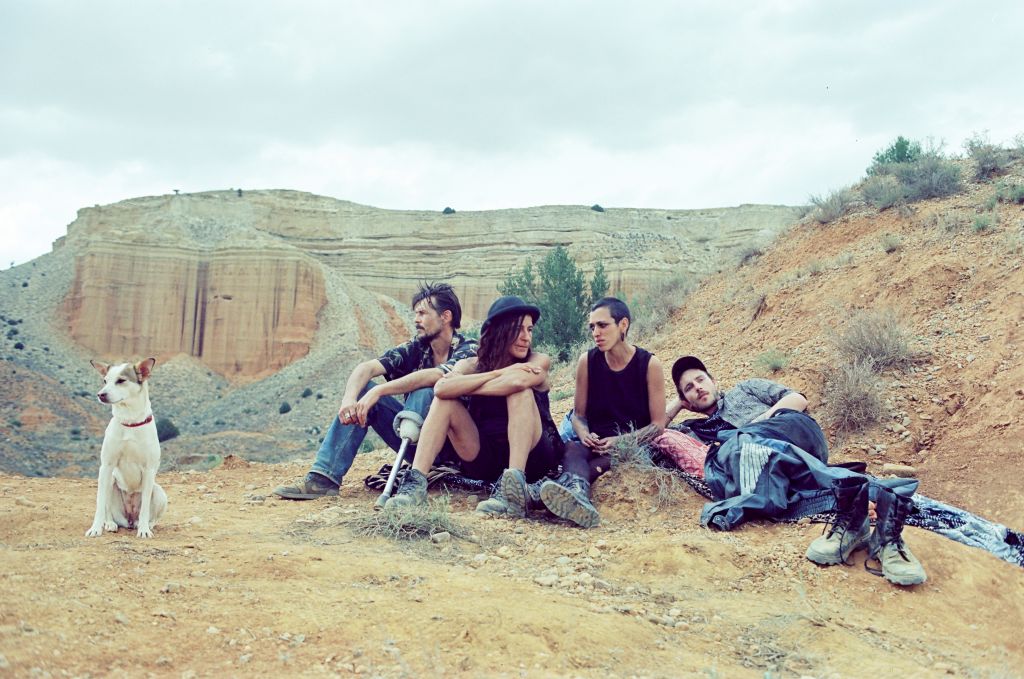
Laxe says he spent lots of time getting to know the nomads during pre-production by inviting them to his home in Galicia. He says the time involved learning more about their experiences, but also sharing relevant films, reading the script, and having extensive, often philosophical conversations.
“I remember, for example, we were talking a lot about death and about experiences near death,” explains Laxe. “Most of them have, as you see, they have their scars. Life checked them. Life proofed them. And thanks to this, they had the wisdom and the knowledge that we feel on their faces, on their gestures, and in their silence.”
The ravers’ weathered faces complement the foreboding desert landscape that SirÄt traverses. The more time that Luis spends with them, the more they defy the preconceived notions he brings regarding their lifestyle, especially when their survivalist instincts keep him alive as the situation escalates.
Laxe takes a minute, though, and acknowledges a criticism he says he’s received from other filmmakers, who feel the writing leaves the characters underdeveloped. He disagrees. The backstory is all there on the ravers’ faces, especially in the context in which Luis encounters them. Their nomadic dance circuit provides an escape: they all have their ghosts from lives left behind.
“What do you have to develop more of when you shoot the face and the scars and the wounds of a human being?” asks Laxe. “There is nothing more precise and more deep than when cinema [shows this]. What I know is that it’s not through script writing that I will be more near the soul of my characters. It will be through images.”
SirÄt brings us close to the souls of these characters as the hypnotic rhythm immerses us in their world. Just wait for the moment when the bassline of the soundtrack becomes practically indistinguishable from one’s own heartbeat. It’s a life force of its own, drawn from the pulse of these dancers in the desert.