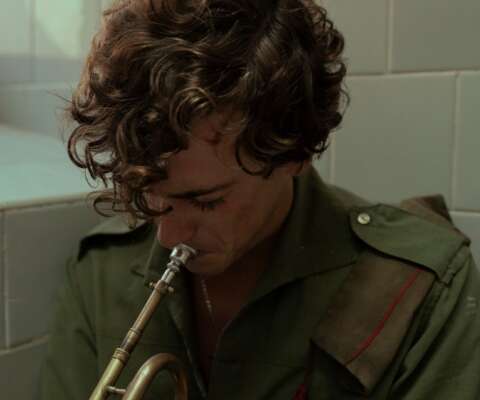


Did somebody order a “double trauma bacon and cheese”? Nyla Innuksuk (Slash/Back) doesn’t want you to enjoy fries with that order. Her new film In the Heart of the South inspires audiences to chew upon the greasy offerings of trauma porn and, hopefully, send it back to the kitchen.
Her latest film serves as a sort of meta-commentary about her first feature. In the Heart of the South gives Slash/Back an American Fiction twist as Inuk filmmaker Yura Ivalu (Anna Lambe) scores a new project as a hot talent on the Toronto film scene. The problem is that everyone clearly wants Yura to go full We’s Lives in Da Ghetto after making some provocative works about the enduring trauma of residential schools. Everyone leans in closer and smiles wider when they detect a whiff of pain that assuages white liberal guilt under the guise of elevated horror.
As Yura pitches a story about two friends separated on the ice up north, with one of the girls being a shaman and returning long after their paths converged, she finds herself caught between pandering and authenticity. Yura faces serious writer’s block as she tries cranking out a story treatment that meets expectations. Uncannily, though, Yura’s long estranged friend Sesi (Zorga Qaunaq) appears at her apartment out of the blue.
The friends share the experience of Yura’s protagonists. They carefully remember the time they were separated on the ice and Yura distinctly recalls Sesi having some shamanic powers. They agree to disagree about some details, but the timing couldn’t be better for a filmmaker seeking inspiration. She’s an endless well of material. Yura doesn’t even have to change the names to deliver exactly what her funder wants.
Sesi’s indeterminate stay crystallizes the complexity of Yura’s situation. The former refuses to conform to the settler culture’s idea of the perfect, docile, and polite Inuk. Where Yura constantly uses her positionality to reassure others, Sesi enjoys confrontation and talks straight.
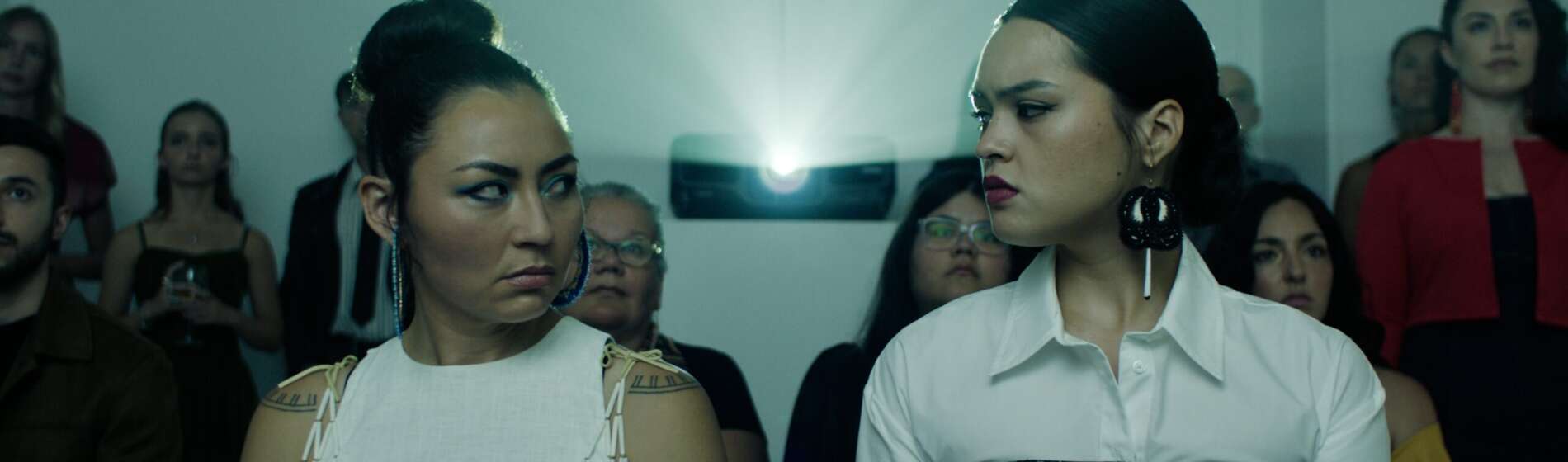
The perfect case in point comes when the friends attend a fellow artist’s installation. The show includes a video piece in which the young-ish Indigenous filmmaker inserts herself into a story about residential school trauma. All the white people in the gallery love it. Yura politely finds some nice words, but Sesi gives it a rotten tomato. “Double trauma bacon and cheese,” she scoffs. Her revulsion is palpable as the pain of previous generations becomes something to be aestheticized for gawking yuppies.
The lingering aftertaste of that bad burger can’t leave Yura’s mouth though. She struggles to resist serving digestible bites of history. Meanwhile, her Spidey senses intuit that she can use horror tropes to flip the conversation on its head. Like Sesi, she can reveal who the monster really is.
In the Heart of the South, with the title evoking the rest-of-Canada everywhere that sits below the North and to whom Yura must endear herself, deliciously blurs the line of Yura’s movie and Innuksuk’s own. The film she’s making reveals itself as the one we’re watching. The film evokes a participatory nature, or a complicity, between those who make a film and those who receive it. If one can’t tell the “double trauma bacon and cheese” from the good burger (acknowledging that Good Burger itself is something of a problematic metaphor here), then one’s own response to In the Heart of the South (Yura’s or Innuksuk’s film) becomes part of the film’s wicked play on what it means to make art as a racialized person in the Canadian scene.
Lambe completely transforms in this role. Yura offers a true 180 from Siaja, Lambe’s spunky heroine in the sitcom North of North. Where that performance draws comic power through unflappable optimism and innocence, Lambe imbues Yura with a streak of self-serving cruelty. Qaunaq, who appears alongside Lambe as her friend in North of North, is equally unrecognizable here. There’s brooding darkness and volatility to this performance. Qaunaq frequently steals the show as Sesi delicately straddles the Trickster persona that exists within Yura’s imagination.
The film sometimes plays it a bit too on the nose, but there’s truth to what it speaks. Moreover, the satire feels firmly rooted from an insider’s perspective as Innuksuk and co-writer Ryan Cavan pepper the film with Easter eggs that culture vultures can detect. For one, it’s hard not to wonder if the stylish film executive named Charlotte (Tara Nicodemo) draws inspiration from another film industry fashionista with the same name, or whether Yura’s annoyingly woke influencer/critic (Alexander Nunez) owes at least one gene to an insufferably performative commentator from the Toronto scene. An arts patron (Martha Burns) who nearly salivates when hearing about all things Inuit art could easily be one of many familiar high rollers from the Six. It’s pretty ballsy satire. But, smartly, it’s not mean-spirited and invites one to find their own place within the puzzle.
But there’s also a sense that Yura voices a lot of what Innuksuk experienced with Slash/Back. Her 2022 film about Inuit youths saving their community from an alien polar bear likely gives South its convincing groundwork. Slash/Back’s a promising feature debut full of great ideas and metaphors, but a genre film too woefully under-funded to fully realize its potential.
Meanwhile, In the Heart of the South wickedly reflects the reality of the contemporary arts scene. Yura’s struggle illustrates how the scene pays lip service to Indigenous artists and other minority groups, but ultimately exploits their work to perpetuate the status quo. It treats trauma as currency but sets artists up to fail while gatekeepers cash in on their experiences. And yet in doing so, South reveals a filmmaker who emerges stronger after enduring the bullshit of the arts scene. Innuksuk has more tools to fulfill the vision here. The reality she gives is one the scene really needs. And a frequently entertaining one to boot.