


“We need to call it. Right?” asks Tess (Laura Dern) in the opening scene of Is this Thing On? .
Tess and her husband Alex (Will Arnett) are figuring out the state of their marriage before going to bed. Tess resumes brushing her teeth while Alex processes this question from the shower. “I think so too,” he replies.
As Alex and Tess awkwardly say their good nights without waking the kids, Is this Thing On? shows audiences that there’s no sure-fire recipe for a perfect marriage. It’s also a refreshing reminder that new discoveries later in life can help us rejuvenate our relationships without hitting the reset button. Directed by Bradley Cooper in a notable change of pace from Maestro and A Star Is Born , this slice of life dramedy takes audiences into the cellars of New York comedy clubs as Alex starts doing stand-up comedy to process his mid-life crisis. Pouring his heart out for the audience treads cringe comedy, especially in his early sets that really bomb, but taking the spotlight allows him to be vulnerable and talk through things he couldn’t put into words with Tess.
“It was really restorative for me,” Arnett tells That Shelf while he was in Toronto promoting the film. “The parallel was what Alex was going through in the film, I was going through as a performer doing this because it was something that was a little bit out of the norm, doing a role like this in a film like this.”
While audiences often connect Arnett with being the funnyman after his work in shows like Arrested Development and Bojack Horseman , stand-up comedy generally isn’t wheelhouse. Nor is being the leading man in a drama. Is this Thing On? marks Arnett’s first film screenplay, which he wrote with Mark Chappell and Bradley Cooper, drawing inspiration from the story of British soccer player John Bishop, who took to comedy clubs following a divorce. Perhaps more significantly, the film presents Arnett’s reinvention as a performer, as Rachel West notes in her review of the film . He’s never been so funny, yet so vulnerable and grounded.
“I had to relearn, or not even relearn—just learn a lot about being in that process,” Arnett continues. “Just have those moments where I didn’t know what I was doing in the same way that Alex did. I had to shed my ego in those moments. It occurred to me as we were getting to the end that I [was] having a similar experience of my own that Alex is having.”
For Dern, speaking with That Shelf virtually in a separate conversation, the evolution of language between the characters was a factor that drew her to the project. She says it offered a relatable reflection of what it means to be fallible in a relationship. “They are not therapy-ized people,” observes Dern. “They don’t necessarily have language around partnership and processing. They just know something’s broken. The movie, for the audience and for us, is the journey toward, ‘Who am I? What am I missing? How did I get here? And who am I to this other person and who am I to this marriage?’”
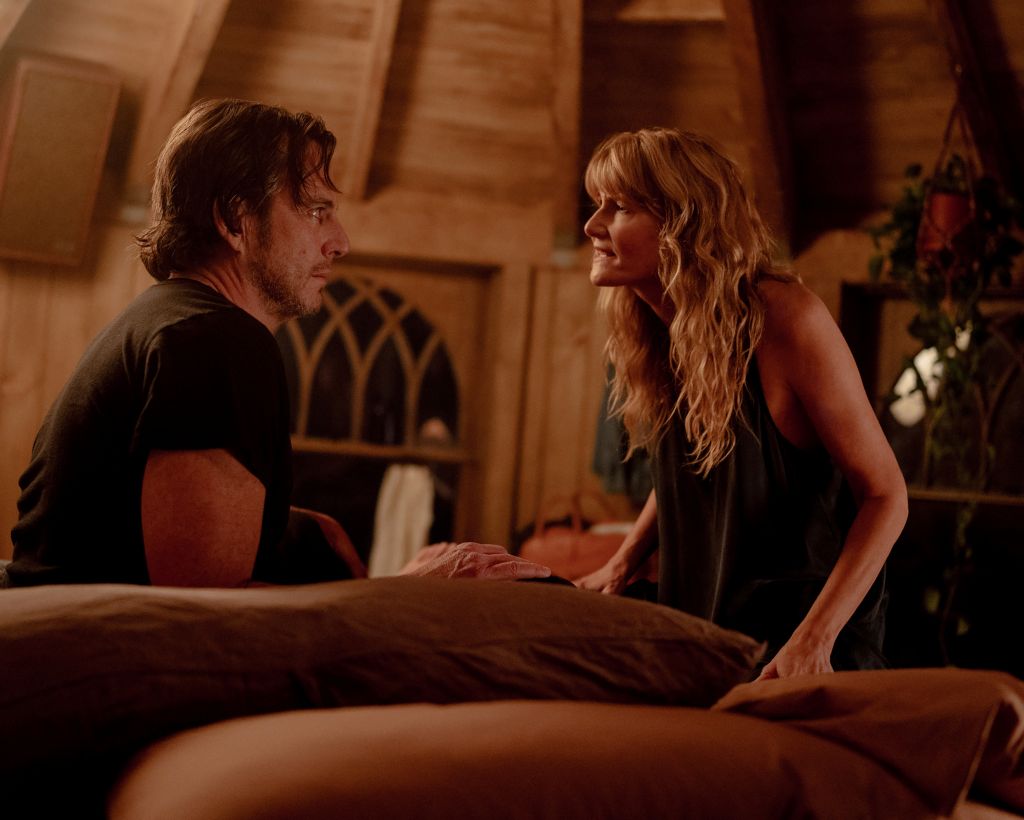
Dern adds that despite the elegance of the scripting, Arnett and Cooper were open to developing Tess and her relationship with Alex to keep the relationship grounded. “What it meant was for us as actors, and for us in our chemistry and our connection, and therefore, our work on the backstory, we had to make sure everything was alive without the language,” adds Dern. For Tess, a retired Olympic volleyball star exploring new opportunities as a coach, that backstory contrasts with Alex’s: one level, it’s assumed that she’s already lived her dream. On the other, she has to find out what comes after going for gold professionally. There’s an unspoken tension as they both seek to prove themselves on different levels as they consider sacrifices made amid opposite career trajectories while building a family.
“That with subtlety and hopefully with the humanity of the situation and the dynamic, we had to create this relationship and this story for an audience,” adds Dern. “The work was months before filming. The three of us worked together. We researched. We did workshops and read throughs and created a marriage that is never referenced in its 25 years, other than my career and my passion, or our children.”
Is this Thing On? evokes the tension in Alex and Tess’s marriage by ensuring that any meaningful conversations about it generally happen when they’re apart. For Alex, this plays out on the stage. For a film with stand-up comedy in its premise, Is this Thing On? lands few laughs in the comedy clubs—intentionally so as Alex’s penchant for bombing becomes a running joke with his fellow comics. The comics and audiences grumble about “The Sad Guy” who kills the vibe in the room, but they admire his courage.
Arnett admits that there’s a tricky balance to delivering comedy badly, while ensuring that the jokes gradually land as Alex finds his confidence and hones his voice. “You get the sense that he could be somewhat funny, but also to get the sense that in those moments that he’s really working through what he’s going through. What was interesting was as a performer, when I would go up and do these stand-up sets, part of me would want to [do them] just because I’ve lived a life that’s been comedy-adjacent, I always say,” explains Arnett. “There is that desire to make the audience laugh, but at the same time, I’ve got to remember the context of why Alex is up there and what he’s capable and what tools he has as a comedian.”
The actor adds that Cooper wouldn’t give the extras in the audience any direction on how to react to Alex’s limited toolbox. If they laughed, they laughed. If a joke was met with dead air, Arnett responded accordingly.
Arnett says that he got a sense of how to feed off the energy of the audience by performing in comedy clubs in character during pre-production. “There were a lot of moments where I’d go down and we’d have a great set and went around the corner five minutes later and just completely bombed,” he laughs. “Nothing is more humbling in that moment. You’re up there and there’s nowhere to hide and you’re bombing and the only people are is your buddies. I feel impervious to anything now because I’ve been completely humiliated.”

The film’s most effective moment plays with the dynamic between humiliation and audience response when Tess visits a comedy club on a date. She has no idea about Alex’s new passion. As Alex spills about their marriage to a crowd of strangers, Cooper makes a brilliant choice to focus not on Alex, but on Tess. He holds the shot as she watches with a mix of emotions. The scene may be Cooper’s smartest decision to date as a director and it’s easily a highlight in Dern’s career as Tess relives every emotional beat of 25 years of marriage without saying a word.
“I remember when Bradley said, ‘I’m gonna write a scene where, at the climax of the movie, you’re going to watch Will, and all we need is to just for us to see the whole marriage on your face. The challenge was enormous and yet, it had to be done and, hopefully is done, in an effortless, painful, but also funny way,” Dern recalls.
“I also loved that Bradley’s commitment to the movie had a real restraint and discipline to it, which was using comedy not to look at the culture or the world, but to look at this place that wasn’t a place that showed [Alex] is amazing at [comedy], more that it was a place that gave him language to himself, and to be able to bring to his partner about the relationship. I relate to that kind of self-understanding that comes with a specific character that you learned from.”
As Tess absorbs Alex’s perspective on their marriage and understands his point of view, filtered through comedy, she eventually finds the right words to articulate her own side of the story. That wisdom comes late in the film when Tess gives Alex some Love Story -esque advice: “A real relationship is finding someone who you can also be unhappy with.”
Dern says she finds that line an empowering moment for her character. “I’ve never played someone who, while in pain and while searching for understanding, is meticulous, is methodical. She’s an Olympic athlete. She comes at things with a precision,” Dern notes, situating Tess within her previous roles. “Even when she gets the language, to get that specific: ‘I want to be with someone I can be unhappy with is so exactly what we’ve all wanted to say to someone we’ve loved,’ you know that this is not a Disney movie. Like, it’s not gonna always go well,” she laughs, reflecting about how the film speaks to the audience in that moment. “And I need you to pick me up and then, you know, I wanna be there when you’re down. We need to, as we talk about, have each other’s back and we’re gonna need to be the strong one at a different moment than the other.”
The film finds a running joke to underscore Dern’s point as Alex decorates his new bachelor pad with a poster-sized photograph of Tess from her days on the court. It’s a killer shot of his wife in action, but viewed from behind. His kids look at the picture somewhat puzzled, while he says he finds strength by seeing Tess in her peak. They wonder why he pays tribute to his wife with a picture that could reasonably be mistaken for anyone—a point that Tess finds frustrating when she finally sees Alex’s apartment.
“I fell in love with playing someone who has that stealth and disciplined ability, even if she doesn’t have language for it. Even if we’re watching her figure out in real time,” says Dern. “I also loved playing someone that I deeply related to, who has had a passion, as she says in the film, since she was 11. We both, in a way, traded childhood for a career, or a career environment. She allowed me to be compassionate to a man’s vulnerability in a new way. Because there is something, she’s very feminine, but she also has a masculinity in her strength. So, I could let him crack and be vulnerable and not have the answers in a new way, in partnership with a male character in a film, which was beautiful.”
Arnett agrees that there’s something beautiful in that frank, and frankly unexpected, perspective from Tess. He thinks there’s as much to learn from Tess’s advice as there is from Alex’s punchlines. He says it’s about recognizing the pressure people put on themselves to be perfect, when their imperfections are often what made the relationship work in the first place.
“I think that [line] was the first crack that allowed Alex to understand what that means. That it’s not always going to be sunny days. If you’re banking on that, that it’s only good when things are sunny, what happens when it rains?” says Arnett. “He finally gets it and he’s like, ‘I was unhappy in our marriage, not with our marriage. I want to be unhappy with you.’ Meaning I want to be whatever it is, and up and down I want it to be with you. And we choose that person.”