

Pop-culture icon and onetime Nobel Prize-winning physicist Albert Einstein coined the phrase “spooky action” in 1947 to describe the instantaneous influence linked particles have on each other across seemingly vast distances (aka, “quantum entanglement”). It also doubles as the newest song written, produced, and eventually performed in concert by “Mother Mary,” a Lady Gaga- and Taylor Swift-inspired mega-star obsessively worshipped by millions of fans around the world, in writer-director David Lowery ’s ( The Green Knight , A Ghost Story ) first feature-length film in five years, Mother Mary .
Often enthralling, sometimes frustrating, but never far from ambitious, Mother Mary centres on the fraught, broken relationship between the title character (the Oscar-winning Anne Hathaway ) and Sam Anselm (the BAFTA- and Emmy-winning Michaela Coel), a preeminent fashion designer who had been Mary’s exclusive designer before Mary unceremoniously ended their partnership a decade earlier. Out of a desire for a bigger name brand to reinvigorate her stale public persona, Mary abruptly ended their relationship, leaving Sam completely devastated. In response, Sam proved herself to be a designer with few, if any, equals in the industry.
Fast forward to the present day, and Sam, despite her obvious artistic and commercial success, continues to resent Mary deeply. She allows their decade-old breakup from a personal-professional relationship that blurred every possible boundary to fester into a toxicity that borders on hatred. But for Mary, at the proverbial crossroads of a mega-pop career once again devolving into stale complacency, Sam holds the key to creative redefinition: A once-in-a-lifetime dress, a grand summation of Mary’s achievements past, present, and future, that can also serve as a mirror to Mary’s true, inner self.
Mother Mary unfolds as a series of play-like dialogues between Mary and Sam inside the latter’s dramatically lit inner country sanctum—a renovated barn where, inspired by divine intervention or its secular equivalent, Sam designs, fits, and cuts singular dresses for her singular clientele. Before, during, and immediately preceding Mary’s initial fitting, the two women must work their way towards reconciliation. As Sam has what Mary wants and needs, a new dress, she has the immediate upper hand. She uses said hand to compel Mary to unburden herself of her fears and anxieties, to reveal her mental and emotional state of mind, and, in a supernatural twist, expose Mary’s soul to its essence.
Part secular confessional, part impromptu therapy session, Mother Mary turns on an ambiguous incident that could be interpreted as either an unfortunate accident or an act of deliberate self-harm. If the latter, it suggests a personal crisis—if not of conscience, then of creativity. An act of willful self-harm also suggests psychological deterioration, specifically clinical depression, inextricably connected to the rupture between Mary’s public and private personas and the resultant damage to Mary’s psyche.
Overflowing with conspicuous, portentous religious symbology of the Christian kind, Mother Mary and its late-film turn toward the supernatural— as always, ghosts can be literal, figurative, and/or metaphysical — might turn off some viewers, violating the unspoken contract between filmmaker and audience to remain true to an otherwise grounded, realistic premise. But setting aside that not entirely unmerited objection, Mother Mary’s third-act genre switch allows Lowery to play in a metaphorical register craftily. Mary and Sam’s reconciliation, if it comes at all, transcends the confessional and therapeutic, reaching into the collective unconscious, the unconscious where ideas, images, and concepts preexist language and logic, specifically Jungian archetypes, not only connect but unify us.
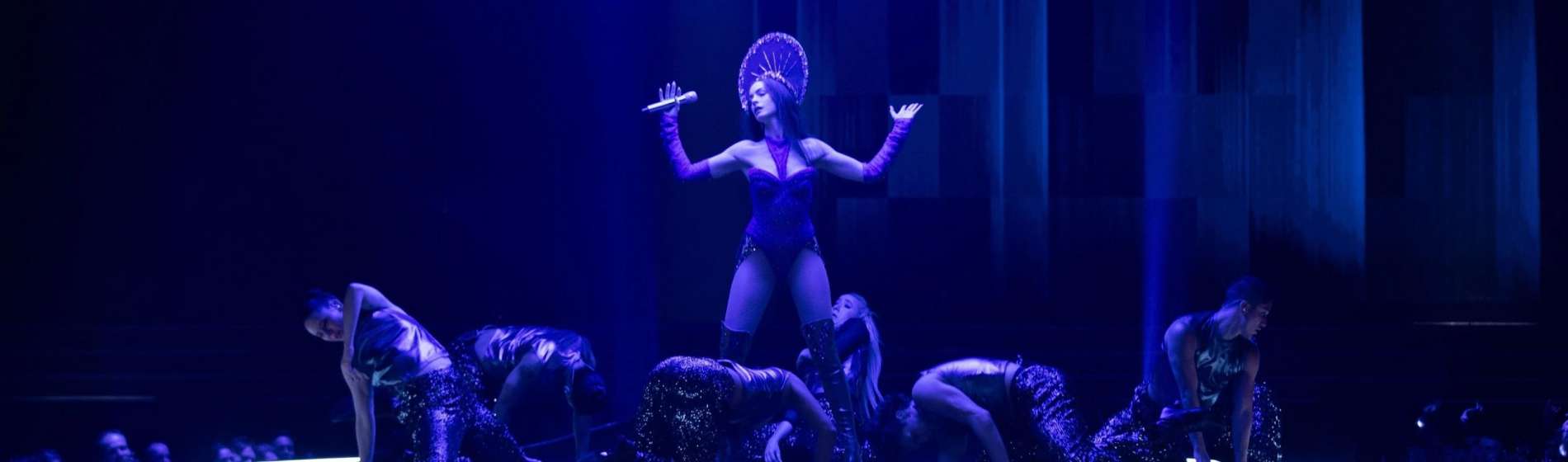
As the power dynamics shift, sometimes imperceptibly, sometimes abruptly, between Mary and Sam over a day, night, and morning, a skillful Lowery interweaves flashbacks, dreams, hallucinations, and snippets of in-film concert footage to excavate Mary and Sam’s shared histories. With seven new EDM/pop-oriented songs composed by Jack Antonoff, Charlie XCX, and FKA Twigs (who also co-stars as a ghost-channeling clairvoyant) specifically for Mother Mary , in-film concert footage emphasizing light, music, and movement, Mother Mary ’s performances convincingly convey the title character’s talents and, almost as importantly, the frenzied, Dionysian fervour of the cult-like fans who attend her concerts with religious devotion.
In addition to a soundtrack filled with earworm-worthy songs, frequent collaborator Daniel Hart’s sonorous score deserves special mention, as do Andrew Droz Palermo and Rina Yang’s cinematography (Yang handled the electrifying concert scenes), Bina Daigeler’s impressively realized costume design, and lauded fashion designer Iris van Herpen’s final dress created for Mother Mary by Sam. Collaborating in near-perfect harmony under Lowery’s sure hand, the entire team brings his bold, extraordinary vision of creativity in crisis to complex, often contradictory, cinematic life.