

Non-spoiler alert: Not a single human character suffers harm, let alone dies, in Predator: Badlands. The film is the latest instalment in the decades-spanning franchise that began in 1987 with Arnold Schwarzenegger as the final dude and peak John McTiernan (the Die Hard series) in the director’s chair. Schwarzenegger and his successors faced off against the technologically advanced “predator” of the title—an extraterrestrial short on conventional good looks, but long on hunting, spine-ripping, and trophy-getting.
In fact, humans don’t appear physically at all in Predator: Badlands , except perhaps offscreen, pulling the strings on their corporate-made, owned, and operated humanoid puppets—the “synths” popularized by Ian Holm in the Ridley Scott-directed Alien, Lance Henriksen in the immediate sequels, and Michael Fassbender in the divisive, Scott-helmed prequels. Created by and for the planet-spanning Weyland-Yutani corporation in the far-flung, ultra-capitalist future, synths have often proven themselves more hazard than benefit, especially for their unfortunate flesh-and-bone counterparts.
Perceived as less-than-human and thus even more expendable, synths exist in a state of perpetual servitude, sent on missions deemed too dangerous for their human counterparts by the Powers-That-Be at corporate HQ—like on the planet Genna, where a synths-only mission finds itself on the losing end of a confrontation with Genna’s alpha predator, the Kalisk, a kaiju-sized, practically unkillable beastie with a singularly unpleasant disposition and a taste for wanton destruction. (Note: The synths-only premise allows the film to provide the requisite disassembly and dismemberment, albeit without humans present, and still receive a PG-13 from the MPAA.)
While that synth-led mission on Genna fails spectacularly, Dek (Dimitrius Schuster-Koloamatangi), a lone Yautja, a predator by another name, arrives, eager to prove himself worthy of the clan led by his brutally unforgiving father. Diminutive by Yautja standards and thus seen as a liability, Dek fled his homeworld seconds before his untimely demise, driven by a mixture of hatred, resentment, and a desire to prove himself by finding and killing the Kalisk, a creature even his homeworld’s greatest hunters fear.
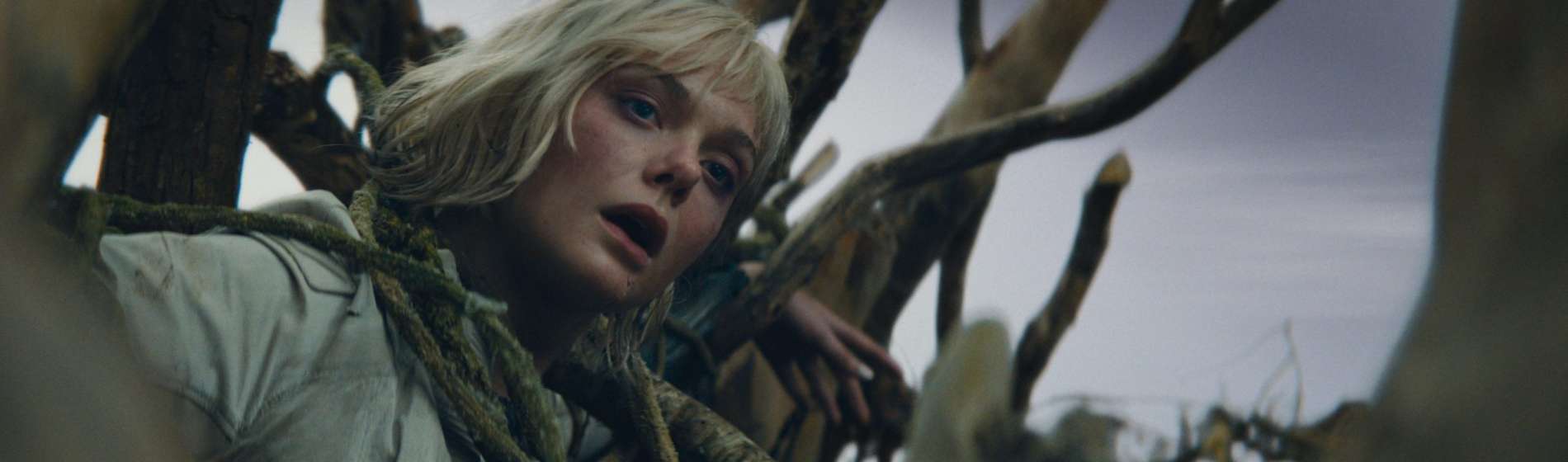
Predator: Badlands centres on the unlikely bonding between Dek and an abandoned, legless synth, Thia ( Elle Fanning , a standout as expected). Dek’s single-minded focus on the Kalisk almost results in his premature death courtesy of Genna’s ultra-aggressive flora and fauna, eventually forcing him to accept Thia’s offer to help him find and defeat the Kalisk in exchange for finding her lost limbs and helping her become whole again.
In between Dek’s predictably surly loner behaviour and Thia’s repeated attempts to insinuate herself into Dek’s good graces, if mostly to retain his favour, another native creature Thia cheerfully dubs Bud (Rohinal Nayaran) becomes part of their unofficial found family. Then Thia’s synth twin, Tessa, programmed as a calculating, mission-driven leader, not a curiosity-driven specialist like her “sister,” joins the hunt, initially for Thia and later for the Kalisk itself, and whatever financial benefits its biological makeup might yield for their off-screen corporate overseers.
Flipping the script and turning a predator from an unstoppable foe to a nominal hero comes at a modest risk, potentially alienating long-time fans of the franchise (typically along the lines of “humanizing” the Yautja or removing the supposed mystery surrounding their origins and culture). As past entries generally followed the template set by the 1987 original, a major shift in focus wasn’t considered a net positive. Up until now tt felt necessary to retain the franchise’s resurrection courtesy of filmmaker Dan Trachtenberg ( 10 Cloverfield Lane ) and his previous contributions to the franchise, 2022’s Prey, and the straight-to-streaming Predator: Killer of Killers animated anthology released this past summer.
Paced with precision and delivering epic-scaled, science-fiction-flavoured set pieces, Predator: Badlands only stumbles when Trachtenberg’s ambitions outstrip budget limitations and the script by Patrick Aison that too often relies on overused genre tropes rather than originating tropes of its own. To be fair, the script handles Dek’s character growth, not to mention his relationship with Thia, with a relatively light, if predictable, touch, drawing humour out of their mismatched worldviews, Dek’s stoic monosyllabic delivery, and Thia’s overexcited verbosity and penchant for non-sequiturs.
The heavy-handed fan service that all but sunk last year’s otherwise engaging Alien: Romulus makes an appearance here too, but in a much more diluted, far less indulgent form. Rather than repeating lines from previous entries drawn from either the Alien or Predator series, Predator: Badlands relies primarily on visual cues or references for callbacks. When a certain character makes a dramatic re-entrance in an oversized exoskeleton, Trachtenberg thankfully resists reusing old dialogue, allowing the scene and its outcome to play out on their own.
Predator: Badlands opens theatrically on Friday, November 7, via 20th Century Studios.