

Do-it-yourself Cornish filmmaker Mark Jenkin’s ( Enys Men , Bait ) latest film, Rose of Nevad a, ends on an eerie, enigmatic line of dialogue: “There is no time.” Read without context, it suggests endings, departures, and separations, to places, people, and, of course, things. Read contextually, it suggests a temporal shift or break — possibly temporary, likely permanent. That Jenkins splits the speaker and the listener via editing isn’t accidental. It’s deliberate, and it creates an uncrossable, irreparable fissure across space and time. That last, wrenching moment also signals an acceptance of self-sacrifice for the communal good, a central idea Jenkin has acknowledged in interviews.
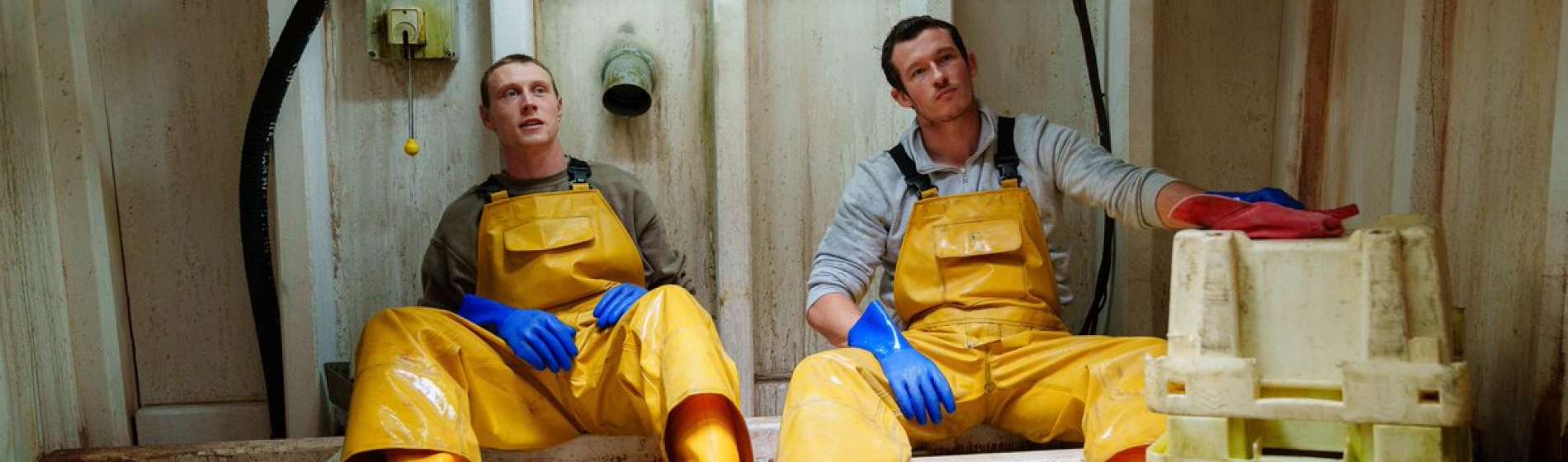
Well before Rose of Nevada ends, though, Jenkin introduces Nick (George MacKay), a down but not out coastal dweller struggling to provide his family with necessities. Between his reliance on a local food bank and a leaky roof he can’t afford to repair, a desperate Nick agrees to join the crew of the newly returned “Rose of Nevada,” a decades-lost, now found trawler setting out to sea with a crusty, old-school captain, Murgey (Francis Magee), and an itinerant drifter, Liam (Callum Turner), who is equally desperate for work, despite the potential dangers of fishing in the North Atlantic.
The inexplicable reappearance of the trawler also signals a kind of rebirth, a second chance for the economically-distressed coastal community in Cornwall, England, which speaks to where filmmaker Jenkin was born, raised, and continues to make his home. Stripped of a recognizable economy, the unnamed, depopulated village in the film struggles along, both a shadow of its former self and a ghostly reminder of long-gone, better times. For the trawler’s owner, Mike (Edward Rowe), the re-found ship represents the chance to kick-start a dormant fishing industry and, more importantly for him, a no less welcome stream of income for his battered finances,
Jenkin captures Nick and Liam’s initial experiences on the trawler through a torrent of fragmented images, and natural (the sea, birds, etc.) and unnatural (the ship’s engines) sounds, resulting in an immersive effect reminiscent of 2012’s standout documentary, Leviathan . Filmed with GoPro cameras across multiple 24-hour shifts aboard a commercial fishing vessel, Leviathan captured an immediacy atypical for the genre, an immediacy that Jenkin deftly translates into narrative form here.
Leaving the “how” out of the equation, Rose sidesteps the rationale for what happens next: Returning home after a successful haul, Nick, Liam, and Murgey find themselves catapulted into the early 1990s. No longer depopulated by economic ruin, the village bustles with activity. The pub is filled with paying customers, and a well-stocked grocery store provides the locals with necessities and non-essentials alike. Both are signs of prosperity, presumably tied to the abundant supply of fish just off the coast. Freshly painted homes, fully tiled or repaired roofs, and a general cleanliness suggest nostalgia, founded not in half-fantasy or willful ignorance, but in a tangible, undeniable reality.
The literally homeless Liam embraces the past and, with it, the role of a returning husband, Alan, to Tina (Rosalind Eleazar) and her preteen daughter, but Nick finds himself at a complete, literal loss. His wife and daughter exist in an inaccessible future, and his clean, well-lit home is now occupied by a Mr. and Mrs. Richards (Adrian Rawlins and Mary Woodvine). The Richards “confuse” Nick with their son, Luke, dead by suicide in an uncertain past or future, insisting Nick put aside his perplexing confusion about his identity and, like Liam, embrace his new identity as their son.
The central conflict in Rose of Nevada unfolds through Liam and Nick’s respective relationships to the past, present, and future. Where Liam once had nothing, he now has a wife and daughter. Where Nick had a wife and daughter, he now has nothing. It’s a cruel, arbitrary rebalancing by an external, possibly supernatural force that Nick repeatedly rejects. Nick’s fracturing psyche inevitably leads to a personal crisis, if not of conscience or even identity, then of self-sacrifice and community, and whether Nick ultimately can trade his future for a past that simultaneously elevates the working-class coastal community but leaves him irrevocably diminished.
Rose of Nevada is in limited release across the U.S. now and opens in select theatres in Canada starting July 10, via Vortex Media.