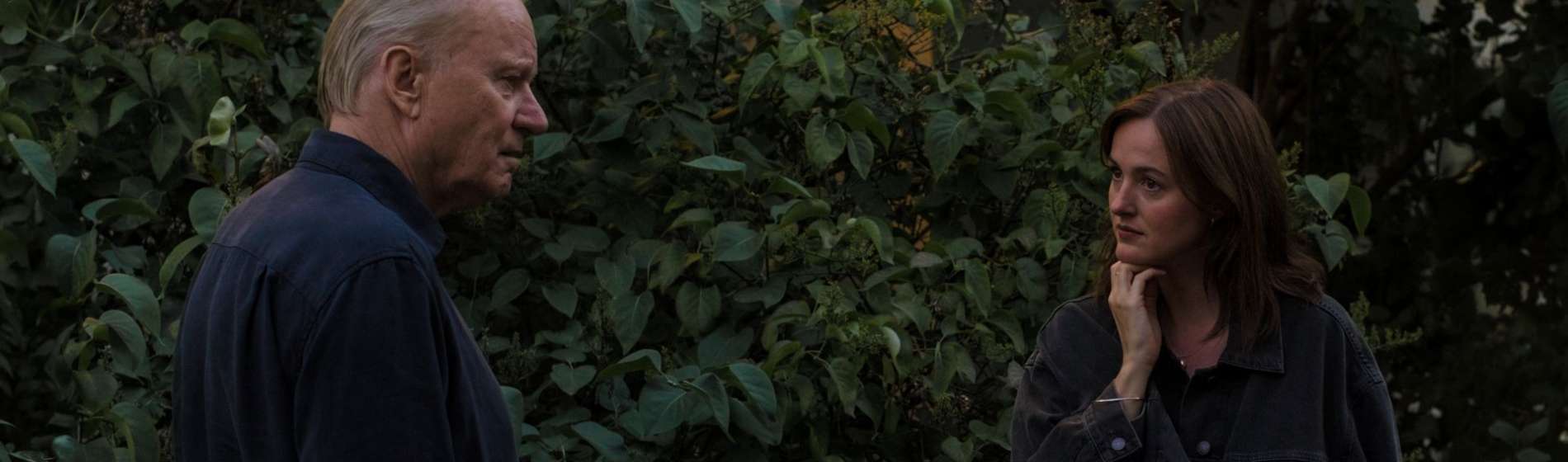


“You two are the best thing that happened to me,” Gustave Borg (Stellan SkarsgÃ¥rd) tells his daughter Nora (Renate Reinsve) in Sentimental Value.
“Then why weren’t you there?” Nora asks.
This pointed exchange offers a pivotal turn in Sentimental Value as father and daughter confront their respective motivations for their next act. Borg, a Bergman-esque filmmaker, evidently chooses his words with double meaning. Nora and her sister Agnes (Inga Ibsdotter Lilleaas) certainly have value in Borg’s life, but not the sentimental kind. The director, who resembles Bergman as much in terms of being an asshole as an artist, prizes his daughters for the artistic inspiration they endow upon him. Family life opens itself up to dramatic license in ways that solitary existence perhaps does not.
But authentic storytelling is all about writing what you know, and Borg’s blindspot is his absenteeism as a father. Perhaps that explains the fifteen year gap in his filmography.
He’s readying a comeback, though, and he wants Nora to play the lead. It’s a tricky ask, since his ingénue and his protagonist are one and the same. The conceit for Borg’s magnum opus, however, is that Nora plays a version of her grandmother, who died by suicide when Gustave was just a boy. The character has shades of Nora’s adolescence though, as her father filters painful memories in a story that bridges generations of familial wounds.
Adding to the complexity of the request is that Borg wants to shoot the film in the family home. Generations of Borgs have lived in the cavernous house, which sinks further into the ground over time thanks to a fault in its design. But if those walls could talk, they might echo the dialogue of Borg’s invasively personal screenplay. And the home’s cool interior, with its winding hallways and dramatic corners, lends the authorial coup for the film’s climax: Borg wants to film his mother’s death in a Steadicam oner, imagining with an all-seeing eye the drama he missed as a boy when he bid her goodbye and left for school that fateful day.
Writer/director Joachim Trier and writer Eskil Vogt reunite following their hit The Worst Person in the World , which starred Reinsve in a breakthrough performance, and together the three find another transformative tale of growing pains. While the film doesn’t quite have the same sense of discovery of their previous collaboration, Sentimental Value exudes the confidence of assured hands here to stay. The film begins as Nora, a stage actress, readies for a stuffy production that refashions a classic anew, but her corseted costume stifles her. In a Birdman -esque backstage frenzy of nerves, stage fright, and artistic genius shaken mightily by some bravura acting, Reinsve frets and sweats and hyperventilates. She just can’t bear to bare herself. She begs her co-star (Anders Danielsen Lie) to quickly fuck the opening night jitters out of her, but he slaps her instead.
Some jolts of physical comedy, a torn costume, and some duct tape later, and Nora commands the stage. The show gets off to a shaky, yet thrilling start. But overcoming stage fright hardly prepares Nora for the theatre of life.
She declines her father’s script, so he instead casts a Hollywood ingénue, Rachel Kemp (Elle Fanning), to play the part. But he gets Rachel to dye her hair like Nora and clearly fashions his direction to create a mirror image.
Rachel has talent, but she struggles with the Mother Borg/Nora character. For one, Borg now wants to shoot the film in English. Rachel hopes to lend it authenticity through a Swedish accent. But she’s no Meryl Streep. When Rachel takes her screen counterpart as a purely fictional creation, she conjures something deeply beautiful and moving. A read through of a scene with a tricky monologue, for example, delivers the best audition/rehearsal scene since Betty’s screen test in Mulholland Dr. Try it again with an accent, however, and she’s a Razzie shoo-in.
Sentimental Value seems bound for Oscars, though, as everyone works on the highest level. This film, which flies by at 135 minutes, deftly reveals itself with raw emotion as the theatricality of the performances-within-the-performances invite the actors to reveal layers while the actors they play discover the characters’ inner lives, pains, and motivations. Reinsve, so brilliant in Worst Person in the World , again proves a truly magnetic screen presence. She’s a natural, disarmingly funny and perceptively heartbreaking from one moment to the next. Fanning meanwhile, delivers a bravura moment in the aforementioned monologue, revealing maturity of a performer who continually surprises.
This is SkarsgÃ¥rd’s show, though. After playing brooding baddies in films like The Girl with the Dragon Tattoo and Dune , he brings heart and humour to this performance. It’s a veteran’s showpiece that resonates with years of experience gleaned not only from film sets, but from the generational spark of having sons like Alexander and Bill in the business. There’s a tangibly playful element of art imitating life as the seasoned actor and Reinsve spar over years spent on film sets instead of at home.
As Rachel and Borg wrestle with the material, and Nora confronts her anxieties about the production, Sentimental Value deftly unfolds a cinematic essay about who has creative license over stories drawn from life. Who has the right to tell a story perhaps varies by the degree of separation one has to it. But the heart of the film is the sense with which SkarsgÃ¥rd imbues a sense that the best art comes from having lived it, which allows one to make inflections and interpretations that ring true. But emotional authenticity tells its own story and only Nora can master the syntax of Rachel’s tricky monologue. She puts the correct emphasis on the proper syllable to hit each note just right. After all, they’re her words—not Rachel’s, not Borg’s—and the collective disappointment with Rachel’s delivery of the accented lines invites a self-reflexive appraisal among the actors about the baggage that each role brings.
Each member of the family wrestles with the complexity of sharing this story. Agnes struggles to accept her father’s request to cast his grandson as his younger self. Agnes, the child star of an early war drama that helped Borg achieve auteur status, resists thrusting her child into the spotlight the way her father did to her. Nora, meanwhile, realizes the opportunity to understand generational loss. The dexterity of Borg’s screenplay—or, really, Trier and Vogt’s writing—intimately connects her unhappiness during adolescence to her father’s grief over growing up without a mother. Borg’s film poignantly serves as a personal reckoning with, and apology for, failing to be a parent when he had no guidance. Through the act of creating something new and using their shared artistic license as mutual catharsis, the artists create a thrilling new chapter in their home’s storied history. Film rarely proves as therapeutic as it does here.