“In the original piece, you have Hedda saying, ‘For once, I want to be in control of a man’s destiny,’” says Hedda star Tessa Thompson. “I think in our piece, you see a woman struggling with trying to be in control of her own.”
Thompson, speaking with press virtually ahead of Hedda ’s premiere on Prime Video, says it was a thrill to inhabit the juicy title role in Nia DaCosta’s radical adaptation of Henrik Ibsen’s play. The film gives Hedda Gabler a gender-flipped twist by making Gabler’s former lover, Eilert Lövborg, a woman. As Hedda throws a lavish soirée, her former flame, Eileen (played by Nina Hoss in the performance of the year), crashes the party with career ambitions and a new flame, Thea (Imogen Poots), in tow. The dynamics become further complicated with Hedda being Black in the film adaptation, so her constant debates with Eileen about the life they could have shared are underscored by realities that differ for each woman.
“Something that really struck me the first time I sat to read it is, obviously, this huge fundamental change that [Nia] made by making a character who’s typically a man, Eilert Lövborg into Eileen, and there’s a whole lot of knockoff effects,” says Thompson. “It makes the piece queer in a way that the original piece isn’t, but more than that, fundamentally it gives Hedda a real foil, another woman who’s in the world and making very different choices. This is a piece that wants to explore our place more; Ibsen wants to explore pathways to personhood and gaining agency over one’s life.”
For Hoss, who previously played Hedda Gabler in a stage production, the chance to dive into Eileen proves a thrilling opportunity. “When I did Hedda on stage, I would always think about the male characters: they’re not really an option. Hedda has the power over them. She’s more clever than both of them and because of the society women lived in at the time, and now also in the 1950s [when the film is set], that’s still something that’s been carried on,” says Hoss, who received TIFF Tribute’s Actor Award this September during the Toronto International Film Festival.
DaCosta’s adaptation makes realizes the possibility of making Eilert/Eileen an option for Hedda, while adding tug-of-war power dynamics between the Hedda and the out-lesbian Eileen. Add to that complication the fact that Eileen is the top rival for Hedda’s husband for a university teaching position.
“The other is aspect that [Eileen] is a phenomenal woman that Hedda is truly in love with, if she’s able to have this emotion,” adds Hoss. “In Eileen’s eyes, I think she isn’t yet because she doesn’t want to be vulnerable. She doesn’t allow herself to feel that because then she could get hurt and that’s something Eileen never got through to. That’s the deep sadness within Eileen: that she couldn’t make her feel the love. But two when they meet, you feel, ‘Oh, God’s not yet done with those two.’”

The actors add that the film opens the potential to bring these characters to life. Hedda capitalizes on the cinematic potential to explore the love and bitterness the women share. Cutaway close-ups and reaction shots in mirrors convey all the things they can’t say.
“There’s so much between them that they can’t verbalize. And if they could, maybe they’d have a better shot,” says Thompson. “Another thing I was helped by is the filmmaking. We really wanted to make sure that this is an adaptation of a play, but that it felt very cinematic. For example, that scene where the incredible Nina Hoss enters as Eileen, you get this sense that time mutates or stands still, and Hedda almost floats to Eileen.” The music and bombast of the roaring party pauses as DaCosta dials down the tempo and Hedda finds herself transfixed by the woman entering the scene. She gravitates towards Eileen on a dolly shot, as if drawn to her by a magnetic pull.
“We had a lot of conversations around the history of these women because we wanted to make sure that when you first see them look at each other that you have this rich sense of history. Even if you don’t understand what it is, you should understand that they have this magnetic connection that’s going to change the course of the evening and change the course of their lives separately and collectively,” adds Thompson. The actor/producer cites this shot as one of the moments in Hedda where she and DaCosta workshopped the script to avoid expository dialogue and instead allowed the craft to tell the story.

“They designed that beautiful double dolly shot, which was actually really awkward to shoot, but it ends up looking like total movie magic,” explains Thompson, miming the position in which she sat for the shot. “I was seat-belted. I couldn’t stand up all the way; I was crunched down. We had to make sure that my dress wasn’t coming into the frame because of my body position. But it ends up really being one of those movie magic moments where you understand Hedda’s internal feeling and how much love she has for this woman.”
Hoss agrees and recalls developing the backstory for Eileen and Hedda with Thompson by listening to old radio broadcasts and music playlists via an app that transported them to the era. “We thought the background story must have been chaotic, wonderful—just exploring for the first time being in love, being out of society, doing something slightly dangerous, hidden, and then not so hidden because they would end with the bohemian world where it was okay to be queer and to celebrate yourself and to explore it,” says Hoss.
The film brings the former flames to head as Eileen introduces her career-defining work in a manuscript about women’s sexuality, co-authored with Thea. That information scorns Hedda twofold as Eileen gets to pursue her passions both personally and professionally. Hedda, meanwhile, plays wife to the man whom Eileen is about to upstage.
“That was something Tessa and I were working on every day on set, knowing we needed to keep the tension up: that we surprise each other, that we challenge each other as actors and as characters so that we feel, as the audience does, that there is always tension between those two,” says Hoss.
DaCosta adds that Hedda’s Blackness helps retain the architecture of Ibsen’s character as the anti-heroine strives to live up to the expectations set by her father, a general, but can never quite validate the power she craves. It’s an intriguing dynamic that makes use of the 1950s’ time shift to subtly show the differing strides for equality in social circles.
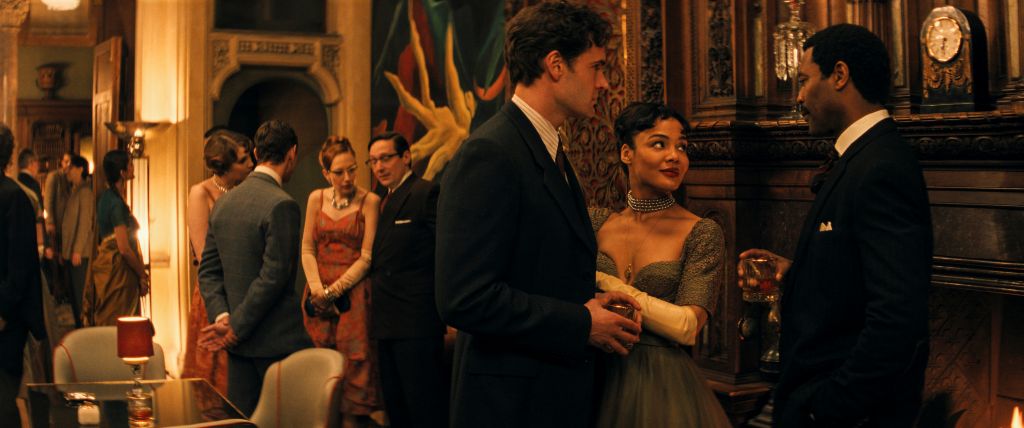
“I really wanted her to feel isolated in the world and not just in terms of her gender, but also her race,” says DaCosta ( Candyman ). “There are so many different ways where that happens. For example, the one time she even mentions her race in the movie to Eileen, she says, ‘How many of these women you want me to be like are Black?’ And Eileen says, ‘Whatever.’ She doesn’t even engage because, to be fair, a lot of people in that time would be like, ‘You’re fine. You don’t need anymore, whatever.’”
Thompson says that she explored Hedda’s sense of social isolation by looking to her grandmothers for inspiration. She notes that one grandmother would never be caught without her signature red lipstick, even at home alone, while the other was a working woman who went out to provide for the family and then came home to her second job as a wife and mother, being a 24/7 provided without quite getting her due.
“I got to excavate that rage and express it on behalf of my grandmothers who never would’ve had the opportunity, because at the time there was no cultural conversation around the ways in which women were mistreated,” says Thompson. “Now that’s in the popular conversation. We understand that. But for my grandmothers, that didn’t exist. You get to see this woman over the course of the night, who has to put on airs and has to perform, but is definitely acting from a lot of personal rage.”
Hoss similarly looks to loss and female rage to reflect the way Eileen carries herself throughout the film. This dynamic comes through the relationship that Eileen holds in the manuscript that she clutches tightly throughout the party. It’s an extension of her being, her pride and joy, and Hoss says that she could open up Eileen by interrogating what the manuscript represents.
“I thought a lot about what is this manuscript in the 1950s? What did she write that is lost now?” asks Hoss. The actor says that while exploring the character, she encountered the documentary The Disappearance of Shere Hite , Nicole Newnham’s portrait of researcher Shere Hite, whose groundbreaking publication on sexuality empowered women and angered men.
Hoss says she leaned into the 1976 publication of The Hite Report and its author. “She’s just like Eileen: a fabulous woman, she’s voluptuous. She’s not hiding the fact that she’s a woman and she’s feminine and she embraces it and she celebrates it, but she wants to push the boundaries within society,” says Hoss. “She talks about female sexuality and I thought that’s what the manuscript is about. I also thought about putting Shere Hite in the ’50s in a way and just being ahead of her time. We needed Shere Hite because Eileen didn’t get to publish her manuscript. That was my entry to Eileen.”
Hedda also gives Hoss the actor’s showpiece of the film in an extended monologue in which Eileen holds court in the library with the male academics and presents her research with hopes to win their esteem. She regales them with the backstory for her research into sexual proclivities by sharing a tale about a bartender who asked to smell her feet. It’s a bravura centrepiece of the film as Eileen commands the room, serving drinks and lighting her colleagues’ cigarettes with theatrical flair, using the palpable anticipation and sexual thrill of the story to accentuate the payoff.
“I had the most ‘Nia DaCosta text,’ I would say, because the scene in the library doesn’t exist [in Ibsen’s play],” says Hoss.
“I had a completely different experience with the same material. Never in my life would I have thought I would revisit this play again because there’s only these two women [Hedda and Thea] in the play and then I’m playing a male character. So, to me, it was revelatory,” Hoss continues. “The scene in the library, this whole downfall of Eileen. The stakes are higher. The chaos is bigger.”
Thompson agrees that the stakes are higher thanks to Hedda ’s feminist perspective and the contemporary lens on a classic. “We fundamentally live in a time that I’m really grateful for, where there’s so much conversation around women supporting women, and this is a woman who isn’t necessarily interested in that,” she notes when asked about Hedda’s Machiavellian nature. “This this is a young woman who’s vivacious, who is spontaneous, who acts on her instincts and her impulses who isn’t afraid to take up space. Being a woman who isn’t afraid to take up space and isn’t afraid to be categorized as difficult just because she’s showing us exactly who she is—to a modern sensibility, that’s something that really can resonate.”