



For part one, an introduction to The Classics Shelf’s Anthony Perkins retrospective, click here.
THE FIFTIES: TEEN IDOL
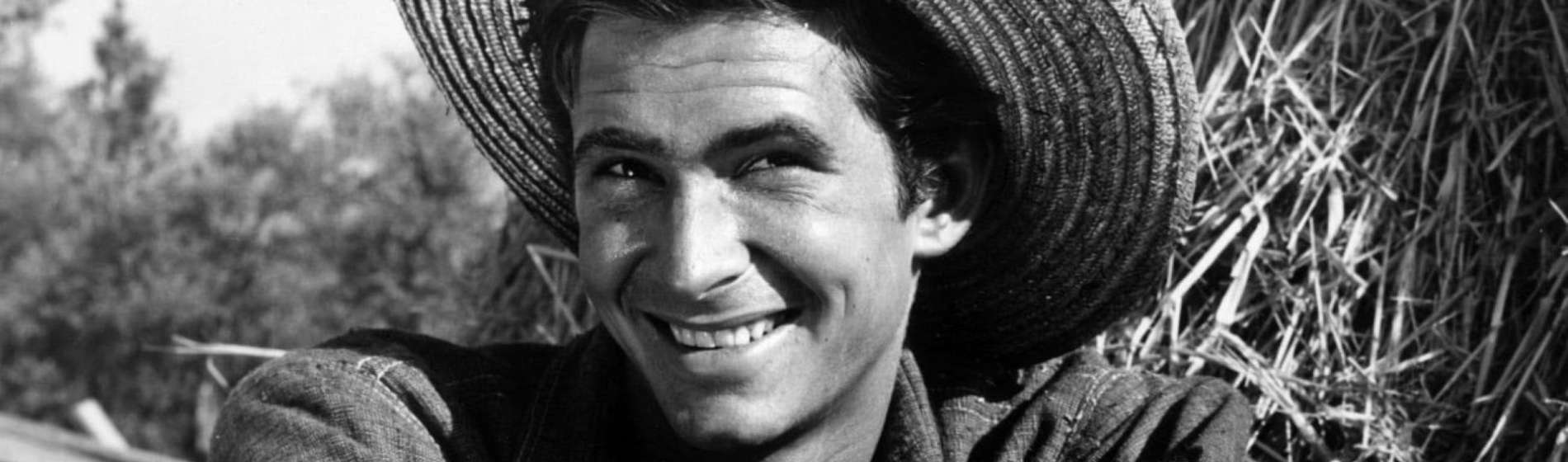
The success of Friendly Persuasion resulted in Perkins signing a semi-exclusive contract with Paramount Studios. The deal allowed him to go back to Broadway regularly while being promoted as one of the era’s teen idols alongside Tab Hunter (with whom he would have a serious romantic relationship) and Troy Donohue. Darker than these men, both physically and emotionally, Perkins emitted a shy, almost tortured soul that audiences fell in love with. The studio happily capitalized on this brand while feeling anxious about whether or not his sexuality read too clearly on film. On the set, he was popular with fellow actors, Gary Cooper loved him as a mentor and Sophia Loren found him delightful to work with. However, he dealt with a lot of personal security about his perceived masculinity and his looks that he would never lose. Always incredibly slim, he often wore shoulder pads with hopes of giving himself a hunkier physique that actually made the rest of his body look that much smaller.
Paramount’s control over his career felt too much like control over his life, and Perkins was soon ready to break free. Studio chief Barney Balaban insisted on him breaking up with Hunter, feeling they weren’t being secretive enough about their relationship, and encouraged him to go into conversion therapy, which is something Perkins would later attempt. Being a matinee idol was not something he longed for, however, and by the end of the decade, he bought himself out of his contract early and spent the sixties making movies in Europe. One of his last roles before doing so, however, would come to define his entire career.
The Actress
George Cukor, 1953
Perkins’ film debut is not one for the books, and no one can be blamed for thinking his career started at Friendly Persuasion. Cukor seems so uninterested in him that he never even gives him a proper close-up in his few scenes, usually the marker of someone being introduced to stardom in an early role, so perhaps it was to his benefit that the film never found an audience anyway. Spencer Tracy deservedly won a Golden Globe for his performance as an ex-sailor turned factory worker who is adamant about his daughter (Jean Simmons) going to school to become a physical education teacher, but she has other plans. The theatre has won her heart and she dreams of becoming an actress, but in a home where every penny is counted and even purchasing magazines is a frivolous expense, she must hide her ambitions from the blustery old man and confide solely in her loving, careworn mother (Teresa Wright, playing the role at the ripe old age of 35). Perkins is the boy next door who wants her to stay in Boston and become his wife, one of the many challenges she faces before finally coming up with a way to head to New York and pursue her dream which, those of us watching now are aware did come true. The screenplay is written by Ruth Gordon, based on her semi-autobiographical play Years Ago, an actress and writer who did make her way in theatre and film, married writer Garson Kanin and later won an Oscar for Rosemary’s Baby in her early 70s. Cukor had previously worked with her and Kanin on the scripts for Adam’s Rib and Pat & Mike but he has less success here. The theatrical origins of the piece haven’t been opened up for the big screen and the whole thing feels a bit too quaint and contained. The performances are magnificent, however, Simmons never exasperating our patience as the breathlessly desperate ingenue, and the whole thing is worth watching for Tracy’s astounding performance of an unforgettable monologue at the end.
Friendly Persuasion
William Wyler, 1956
While not technically Perkins’ first film, Wyler’s excellent drama made him a star and earned him what would eventually be his only Oscar nomination. The story about a Quaker family seems on the surface just an enjoyable period epic, but careful examination reveals something much more meaningful going on. Gary Cooper leads the cast as father to a household who, along with his wife (Dorothy McGuire in her finest performance), is trying to keep the desires of modern living out of home life. Civil war is imminent and many of the townspeople have decided that their religion’s pacifism is to be put aside temporarily to protect their town. Cooper and clan object, insisting that their beliefs are meant for just these circumstances, but eventually even his own son (Perkins) is bitten by the desire to go off in search of adventure. The allegory for McCarthyism and a country that is built on the principle of freedom but abandons it in the name of protecting freedom is not subtle, but the timeless nature of the story hits deep even if you have little knowledge of Hollywood in the fifties. A fantastic sequence involving soldiers invading the homestead and McGuire’s subsequent generosity to them is one of the most powerful examples of admirable morality ever put on film.
Golden Globe Award: Most Promising Newcomer-Male; Academy Award Nomination: Best Supporting Actor
Fear Strikes Out
Robert Mulligan, 1957
Perkins’ first lead role is an attempt to give him an East of Eden, a potent film about a young man pushed to madness by an overbearing father who is looking to make up for his own failed dreams. Based on the true story of baseball legend Jim Piersall, it focuses on the early years of his career being pushed to excellence by his disappointed father (Karl Malden), which leads to the breakdown of his mental health. Piersall would eventually play seventeen successful seasons in Major League Baseball, but in the beginning, it looked like an iffy proposition considering his volatile personality. He was constantly seeking perfection in himself and his teammates before realizing that it was the pressure of never being able to please the old man that was going to sink him. Norma Moore does her best to make an impression in the “Honey, Come to Bed” role of Piersall’s wife, but the exciting tension is between the two male leads. Malden especially finds a great deal more dimension to the monstrous patriarch than is necessarily on the page. Directed and produced by the team of Robert Mulligan and Alan J. Pakula, who would later score a major triumph with To Kill a Mockingbird, it’s a film that never fully escapes the trappings of biopic clichés but which also boasts a series of accomplishments that make it well worth watching. Its view of psychology, while dated, is much more sympathetic than you’d give the era credit for, the film understands bipolar disorder despite not having the terminology for it. The scene of Piersall’s meltdown after hitting a home run is a wonder of performance and direction, and Perkins fulfills all aspects of the role with incredibly skill. On the set, his insecurities allegedly made for tension between himself and the crew, and the fact that he couldn’t play baseball before getting any on-set training didn’t help earn their admiration, but on screen, he finds enormous depths of sensitivity to display, winning the hearts of young audiences as a brooding, beautiful teen idol while also giving a gripping performance of a personality on the brink.
The Lonely Man
Henry Levin, 1957
Studios often dealt with Perkins’ eternal boyishness (and their fear of its reading as queerness) by casting him, ironically, as a soft kid in need of the strong guidance of a manly man, and the westerns he starred in are often in this fashion. Levin’s little adventure is hardly a high watermark of the genre. It barely rises above its clichés, but it has elements worth cherishing, particularly a very rare, tender performance by Jack Palance in the lead. Palance plays a notorious gunman who is feared and hated by all for his younger days as a career criminal, and returns to a tiny town to find the woman and child he abandoned years earlier. The wife has long since died and his son (Perkins) is recently arrived at maturity but full of resentment at his Pa for leaving his Ma to fend for herself. (Being a Mama’s Boy was something that the movies was always intent on curing Perkins of, until Hitchcock definitively pointed out that it was not that easy.) Thrown out of their town, father and son hole up at Palance’s ranch where a woman he saved from a life as a casino hostess is living, and Perkins resents her on behalf of his mother too (and then falls in love with her, which when you consider how openly the film suggests she has already slept with his father means we’re watching something pretty kinky). Elaine Aiken is “introduced” in the role of the female ingenue and she’s not quite up to the task of being the next Eva Marie Saint. Her delivery is awkward and she doesn’t pop on camera. However, Perkins and Palance create fire with their chemistry on screen enough to make you forget that the rest of the movie is just the usual conflicts that need to be dealt with (killing old colleagues and rivals before the poignant ending in dusty town square). It isn’t great stuff, but it looks terrific and the actors make it very easy to sit through.
The Tin Star
Anthony Mann, 1957
A bounty hunter arrives in a frontier town and becomes mentor to a young sheriff dealing with citizen unrest. Another western whose justice-oriented ending softens the blow of its criticism of American greed and racism, compelling from beginning to end thanks to taut direction and superb performances.
This Angry Age
René Clément, 1958
Clement shot this adaptation of The Sea Wall (Un barrage contre le Pacifique) in Italian and English, releasing the former in colour and the latter in black and white. (The English version is all I could find online.) In it, Jo Van Fleet chews the scenery as the drunken, angry matriarch who spent her life savings on what turned out to be useless marshland in what was then French Indochina (today Vietnam, though it was shot on location in Thailand). She and her two children are barely surviving on this land. She deals with it by maintaining an almost obsessive control over their lives. She forbids the wanderlust that is overcoming her son (Perkins, who filled in for James Dean after his death) and hiding her beautiful young daughter (Silvana Mangano, who has an Italian accent and no one explains it) from the outside world. Van Fleet’s hold begins to disintegrate when her son finally figures out a way to leave, if only to the nearby city, while prospective buyers for her property also get an eyeful of Mangano and begin to stir the beginnings of her own coming of age. Clement has amped up the steamy melodrama to the nth degree in this adaptation, but Perkins works best on film when his aggression is internalized, and his butting heads with his overbearing mother never quite pays off. The novel would interpreted in very lush but much subtler tones by Rithy Pan in his 2008 version (starring Isabelle Huppert and the late Gaspard Ulliel), but for all that you can glean from the terrible print available on YouTube, this film’s uneven narrative is saved by the evocative power of the location photography and a series of characters who, while never coming together as a cohesive whole, are all interesting and charismatic in their own individual ways.
Desire Under the Elms
Delbert Mann, 1958
The popularity of adapting important American theatre to the big screen resulted in a few failed combinations of talent such as this one, an unsuccessful rendering of the late Eugene O’Neill’s 1924 play. Perkins, only recently minted a star, plays Eben, a farmer’s son whose mother had brought her family’s land into her marriage with an abusive old lout named Ephraim, who already had two older sons of his own. Eben plans to get his mother’s farm back under his ownership regardless of what how he will make it happen, thinking his job done when he steals his father’s hidden money and gives it to his brothers to make their dream of making their way in the wider world come true. His plans are foiled, however, when Ephraim comes home with a new wife, a gorgeous siren named Anna (made Italian and renamed from the play’s Abbie to accommodate Sophia Loren in the part) who is just as determined as Eben to own a parcel of her new husband’s land. Naturally, they fight, and naturally, they end up in bed together. Loren hasn’t yet achieved her strengths as an actress in English here, but it’s Burl Ives as Ephraim who fails to deliver what the character needs. A tough, iron-willed monster is turned into a sneaky Santa Claus in a bad wig and it’s hard to watch, but even with better casting in Ives’ role, there’s no denying that this is a lifeless film. Frequently interested in bringing ancient Greek theatre to the modern stage with more familiar cultural trappings, O’Neill gives us a pre-Civil War Phaedra (another version of which Perkins would film four years later), but Mann is so busy trying to sell the sex appeal of his younger stars that he forgets to investigate the play’s themes or classical allusions.
The Matchmaker
Joseph Anthony, 1958
Shirley Booth is wonderful (if her usual overwrought, stagy self) in this film version of Thornton Wilder’s popular play, which was also the inspiration for the musical Hello, Dolly. She plays a chatty matchmaker in nineteenth-century New York whose latest pairing schemes are actually just a cover for her own designs on a wealthy merchant (Paul Ford). Ford’s overly anxious employee (Anthony Perkins) runs away to the Big Apple and finds love with shopgirl Shirley MacLaine (in a lovely performance). The costumes will catch your eye, and the script follows Wilder’s original play faithfully, although the pace lags at times.
Green Mansions
Mel Ferrer, 1959
Anthony Perkins plays a politician’s son who disappears into the wild Amazon in search of the men who killed his father but, instead of finding them, encounters Rima the Bird Girl (Audrey Hepburn). A protector of animals who lives in a forest hut with her grandfather (Lee J. Cobb), she also kills all the people who attack her furry little friends. When Perkins suspects her life is in danger from her conniving patriarch and the suspicious tribes around her, he decides to personally escort her out of the wild and into civilization. The odd bits of location photography are breathtaking, but the main forest sets are too obviously fake and the dialogue simplistic. Any attempt to bring the original novel’s more mystical elements to the screen is completely undetectable, and even the usually reliable Hepburn comes off as an amateur.
On the Beach
Stanley Kramer, 1959
Humanity is about to disappear off the planet following a nuclear explosion at the end of a fictional, near-future war, all of which makes the perfect opportunity for Kramer to make another in a long line of issue films to wake humanity up to its many failures. Based on the novel by Nevil Shute, this absorbing, thought-provoking drama stars Gregory Peck as the captain of a submarine whose vessel contains among the few American survivors of the event. They sail to Australia to find the one place in the world that has yet to be affected by the radioactive cloud spreading across the globe. The cloud is on its way to the antipodes in a matter of months, so Peck is assigned the task of taking his boat north to the California coast to see if there is any chance of the radioactivity dissipating, and to find out the source of a mysterious Morse code signal being transmitted illegibly across the radio waves from San Francisco. On his ship is Perkins as his Lieutenant Commander, who hopes to get back to Melbourne and spend his last few remaining healthy months with his wife and newborn child, while Fred Astaire plays one of the scientists who created the bomb and who has become an alcoholic in despair. Back on Australia’s shores is the beautiful Ava Gardner, with whom Peck has fallen in love despite still thinking of his wife and family back home who are likely no longer alive. Rather than preaching a screed about his era’s apocalyptic anxiety over nuclear power, Kramer emphasizes humanity over ideology in this beautifully photographed and often very touching film, asking his audience to question the wisdom of unchecked scientific advancement in military defense, while making sure we understand how precious and rare the life we hold dear really is. Later, less prestigious films like The World, The Flesh and The Devil are more effective at putting across haunting looks at abandoned cities and desolate new worlds, but this one gets points for a highly credible sense of imminent and unavoidable doom. That the backgrounds against which this sorrow plays are all the beautiful vistas of the film’s location shooting only make it that much more upsetting to experience. Moreover, the fact that the ultimate star of the show is a Coke bottle is tragically humorous. When it’s over, the effect is soul-stirring more than depressing, and it’s one of Kramer’s more complicated and interesting efforts in social justice filmmaking. Remade as a cable film in 2000 with Bryan Brown, Rachel Ward and Armand Assante.
Tall Story
Joshua Logan, 1960
Jane Fonda makes her film debut in this dreadful campus comedy, playing a college freshman who proudly announces to her two new professors that she is at school merely to land herself a husband. She has her sights set on basketball superstar Perkins, partly because he’s so dreamy but also, for practical reasons, because like her, he is also tall. He, in turn, is getting good grades and scoring big on the basketball court while making a few bucks as a cab driver, eventually succumbing to Fonda’s advances and realizing he wants to marry her. To do so, he needs money, which brings him to a moral quandary when an upcoming game against a visiting Russian basketball team puts him in the way of some shady gamblers who want to fix the outcome. An unusually small movie for the generally more ambitious Logan, who directed Fonda’s father in Mister Roberts only a few years earlier, this one has as its main joke the fact that the kind of All-American scrubbed up small town you see on Leave It to Beaver is populated by old people screaming politics at each other while young hormones rage in private corners at every available opportunity. Perkins and Fonda are adorable and have a great time together, but the screenplay is all over the place, likely the result of editing out the more political overtones of the play, and even when you forgive the dated social morality, the whole thing makes little sense. The late Robert Redford makes his film debut as one of the basketball players.
Read More:
Part One – Introduction: Anthony Perkins
Coming Soon: Part Three – The Sixties: Continential Gentleman
Coming Soon: Part Four – The Seventies: Character Actor
Coming Soon: Part Five – The Last Decade: Reclaiming the Past