


The Berlin Film Festival just concluded and, for reasons you’ll decide on for yourself, was once again subjected to more intense scrutiny on its politics from journalists and commentators than the other two major European festivals (Cannes, Venice) ever endure. Perhaps it’s the harsh winter or just the vibe of a city in Europe’s industrial north, a place where, I should point out on a purely anecdotal note, I was treated like an inconvenience by just about every restaurant employee I met when I visited.
Perhaps, to be more specific about the festival itself, it’s simply because the movie lineup in Berlin’s Official Competition is always a lot less dazzling than at the other two festivals and doesn’t make for as interesting a topic to discuss. In the past, the lineup often featured Hollywood’s leftovers from the previous year (as recently as Magnolia winning in 2000), but these days, Berlin has to fight to convince filmmakers not to hold out for an invitation from Cannes, and it is (allegedly) an annual struggle. The rate of Golden Bear winners that I love is, on average, lower than the Palmes, but Berlin has managed to reward a number of classics with its top prize, and these are my favourites.
10. Hobson’s Choice
David Lean, 1954
Charles Laughton is a bootmaker who spends his nights drunk and his days sleeping while his three maiden daughters work his establishment. Brenda De Banzie is superb as his eldest, whose hurried marriage to the illiterate but talented cobbler from below stairs (John Mills) scandalizes her sisters until they realize that it allows them to wed their own fiancés without worrying about their father’s refusal to pay their dowries. The brilliant writing of one of Britain’s most beloved plays, chronicling the bitter loss of power by the British aristocracy without getting heavy-handed in its allegory, is given first-rate treatment in this cinematic adaptation by Lean.
Ceremony : 4th, 1954. Awards : Golden Bear
9. La Notte
Michelangelo Antonioni, 1961
A wealthy Milanese couple have fallen into the boredom of a long marriage and, over the course of a single day, we follow them as they visit an ill friend in the hospital, attend the launch party of the husband’s latest novel, get separated by circumstances and then reunite at a swanky party in a giant country villa, where their union hits a crisis point. Antonioni’s discreet ennui of the bourgeoisie isn’t exactly groundbreaking subject matter, but it does make for some great, trashily pretentious European art house entertainment. Watching his three stars in action (Mastroianni, Moreau, Vitti) is a stunning experience.
Ceremony : 11th, 1961. Awards : Golden Bear, FIPRESCI Award
8. Honey ( Bal )
Semih KaplanoÄŸlu, 2010
A little boy is isolated from his peers by his difficulty with speech, spending his days accompanying his beekeeping father or soaking in the natural wonders of his idyllic, rural Turkish village. There is palpable tenderness vibrating off every frame of this delicate, lush and deftly sympathetic drama that never overplays a single moment of its splendour.
Ceremony : 60th, 2010. Awards : Golden Bear, Prize of the Ecumenical Jury
7. Wild Strawberries ( Smultronstället )
Ingmar Bergman, 1957
A professor (Victor Sjöström) who is nearing his twilight years is on a road trip with his unhappy daughter-in-law (Ingrid Thulin) towards a ceremony that will honour his career. On the road he ruminates on his life, about what made it fulfilling or frustrating in an exquisitely filmed Mrs. Dalloway -like fashion, while also dealing in the present, practical world with the passengers he meets along the way. Bergman’s films would often be this deep, but rarely this delicate, and it remains my favourite in his oeuvre.
Ceremony : 8th, 1958. Awards : Golden Bear
6. Sense And Sensibility
Ang Lee, 1995
The best feature film adaptation of a Jane Austen novel, equally only by Amy Heckerling’s Clueless . Emma Thompson and Kate Winslet are impossibly good as two radically different sisters, one reserved and private, the other boisterous and lively, together tackling the same problem of how to find happiness in a world where a woman’s only career option is to get married. Thompson’s Oscar-winning screenplay is too liberal in its alterations for Austen purists (a woman on a train stopped speaking to her after Thompson revealed she’d cut out a character she loved), but she delivers wit and affection in equal measure, whose emotional nuances, brought out by Lee’s deft direction, are worthy of the great (maybe greatest) novelist.
Ceremony : 46th, 1996. Awards : Golden Bear
5. A Separation ( JodÄi-e NÄder az Simin )
Asghar Farhadi, 2011
A middle-class Tehran couple separate, and wife Simin (Leila Hatami) goes to live with her parents, while Nader (Peyman Moaadi) hires the poorer Razieh (Sareh Bayat) as his housekeeper to look after his ailing father. She agrees to the job despite her discomfort with her duties because her husband Hodjat (Shahab Hosseini) is out of work, but things don’t go well and complications ensue that see Nader back in court accused of murder. This is about as perfect as films ever get, graced with an ensemble of actors who achieve a level of realism that bring out the tiny details of Farhadi’s masterful command of narrative twists with explosively large results.
Ceremony : 61st, 2011. Awards : Golden Bear, Silver Bears for Best Actor and Actress to the ensemble
4. The Ascent ( Voskhozhdeniye )
Larisa Shepitko, 1977
Two Russian soldiers fighting in the Second World War separate from their partisan comrades and go looking for supplies when they spot a farm in the snow-covered wilderness, but are unable to return when they are spotted by Germans and one of them is wounded by gunfire. They take up refuge in the first home they come across, but Nazis capture them, along with the single mother of three who sheltered them, and they are sent to prison. Shepitko’s stunning masterpiece is a brutal, unflinching look at the harsh realities of war and the tragic consequences of self-preservation in a time of fear, but it isn’t all misery and heartbreak: there is lyricism in the sadness here, and pure poetry in the relationship between the two men before cruelty drives a wedge between a human being and their soul. Sadly, this was the great filmmaker’s final film before her tragic death in a car accident two years after it was released.
Ceremony : 27th, 1977. Awards : Golden Bear, FIPRESCI Award
3. Head-On ( Gegen die Wand )
Fatih Akın, 2004
A German Turk named Cahit is on a downward spiral of depression and lands himself in a clinic after a suicide attempt, where he meets Sibel, a Turkish girl who just wants to party but whose religiously conservative Muslim family has inspired her own desire to self-destruct. Sibel begs Cahit to marry her, promising that she won’t be any more than a good roommate, but the consequences of misogyny and religious fanaticism soon take them on a fascinating journey. Akin’s direction maintains an intensity that grabs you and never lets go, accompanied by a superb soundtrack that accentuates every plot turn.
Ceremony : 54th, 2004. Awards : Golden Bear; FIPRESCI Award
2. Central Station ( Central Do Brasil )
Walter Salles, 1998
A retired schoolteacher makes extra cash writing letters for passengers at a Rio de Janeiro train station, during which she befriends an orphaned boy who loses his mother in an accident not far from her post. After accidentally placing him in the hands of organ traffickers, she reluctantly helps the boy return to his father’s house in the country despite the fact that there is no love lost between them, but circumstances turn harsh quickly and force them to stick together in order to make it through their adventure alive. A riveting update of Cassavetes’ Gloria , this one ended up as one of the most celebrated international films of the year, earning Fernanda Montenegro a well-deserved Oscar nomination for a razor-sharp performance whose refusal to veer towards the sentimental provides much of the film’s deeply felt emotional rewards.
Ceremony : 48th, 1998. Awards : Golden Bear, Best Actress (Montenegro)
1. The Wages of Fear ( Le Salaire de la peur )
Henri-Georges Clouzot, 1953
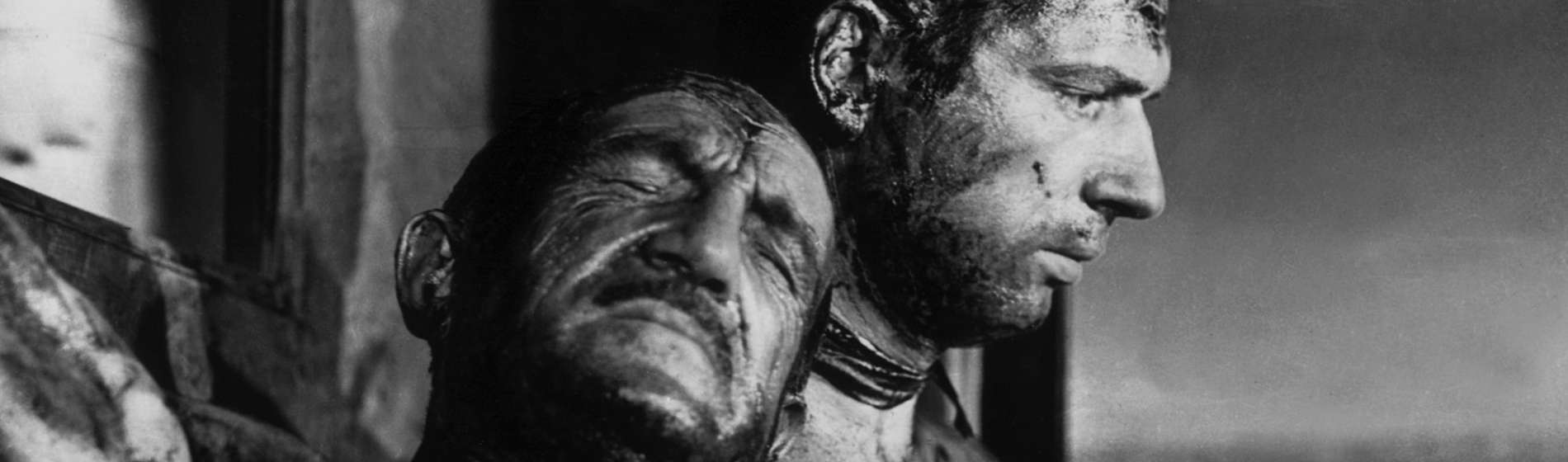
A number of films played in competition at more than one of the top three festivals before the events’ directors got rigorous about exclusivity in their selections, but only Clouzot’s masterpiece managed to win the top prize at two of them, receiving the Grand Prize (before there was a Palme d’Or ) in France two months before taking the top prize in Berlin. Four unemployed men loafing in a South American city jump at the chance to take on a dangerous job for a big American oil company, hired to take four huge trucks loaded with nitroglycerin (that can be set off by the slightest disturbance) up a huge mountain. Clouzot takes his time building the action up in the first act, letting you get comfortable in the film’s lazy rhythms before whipping out a series of intense action sequences that will take your breath away.
Ceremony : 3rd, 1953. Awards : Golden Bear