


There are no filmmakers, not even your absolute favourites, who have a perfect track record. When they have the good fortune to live long lives and stay in the game, it’s rare that the material they’re working with at the end of their careers is as good as what they had in their heyday. Karina Longworth’s podcast You Must Remember This, a gift to film lovers if ever there was one, did a series on the late careers of directors from Hollywood’s Golden Age and found there to be a curious variety of outcomes for many of them, artists whose freedom from the strictures of the studio system allowed them to pursue idiosyncratic projects that were sometimes successful, but other times revealed diminished talents or jaded world views.
There are cases, though, when the directors who have passed away went out on a high and, for their final efforts, released films worthy of their best. Here are my ten favourites.
10. Rich and Famous
George Cukor, 1981
Cukor thought he was done with directing when he was asked to fill in for this film’s original director, Robert Mulligan, who was forced to fulfill other commitments after a strike delayed production schedules. The result is one of the few strong endings to the career of a Golden Age director, adapted from the play Old Acquaintance by John Van Druten (previously filmed under that title with Bette Davis and Miriam Hopkins in 1943), about two women whose friendship begins in college, continues through the early years of one’s turbulent marriage and the other’s career as a celebrated novelist. Cukor never finds the middle ground between intellectual character examination and Dynasty indulgence that he’s searching for. There are times when it’s too obvious that it’s based on a play and other times when it’s trying too hard not to be, but the end result is a pleasurable mix of the two. Watching Candice Bergen and Jacqueline Bassett, who are both superb, is a treat from beginning to end. Meg Ryan makes her on-screen debut as Bergen’s daughter.
9. Blue
Derek Jarman, 1993
Nearing the end of his life and losing his eyesight, Jarman made his last work without compromising his ability to have audiences see life through his perspective. A screen that is perpetually, endlessly blue appears for eighty minutes while music and a host of voices appear on the soundtrack, with one central narrator filling in for Jarman himself as he ruminates on the mundane daily realities of life with AIDS. It’s Jarman at his most conceptual, which is saying a lot, but it is also fascinating, sometimes funny, often very thought provoking.
8. Le Trou
Jacques Becker, 1960
Becker became famous for a series of very sexy romances in the forties (most of which still have erotic potency today) before turning to success with crime thrillers in the fifties, making one of his most celebrated and enduring classics before dying of lung cancer at the young age of 53. In it, a new prisoner in a French penitentiary is put in a room with four other men who are already feeling crowded and, after befriending them, discovers plans for an elaborate breakout. Avoiding stylish editing or a flashy score, this anti-Rififi focuses on documentary-like realism with sequences that take place in real time and a cast that includes a lot of non-professionals, including one man who participated in the real events that this film is based on.
7. The Ascent
Larisa Shepitko, 1977
I wrote about this in another top ten recently so I won’t belabour the point, but as its director tragically died in a car accident two years after making it, it counts for this collection as well. (She was working on another film at the time of her death, which her widower Elem Klimov completed for her.) A group of partisan soldiers struggle to survive the Russian cold during the Second World War, two of whom go looking for supplies in the snow-covered wilderness and end up stranded after they are spotted by Germans. There is lyricism in the sadness here, and pure poetry in the relationship between the two men at the heart of the story before cruelty drives a wedge between a human being and their soul.
6. An Autumn Afternoon
Yasujiro Ozu, 1962
Ozu favourite Chishû Ryû stars as a widower who, as in many of the master’s films, begins to get involved in the marital affairs of his daughter after he attends a school reunion and is horrified to discover that his former teacher’s aging daughter is a lonely old maid. The formation of a new family, and the destruction of the family it leaves behind, were a lifelong obsession for the master filmmaker, but in his final film there is an added note of melancholy to the way he ends a film whose plot is a reworking of his masterful Late Spring. What was previously a bittersweet new beginning for the bride is now an ending whose image is of a peaceful but lonely old man facing the inevitable. Ozu didn’t know that he wouldn’t make another movie (dying on his birthday at tender age of 60), it’s hard not to see a farewell in the way he concludes this one.
5. Moolaadé
Ousmane Sembène, 2003
A woman in a Bambara village in Burkina Faso takes in four young girls who have escaped their circumcision ceremonies and offers them spiritual protection. The men of the village react to the threat of revolution by taking all the women’s radios away, which they believe is what is giving their wives these inconvenient, newfangled ideas. This in turn inspires the women to band together in revolt and challenge a so-called religious tradition, one that mutilates them in the name of giving their husbands more control over their bodies. Sembène, the “father of African film” as he is often known, ends an impressive career of one classic after another with his first mainstream breakthrough, a film that is as necessary and politically poignant as it is entertaining and slyly funny. Fatoumata Coulibaly is marvellous in what I once referred to in a film class as the “feel-good female circumcision film of the year.”
4. Imitation of Life
Douglas Sirk, 1959
Sirk scored a box office hit with this remake of the 1934 adaptation of Fannie Hurst’s novel, then retired and returned to his native Germany, not going behind a camera again except for a few shorts he made while teaching at a Munich film school (he lived until 1987). His final feature is among his most emotionally powerful, about a white actress (Lana Turner) who hires a Black maid (Juanita Moore) and never quite squares the line between their friendship and professional remove, which is a tension that pales in comparison to the drama being generated by their daughters. Turner’s, played by Sandra Dee, resents her mother’s dedication to her career and tries to steal her man (the always dreamy John Gavin), while Moore’s, played by Susan Kohner (mother of the future American Pie Weitz Brothers), is light-skinned enough to pass for white and uses it to break her mother’s heart. There are no films made about race in Hollywood’s Golden Age that pass today’s standards, but this one is unsparingly sharp in how it investigates the bigotry at the heart of American society and, as a result, its softer melodramatic overtones feel artfully contrived rather than naive. The sincerity of its characterizations, always a hallmark of Sirk’s power as a director, also makes it incredibly devastating.
3. L’Argent
Robert Bresson, 1983
Made sixteen years before his death at the impressive age of 98, Bresson’s swan song is also where his style, storytelling, and ruminations on life find themselves at their most potent, a skillfully spare and overwhelmingly powerful adaptation of Tolstoy’s posthumously published 1911 novella The Forged Coupon. A forged banknote that two teenagers pass at a photography shop falls into the hands of a gas worker, who is caught using it and ends up in prison, treated with an inhumanity that turns him into the criminal he was wrongly accused of being in the first place. There’s little dialogue and the soundtrack rarely rises above a hush, Bresson never lets the melodramatic contents of this explosive story ever feel like more than an intense prayer, whittling down the narrative elements to static but richly evocative shots that get a great deal of information across with minimal effort.
2. Red (Trois Couleurs: Rouge)
Krzysztof Kieślowski, 1994
The third part of Krzysztof Kieślowski’s Three Colours trilogy is far and away the best of the three, bringing him to the Oscars for the first time for what would sadly be his last completed work (his co-producer later stated that they hated the ceremony, finding it endless and dull and helping themselves to the free booze to get through it). A Geneva model (Irène Jacob) becomes acquainted with a crusty old judge (Jean-Louis Trintignant) after she accidentally runs over his dog, while her own neighbour is an aspiring judge whose ill-fated romance with a telephone weather operator is mysteriously connected to her new friend’s story. Beautifully photographed, delicate in its application of a kind of unexplained magic while maintaining a consistent hold on the depth of its characters. Kieślowski announced his retirement from directing after its release, then two years later underwent an open-heart surgery that he did not survive. After his death, a script he had written as part of a proposed new trilogy with co-scenarist Krzysztof Piesiewicz was filmed by Tom Tykwer, Heaven, released in 2002.
1. The Dead
John Huston, 1987
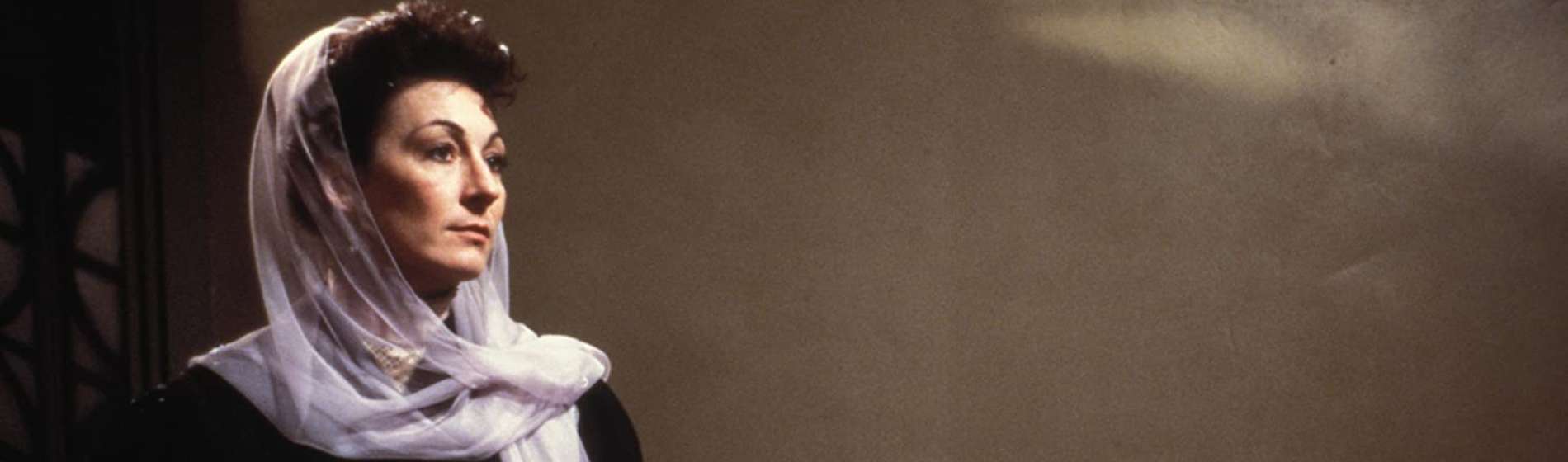
Huston struggled to get through the shoot of this film, confined to a wheelchair and breathing most days with the help of a respirator, with Karel Reisz standing by in case he couldn’t complete the production (and because Huston couldn’t be insured). The result doesn’t show in the finished product, a personal favourite of mine that I’ve written about numerous times in this column. Based on the short story by James Joyce from his “Dubliners” collection, it takes places on a cold Dublin night when a group of friends have gathered for dancing and dining, during which they rehash the memories of those who have gone before. Anjelica Huston, whose stress over her father’s frail state had an adverse effect on her own health after filming was completed, gives one of her most enchanting performances as a married woman who follows the evening’s revels with an admission to her husband (Donal McCann) about a past love affair as they prepare to go to bed in their hotel room. The film hardly ever rises above a whisper, always elegant and small in scope but emotionally vast.