

Depending on the definition, the total number of Christian denominations in the United States ranges from a few hundred to several thousand. Worldwide, that number jumps to approximately 45,000. Each denomination claims, if not a direct conduit to God, then to a religious leader (or leaders) who, like the Quakers and the Shakers did. Handed down from one generation to another, their teachings reflect core beliefs: everything from the nature of God and their relationship to him, to their day-to-day religious practices.
At their height in the 19th century, the Shakers, limited by a core belief in celibacy for its adherents, numbered only 6,000 practitioners. Since their founding by Ann Lee in pre-Revolutionary America, they’ve dwindled to just a mere handful. However, where their adherents have disappeared, their beliefs have not. Nor has the intense fascination bordering on obsession of religious or academic scholars, and in the case of writer-director Mona Fastvold ( The Brutalist , The World to Come ) and her latest film, The Testament of Ann Lee , an utterly brilliant, near uncategorizable blend of religious hagiography, psychological portraiture, and unconventional musical. ( Read more in our interview with Fastvold and star Amanda Seyfried .)
Covering practically the total of Ann Lee’s (Amanda Seyfried) life from early childhood, where, as one child among many in the Lee household, she witnesses her parents engaging in sexual intercourse. This experience both mars and drives her rejection of sexual intercourse in or outside marriage altogether. Initially, Fastvold portrays Lee as burdened by social, economic, and cultural circumstances, specifically an entrenched patriarchal system. But where Lee can’t find meaning in the everyday drudgery of toil and work, she finds purpose in the Quakers, a relatively new Protestant denomination centred on song- and movement-based religious practice. For the Quakers, communal song and movement became integral to achieving spiritual communion.
In England, however, the ostentatious, public worship of the “Shaking” Quakers led to religious repression and persecution, eventually leading Ann, now the unchallenged leader of the Shakers and driven by an “inner light” that reveals her own divinity as the Second Coming of Christ (blasphemy for practically every other denomination), to bring both her teachings and a small band of dedicated followers to the New World.
Narrated throughout by one of Lee’s most ardent followers, Mary Partington (Thomasin McKenzie), The Testament of Ann Lee traces the title character’s embrace of celibacy as a cornerstone of the Shakers, to Ann’s complex feelings towards sexuality. Heightened by the loss of four children in infancy, a traumatized, broken Ann slips into a postpartum depression so deep and so profound that it results in institutionalization. Non-existent or limited treatment leaves Ann with only her spirituality to guide her back into the world.
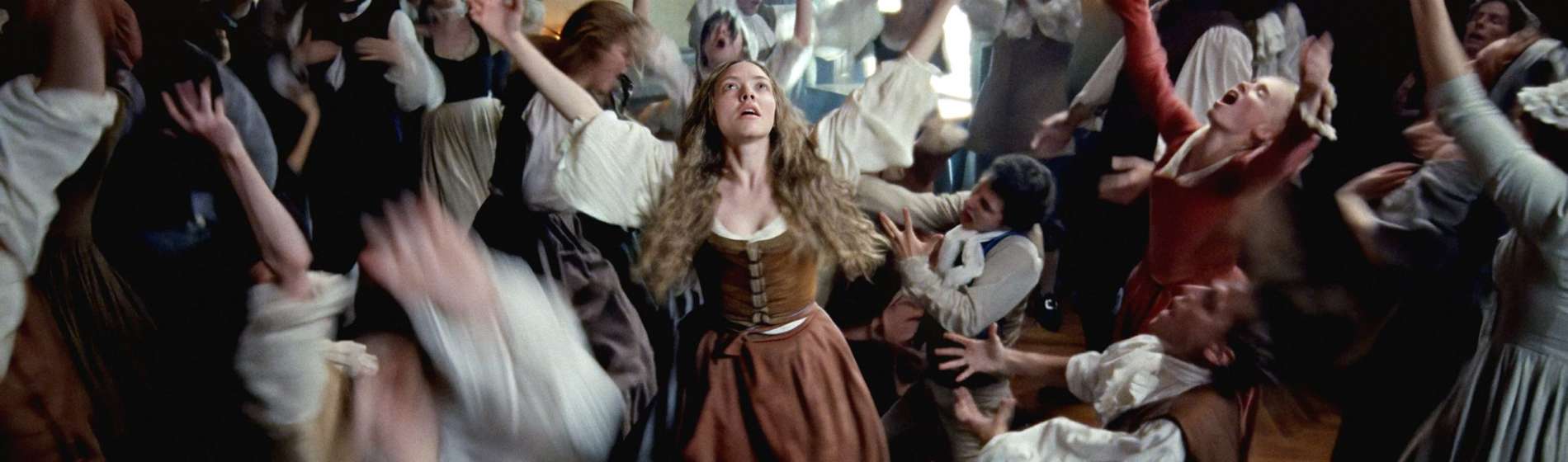
And when she does re-enter the world, it’s no longer as a poor, illiterate woman without social standing, but as a spiritual leader. She’s guided by an unshakable certainty in herself (“she’s been touched by God”) and a plan for a new community. The journey to America proves a fraught one. Lee and her followers face derision and contempt from the non-believers and the crew of the sailing ship transporting them to the New World. A sudden storm, however, turns those same non-believers into grudging admirers after Lee and her followers rush to the upper deck, singing, chanting, and dancing until the storm clears and the sun returns.
Meshing conventional dialogue, diegetic musical performances, and the unironic, earnest depiction of Lee’s inner life, Fastvold meticulously constructs a singular experience. She juxtaposes Ann’s physical journey with her spiritual one as the leader of a celibate sect that not only preached, but also practised a utopian egalitarian community centred on Lee as the Second Coming of Jesus Christ—a factor both radical and threatening to the sociopolitical order of the day.
Elevated by Seyfried’s career-best, award-worthy performance, William Rexer’s luminous cinematography, and Fastvold’s unerringly assured direction, The Testament of Ann Lee will inevitably stand the test of time and emerge not just as one of the year’s best, but one of the decade’s best films. It also places Fastvold in the front ranks of working filmmakers.