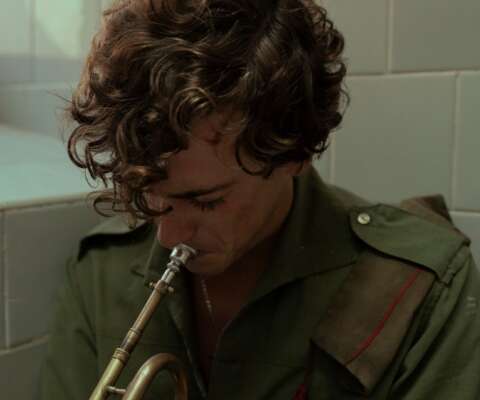


Unabomber could have been an interesting two-hander with Russell Crowe playing a cultish, egomaniacal Harvard professor and Jacob Tremblay playing a young, troubled Ted Kaczynski opposite him, but it doesn’t end up that way, unfortunately. There are true dramatic stakes in the true story of the 16-year old wunderkind who was looking for a father figure, but went on to commit the murders in a mail bombing campaign that injured two dozen others. It also could’ve been a tense, dramatic portrayal of the FBI’s fruitless search for Kaczynski until his sister-in-law convinces her husband, David — Ted’s brother — that his notorious 35,000 word manifesto reads just like his past letters and rants. She makes the case that they should therefore turn him in.
Unabomber is both of these things, but it’s also neither. It deviates too far from the truth in too many crucial areas, such as its female FBI lead and her general investigation. The dramatic highs presented here (Crowe’s Professor Henry Murray versus young Ted Kaczynski) don’t seem to scale up properly to the idea of the real experience. It’s clear what the film’s director Janus Metz Pedersen wants it to be, and what Netflix is looking for too. The film wants to have the psychological depth and invigorating back and forths that made Phillip Seymour Hoffman and Joaquin Phoenix pop on screen in The Master, but it’s not capable of that. The writing (specifically in the dialogue) is wooden, and at best appropriate but cliche. There are moments of brilliance in the acting from Crowe, but Tremblay is not quite able to muster the amount of frustration the emotionally terrorized and lonely Kaczynski must have felt.
The true big mistake made by this film comes in the form of Shailene Woodley’s (fictionalized) FBI character Joanne Miller. She faces every cliché procedural hurdle in the book (from personal to professional), and virtually just runs in circles trying to achieve something in the Unabomber affair until she eventually harasses David into speaking.
Kaczynski, a figure that dominated news headlines off and on by bombing a variety of businesses and civilian homes, eventually got the press to print his aforementioned manifesto, but he wasn’t born an eco-terrorist. He became that way. It was by nurture, not nature. The film makes it clear that, when one looks at Kaczynski’s family, he was not as different from them as one may assume. David, too, lived away from the world for some time, semi-mysteriously. He bought a remote plot of land, built a ramshackle home, and only returned when he learned his father had died. He reintegrated into society, got married, and led a relatively normal life until the exposure of Ted.
Ted, unfortunately, went down a different path when he was admitted early to Harvard. He was deemed an extremely intelligent young man, and therefore invited into a semi-secret debate society, championed by Professor Murray. The debate society is a little like a turn of the century salon, where members chat about philosophy and society. Murray ingratiates himself further with Ted by getting him to open up about his insecurities. For example, he feels apart from society. As he enters further into this debate circle, he’s placed against another student (one in his early 20s). The student – to Ted’s surprise – knows all the personal secrets Ted revealed, and uses them against him. What began as a debate club quickly turns into a psychological torture test, overseen by Murray. Ted goes from feeling alienated but potentially understood by his peers and superiors all the way feeling he’s received confirmation that he is in fact an outsider, no doubt making it easier down the road when he begins to terrorize people, not just the buildings they reside in or structures owned by the companies he targets.
This is a weighty subject, yet the team assembled here is not up to the task of carrying its considerable burden, and properly investigating its many layers and then providing some sort of definitive conclusion. This is partially because so much of the film’s real estate is taken up by the fruitless search of Woodley’s fictionalized Agent Miller. In reality, an FBI agent is not the one who solves the Unabomber mystery, it is Ted’s own brother and sister-in-law. It feels as though too much time is spent not on how the FBI followed clues but more about this fictional character’s fascination with the subject. Much of what she learns about Ted’s early life is not directly based on what she finds during her investigation, but rather what she learns from his family. Ultimately, it feels like a framing device for the story that grows into its own distraction.
There is enough fiction in the conversations between Crowe’s Professor Murray and Tremblay’s young Kaczynski without also creating an entirely new character. The parts of this film that take place in the “present” (that is, in the pursuit of the adult Kaczynski, played by Michael Laurence), are entirely useless, and pointless. We learn the equivalent of a Wikipedia paragraph about the way the FBI caught Kaczynski, and get virtually nothing about the adult man that we don’t hear from the FBI agents or are forced to assume based on the scenes at Harvard. The film seems as scattered about its subject as the FBI was until they were handed truly relevant information.