

Echoing both Alfred Hitchcock’s seminal slasher Psycho and Mary Harron’s deconstruction of ‘90s-era capitalism, American Psycho, director Zachary Wigon and author-screenwriter Virginia Feito’s Victorian Psycho promises copious amounts of blood, gore, and viscera in a familiar, repressive 19th-century English setting. While Victorian Psycho lives up to the title, the result is sometimes frustrating, sidestepping the expected slasher-style theatrics in favour of inadequately developed psychological horror.
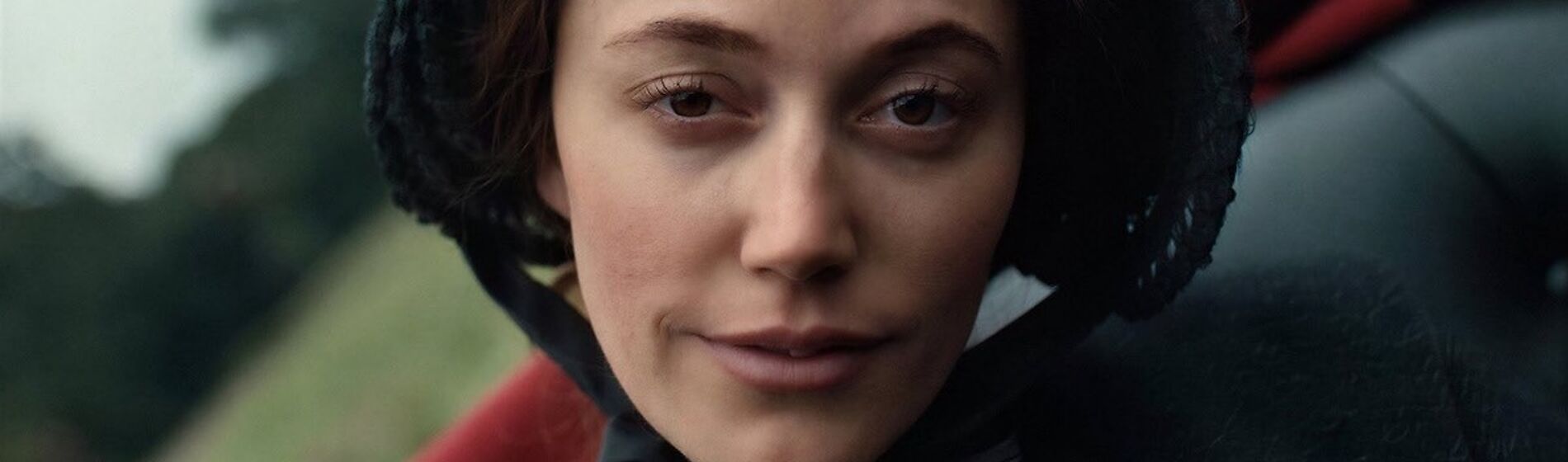
In the opening moments, Winifred Notty (Maika Monroe), a governess with a lengthy work history, describes herself as the sanest person she’s known as she journeys to her latest gig in the Yorkshire countryside. A self-serving, comforting fiction, maybe, but also the first hint that Winifred’s voice-over narration can’t — and shouldn’t — be trusted. The discrepancy between what she shares with the audience and the “objective” in-film reality suggests she’s irredeemably lost. Her homicidal impulses are barely kept in check by a combination of her survival instincts and a fantasy life she’s inescapably compelled to follow to the bitter end.
Then again, Wigon (Sanctuary, The Heart Machine) and Feito (Mrs. March), adapting her own 2025 novel for the screen, situate Winifred in an objectively unjust, cruel world, one where class (capitalism) and gender (misogyny, patriarchy) would make practically anyone who suffered the slings and arrows of outrageous fortune stark raving mad. Unloved and rejected by her mother, abandoned by her biological father before she entered the world, and marked by a lifetime of physical and emotional abuse, Winifred unhealthily fantasizes about finding a family that embraces her as one of their own.
Nodding to Joseph Ruben’s 1987 cult classic, The Stepfather, Winifred has searched high and low for the perfect family, leaving a trail of premature deaths and unexplained disappearances wherever she’s gone. Just as her class and gender leave her practically defenceless in a patriarchal society that sees her as replaceable, that sense of anonymity also protects her from accusations of murder. Surely, a governess trained to instruct and mentor the children of the wealthy and powerful can’t be capable of homicidal violence.
Victorian Psycho, however, leaves no doubt about Winifred’s monstrous nature or her homicidal proficiency. On a garden walk with her two charges, Andrew (Jacobi Jupe) and Drusilla Pounds (Evie Templeton), she quickly dispatches an injured deer, claiming not just that she’s relieving the deer from its suffering, but that all creatures suffer in perpetual pain. As an explanation for her nihilistic worldview, it goes a long way. Ending a life, any life, whether human or animal, becomes automatically justified.
Introducing Winifred as a psychopath with a body count removes any mystery behind her actions. It’s not a matter of if, but when. By eliminating that element, however, Victorian Psycho stalls repeatedly narrative-wise. Even after Winifred dispatches the first of several human-sized obstacles to her fantasy, namely an ill-fated gardener who attempts to extort her Winifred, the film resettles into a collection of scenes involving the governess’s awkward attempts at social interactions or her failing struggle to control her dark side, which she dubs “Fred” (as if only men could be homicidal).
With the exception of another servant-turned-confidant, Ms. Lamb (Thomasin McKenzie, underused), Winifred steers clear of the household staff, instead focusing her attention on Andrew, Drusilla, and their seemingly clueless parents, Mr. and Mrs. Pounds (Jason Isaacs and Ruth Wilson). Where Andrew takes a measured dislike to Winifred and her unconventional teaching methods, Drusilla begins to embrace them, seeing herself in Winifred and, presumably vice versa, as victims of a patriarchal system that sees Drusilla’s value only in the wealth, power, and status she might acquire through marriage to another landed aristocratic family.
While understandable narratively and/or thematically, Winifred and Drusilla’s eventual alliance receives too little attention to be credible. Presumably the result of condensing Feito’s novel into a feature-length film, the lack of adequate development in Winifred and Drusilla’s relationship undermines a third act. Wigon and Feito’s decision to toggle between two disjointed realities, Winifred’s and the family she’s claimed as her own, arrives too late in the film, let alone in the third act, to provide compelling insight into Winifred’s fracturing mind.
For all its faults, narrative or otherwise, Victorian Psycho always remains consistently watchable thanks to Wigon’s hyper-stylish direction, Nico Aguilar’s vibrant, kinetic cinematography, Ariel Marx’s aptly dissonant score, and Monroe’s central performance. An expressive, malleable performer whose talents often go overlooked or untapped, Monroe gives Winifred a refreshing physicality. Her Winifred, however, isn’t just a collection of facial or body tics, but fully alive in her complexities and contradictions. She is the victim of an exploitative class and gender system and, at least in this telling, a rebel who upends the system, even if, ultimately, she doesn’t benefit directly.