

It might be across the city, but 100 Sunset feels like the next door neighbour of Concrete Valley . Kunsang Kyirong’s feature directorial debut evokes the spirit of Antoine Bourges’ TIFF 2023 revelation about Syrian refugees living in an apartment complex of Toronto’s Thorncliffe Park. 100 Sunset zeroes in on the titular apartment in Toronto’s Parkdale neighbourhood in the west end. The building houses members of the Tibetan-Canadian community, and 100 Sunset unfolds the pattern of a series of waking days. It’s a quotidian snapshot of a corner of this city rarely put to film.
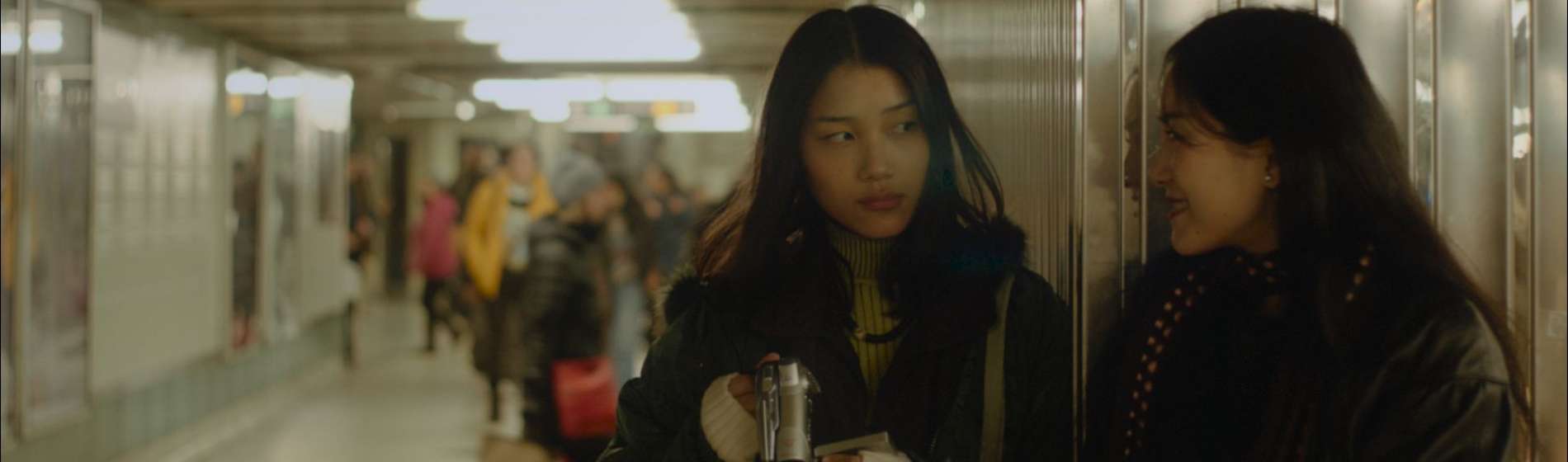
Kyirong observes the daily goings on of a shy young woman named Kunsel (Tenzin Kunsel), who enjoys spying on her neighbours and recording her thoughts with a digital camera. She is an observant young woman. Her ability to intuit the dynamics of urban city life ensures that she adapts to her new homeland at a different pace from others in the building. She finds herself straddling two worlds, tied to tradition thanks to her immersion in her community, but driven by western notions of womanhood and independence. Her rebellious nature cautiously clashes with her neighbours, but eventually finds a kindred spirit in Passang (Sonam Choekyi). The young Tibetan woman has a fate that echoes, or perhaps foreshadows, Kunsel’s future.
Passang beams as the bride of a much older husband in an arranged marriage. She’s all smiles, but can’t hide her hunger for an alternative. These two women embrace the possibility afforded to them by their relocation to a new land: they were promised new futures in Canada, so why not claim them?
The young women embark on a quest into the unknown, deftly symbolized in the tried and tested trope of the road movie. The difference here is that Kunsel and Passang set forth on a train trip, ironically and hauntingly forging paths by traversing a country whose initial rail lines were laid with the fates of Asian-Canadian immigrants who came here in search of new opportunities.
Kyirong finds an evocative premise here, but the film’s meandering nature often leaves it adrift as it explores new pockets of the Canadian landscape, whether in concrete jungles or verdant forests. 100 Sunset nevertheless makes an earnest effort to represent a community authentically, which can be felt in the casting of many non-professionals and members of the community. The naturalism of the performances lends the film a down-to-earth restraint, if a somewhat muted emotional payoff.
But the film’s kinship to Concrete Valley , whether intentional or inadvertent, also leaves it somewhat lacking. (Acknowledging that the comparison may be unfair.) In Bourges’ film, a dexterous interplay between persona and performance blurs the drama with life itself, inviting questions of the demand to play a part in a new home and to express oneself in new tongues and customs. Casting members of the community here doesn’t entail quite as substantial an exercise in fiction/non-fiction. However, the drama that Kyirong delivers feels absolutely true to life.
As a first feature, 100 Sunset shows much promise and invites many new Canadians to see themselves reflected in the experiences with which Kunsel and Passang wrestle. The film’s specificity opens a new window with each rising sun.