

The circle of life continues as Simba and company return in Mufasa: The Lion King. This latest entry in Disney’s “photo real” reboot of the 1994 animated classic once again provides great entertainment and an impressive technical feat. But the cat’s showing signs that it’s used a few of its nine lives.
This Lion King story falls shortly after the 2019 entry with cub Kiara (Blue Ivy Carter) holding down the fort as parents Simba (Donald Glover) and Nala (Beyoncé) leave Pride Rock to deliver a baby. The inquisitive Kiara passes the time with babysitters Timon (Billy Eichner) and Pumbaa (Seth Rogen) and trusty Rafiki (John Kani). The latter regales them all with a Lion King origin story and tells Kiara how her grandfather became king of the jungle.
An awkward transition between the present-day storyline and the story-within-a-story jumbles things a bit, but things generally picks up pace once Mufasa (voiced by Braelyn Rankins in his early years and Aaron Pierre in later ones) finds himself separated from his parents amid a great flood. Mufasa finds a friend and salvation in fellow cub Taka (Theo Somolu, and Kelvin Harrison, Jr. in later years) who saves him and invites him to be part of his pack—with some strong reservations from his father.
It’s good news/bad news for the lion pack, however, as the years go by and the boys bond. Mufasa fits right in, but his reluctant step-father feels threatened, sensing that his own son isn’t as strong a leader. But when a pack of ghostly outsiders, led by the nasty Kiros (Mads Mikkelsen), storms the territory, Mufasa and Taka are running for their lives. All they have is each other.
This return to the jungle follows many of the familiar beats in Lion King lore despite the new premise. Actions and character turns mostly follow what audiences have seen in the 1994 original, the 2019, reimagining, and the films in between. Narrative familiarly proves both a help and a hindrance. On one hand, it can be difficult to follow Mufasa since the lions, stunningly realistic as they are, all look the same. Unlike the more personable characters of the 2D original, it’s hard to identify the personality of each cat. Alternatively, since one knows where the story’s heading, one can generally transfer the story beats onto the characters to help follow along.
Director Barry Jenkins, a darling of the independent scene after Moonlight and If Beale Street Could Talk, seems a bit out of his element here with some action sequences that prove a bit clunkier than the usual Disney magic does. When the story pulls inward though, Mufasa benefits from Jenkins’ authorship. There’s genuine heart as it focuses on the family relationship and the parable about togetherness, which the compositions frequently evoke as the animals provide constant displays of respect and affection. There’s soul to elevate the big screen escapism.
Mufasa provides some enjoyable musical numbers too as the lions and company bond through song. The score by David Metzger harnesses African influences and keeps to the spirit of Hans Zimmer’s Oscar-winning work of the original. The music complements the narrative frame’s emphasis on oral storytelling, too, as the tribal rhythms both fuel and signal character turns and emotional cues. It’s all quite impressively realised, if, again, slightly derivative. One can peg the songs that stand in for “Be Prepared” or “I Just Can’t Wait to Be King.” They’re beautiful sequences—just not particularly original ones.
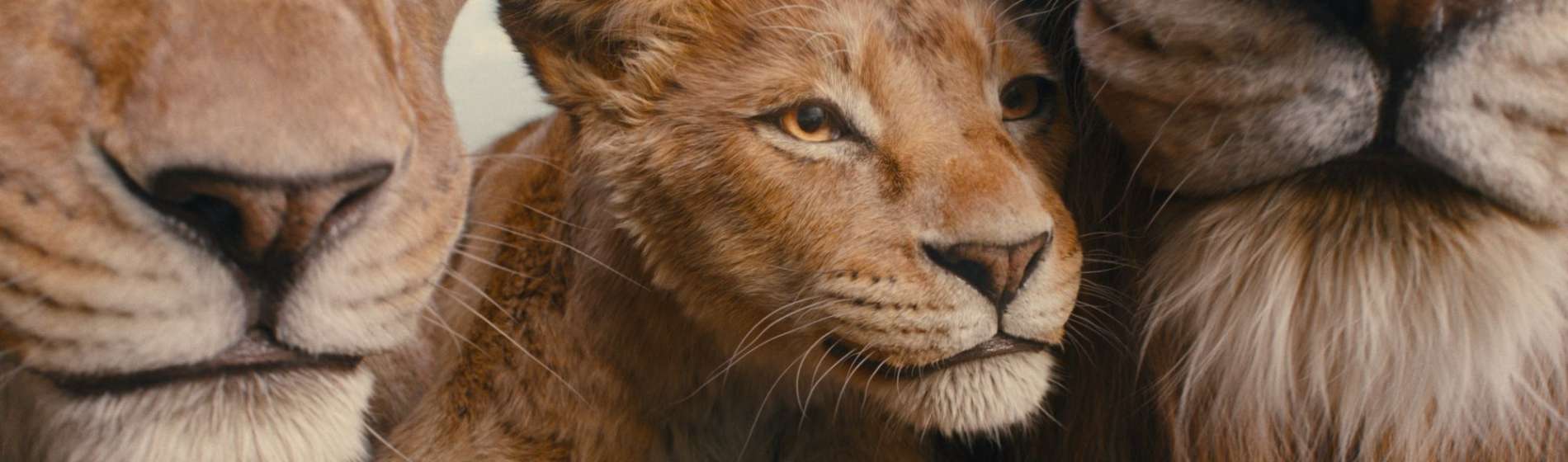
What’s really new here is the astonishing technical feat of the animation. Animals have never looked this authentically realised. The lions’ fur has textures that one can nearly pet as each follicle proves visible to the audiences’ eyes while combining to make Mufasa’s lush mane that rustles in the wind as he charges across the plains. The lions move with agility as the technical wizards in the VFX department get all their lithe and nimble prowess down pat.
And in close-up, the lions have genuinely remarkable expressions in which any cat lover will recognize a feline’s charm or mischievous nature. Eyes usually betray characters both human and non. These animals seemingly crack the code that has long eluded animation departments. Perhaps that’s where Mufasa’s sense of familiarity proves strongest: gazing into the eyes of the lions and recognizing their personalities. Nobody looks into the camera to reveal their soul quite like the characters of a Barry Jenkins’ film do. Even CGI cats.
Mufasa: The Lion King is now playing in theatres.
Watch Jason Gorber’s interview with Mufasa stars Aaron Pierre and Kelvin Harrison Jr.