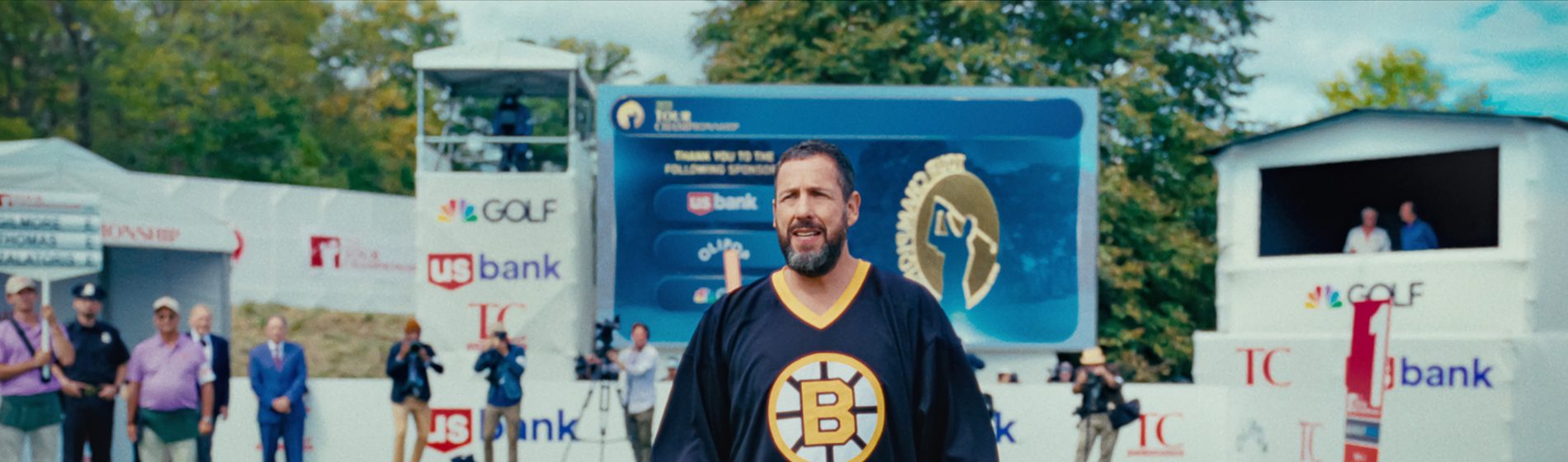


Adam Sandler‘s long-awaited Happy Gilmore 2 is a success, but not for the same reasons as the 1996 original.
This is technically a modern comedy, but its goal is nostalgia, not laughs, with a focus on mining Happy Gilmore 1990s’ lore and the meta narrative surrounding Sandler and the cult status the film has developed. The original Happy Gilmore, on the other hand, was a big, broad comedy that happened to use golf as its vehicle, and threw in some specifics to the sport here and there to appease its grumbling fans.
Are there jokes in this sequel? Yes: plenty. Many of them are callbacks to the first film, or are simply pulled from the same crass reservoir.
There are also many cameos. Many. Future film classes will offer a left-page script, right-page explanation of this film in the vein of Shakespeare or Tolstoy reading guides, and why they were chosen. Name someone with an ounce of charisma in the popular sports world, or a member of Sandler’s family, and they are probably in this film. And so is Puerto Rican rapper Bad Bunny as Happy’s caddy. He is one of the film’s greatest surprises.

The cameos generally work exceedingly well, disarming viewers who are either wary of the idea of this sequel, or those coming to it as pure golf fans, curious about all the hubbub after nearly 30 years. In addition to golf legends taking their best swing at playing Meryl Streep, we get filmmaker Benny Safdie (Uncut Gems) in a memorably slimy supporting role, Christopher McDonald as rival Shooter McGavin (fresh out of a psych ward), and Ben Stiller as an abusive authority in charge of an alcohol rehabilitation class. He is as sinister and unnerving as he was in the original.
In the intervening years, Happy won a bunch more major championships, had a big family of five with Virginia (Julie Bowen), and began to settle down. Unfortunately, out on the course, he accidentally hit Virginia in the head with a shanked ball and killed her. Yes: killed her.
Don’t worry, Bowen appears scattered throughout the movie as an encouraging figure like a deceased Jedi.
Happy’s heartbroken and quits golf. He becomes an alcoholic. He loses everything. He loses the house his beloved grandma left to him and his life continues to spin out of control. Eventually he’s sentenced to alcohol rehabilitation centre (enter Ben Stiller).
His kids rally around him, and he eventually re-enters the golf world, including a tournament where he’s generally a success. He meets some of his old contemporaries (many of whom are actual modern golf legends), and learns that a new version of the sport, Maxi Golf, which is meant to appease newer generations with its faster pace, is threatening to make extinct the original. This plot will satisfy many sports traditionalists since this exact thing has happened in basketball, football, cricket, and most recently, baseball.
Happy suggests a match up between the five best players from each league to re-generate interest and try and squash things. And then we’re off to the races, where Sandler manages to mash heart, stupid comedy, and sports action into a very satisfying meal.
Happy Gilmore 2 isn’t quite as funny, weird, or original as the first movie. But for it to be to even be close makes it a win. Moreover, for how much it attempts to recapture Happy Gilmore, this sequel resembles it very little visually.
There were quirks to the original’s visuals, no doubt, such as following the slap-shotted golf ball down a suburban street and through someone’s bay window. There were a few throwbacks to gags that seemed to be from a by-gone era, like the way the physical comedy was played to an exaggerated, folksy degree. The camera would follow that. But, generally, the visuals in the film were simple and logical.
Here, the visuals could also be called simple and logical… for 2025. There is a sheen. There is a kind of spectacle and oversaturation on display.

Happy Gilmore, both the film and the character, could be called scrappy. Happy Gilmore 2 is not scrappy. The kid moved up from a beater Toyota to a Ferrari, and he’s back to reap the social rewards of being the still-cool guy at the high school reunion. And what a reunion it is.
However far McDonald went as Shooter McGavin in the ’90s, here he is turned up to 11. The script gives him some particularly outlandish lines and moves, and he handles them wonderfully. He meets them where they want to be. Certain moments bring to mind a comedic version of Robert De Niro‘s Max Cady in Cape Fear. Other times, it’s more like The Simpsons‘ Sideshow Bob. The modern version of Shooter is smarmy, envious, and occasionally gracious, but he’s been burdened by oppressive memories of his rivalry with Happy.
Sandler, meanwhile, has proven himself more recently on the dramatic side (Uncut Gems, The Meyerowitz Stories), but it’s been a while since he delivered a great comedic performance. Happy Gilmore, to a lot of people, is his best movie, so there’s a lot riding on this sequel.
Does Sandler still have the comedic juice to do justice this legacy? Happy Gilmore 2 doesn’t choke: it lets Sandler earn that gold jacket once again.
Happy Gilmore is streaming on Netflix now.