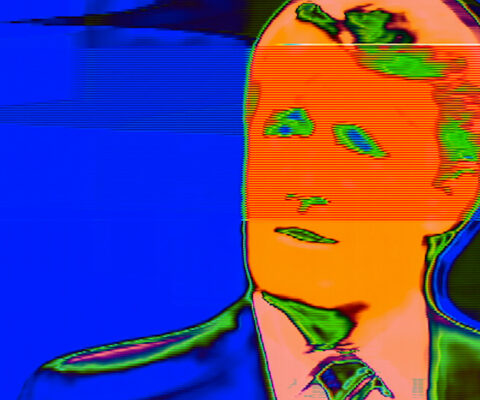


The wonderful thing about animation is that it can be used to tell any kind of story. Too often, we deem animated films as somehow lesser than or relegate them to being just for kids even some of the most creative and inspiring films of late are animated. Into the Spider-Verse , Flee , Mad God , and last year’s Flow , to name a few of the stunningly creative works brought to life by animation. This year, they are joined by Dog of God– although taste levels might determine how well the film matches the laurels of its contemporaries.
Latvian directors Raitis Abele and Lauris Abele use animation to bring to life a weird, wild, and horrific story about a young woman accused of witchcraft by a corrupt priest, and the self-proclaimed werewolf who arrives to observe and protect. He brings with him the severed testicles of the devil himself. Yes, this movie is dark and weird, and it’s going to be either directly up your alley or very much not.

The basic story is fairly straightforward: in a 17th-century Baltic town, there is a lustful priest and a bumbling baron. Together, they rule over the people, most of whom are destitute, perpetually drunk, or both. When a precious relic goes missing, the priest blames the local barmaid, a woman for whom he lusts. She also dabbles in alchemy and medicines, which gets her accused of witchcraft. When she’s put on trial, the werewolf shows up and things get very adult, very quickly. When the werewolf comes bearing gifts (re: Satan’s testicles), the power of said balls fully consumes the baron, who is very horny and desperate to sire an heir.
You can probably guess where things might be headed, but it suffices to say that Dog of God asks audiences to expand the limits of their imagination. By the third act, normalcy breaks down entirely, and things devolve into a fever-dream territory. This is where the animation truly shines. Everything is rendered in beautiful and depraved detail with a layered sound design to match.

The town itself is rendered in stark greys and browns. It’s a town perpetually in the dark, drenched in rain, and built on a field of mud. There seems to be only three buildings and a dark forest, all of which feel depressing and oppressive. The character design is similarly dark and veiled in shadow. Clothes are mostly in blacks, with bursts of red that will stick in your memory.
There’s also the way Dog of God is animated: rather than start from scratch, each character is an actor whose performance has been rotoscoped. This lends naturalism to character movement and body language, but sometimes it inspires characters to live in the uncanny valley. It’s a fine balance, and it mostly works.
There are issues here, though, starting with the fact that you have definitely seen this story before, just perhaps not framed through this particular branch of Eastern European folklore. That mysticism is interesting, but it also isn’t quite enough to overcome the film’s pacing. The third act indeed gets a little unhinged, but it takes way too long to get there, and for some, it will be too much. The second act is, in particular, so languid that it may cause viewers to lose interest. It is may inspire some audiences to question the film’s balance of style and substance.
There’s no denying the creativity on display in Dog of God , nor the quality of the film’s animation and sound design, but these pacing issues, along with the lengths and depths it goes to, will likely turn off many viewers. For those who pick up what it’s putting down, it will likely be a revelatory experience, and for everyone else, it will likely spur the question, “What the hell did I just watch?”
Dog of God has its Canadian premiere as part of the 2025 Fantasia Film Festival .