

Almost forty years after the end of World War II, The Clash sang “Should I Stay Or Should I Go,” an earworm-worthy anthem that stands out as one of the best in their all-too-brief career as England’s premier punk-rock band. Add a question mark to The Clash’s song, and the result lies at the centre of writer-director Anthony Maras’ (Hotel Mumbai) latest film, Pressure.
An old-school, throwback war drama, Pressure hones in on the 72 hours leading up to the D-Day invasion of Normandy on June 6, 1944, which officially opened the Western Front in the European theatre and, along with the Soviet Union’s pincer-like advances on the Eastern Front, led to the eventual collapse of Nazi Germany less than a year later. But where an immutable historical record gives us a series of causally related, logical, ultimately irrevocable events, Pressure reintroduces the uncertainty, the radical doubt surrounding the central question: not whether the Allies should invade Normandy (a given, obviously), but when the invasion itself should begin.
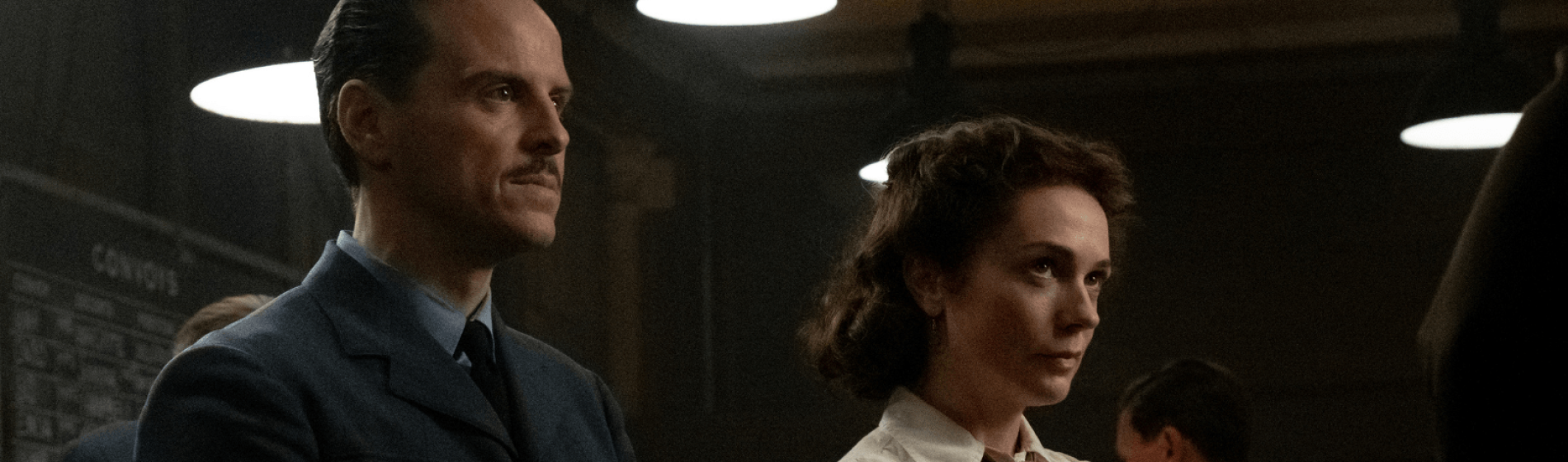
The answer to that question relied less on logistics, or the accrual of men and materiel for the greatest land-and-sea invasion in recorded history, than on the weather. With the moon and tides on the Allied side, the first week of June represented the best-case scenario. But with the invasion crossing the English Channel, a body of water long known for its extremely variable weather, they required something else altogether: a best-in-class meteorologist, Group Captain James Stagg (Andrew Scott, delivering yet another uniformly watchable, nuanced turn), aka Prime Minister Winston Churchill’s favourite weatherman.
Assigned to oversee the final preparations for Operation Overlord (the official name of the “D-Day” invasion), Stagg enters Allied HQ at Southwick House as the last, possibly crucial, cog in the war machinery. While the Allied armies and navies (U.S., British, and Canadian) patiently wait, General Dwight D. Eisenhower (Oscar winner Brendan Fraser, slightly miscast), and his Allied braintrust, including General Bernard ‘Monty’ Montgomery (Damian Lewis), the commander of the British Army, Air Marshal Leigh-Mallory (Con O’Neill), General Omar Bradley (Alexander Hanson), and Admiral Bertram Ramsay (Robert Portal), make final preparations for the invasion, including the most crucial decision rarely left undiscussed: Should they invade on the 5th as originally planned, or wait until better weather conditions present themselves.
Pressure sets the central conflict early on, between Stagg and his science-based approach to weather forecasting and Eisenhower and his understandable obsession with certainty. Eisenhower’s American meteorologist, Irving Krick (Chris Messina), favours a historical approach, relying on meticulously recorded weather conditions going back decades. Stagg’s approach rejects Krick and his historical analogs, instead recognizing the inherent complexity of North Atlantic weather, embracing data collection and analysis, and issuing weather forecasts with varying levels of confidence.
At repeated points, Krick gives Eisenhower the answer he wants, but Stagg, as stubborn and self-confident as Eisenhower, gives the future president of the United States the answer he obviously needs. The script, co-adapted by Maras with playwright David Haig and based on the latter’s 2014 well-regarded stage play, deftly interweaves Stagg and Eisenhower’s conflict with Stagg and Krick, and in a larger sense, Eisenhower and his braintrust. Montgomery literally wants to throw caution to the wind, while others hesitate, attempting to balance certainties and uncertainties, including the growing possibility that Germany will uncover the scale, scope, and magnitude of the D-Day invasion.
A decidedly male-centric war story smartly adds Kay Summersby (Kerry Condon), Eisenhower’s chief aide, to offset the ego-driven male energy and serve as a much-needed mediator between Eisenhower and Stagg. Her efforts prove critical to bringing the men together, forcing each, in turn, to see and better understand the other’s perspective. Not surprisingly, the “Go/No Go” decision becomes a hinge point in the narrative, with Stagg first offering his evidence-based advice and Eisenhower responding in kind.
History proved Stagg and Eisenhower right in their individual and collective decision-making, and now, with the finely crafted, well-directed Pressure, moviegoers receive not just an essential history lesson, but the chance to experience second-hand the — albeit fictionalized — events that led to the successful invasion of Normandy and the first of countless Nazi defeats across Western Europe throughout the following year, both on the newly formed Western Front and the Soviet-led Eastern Front, ending with Hitler’s ignominious demise in an underground bunker on April 30, 1945.