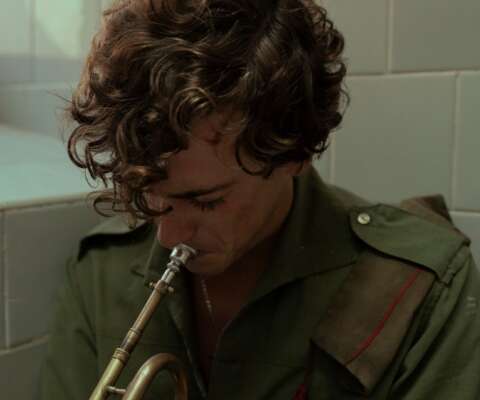



If there was a film that came out of nowhere to rock the Cannes Film Festival, it would be La Bola Negra (The Black Ball) from directorial duo Javier Ambrossi and Javier Calvo (a.k.a. Los Javis). The pair were largely unknown, making the film their major festival debut. Based on their previous, lesser-known works, the only certainty about The Black Ball was that it would be unapologetically queer. What nobody expected was that Los Javis would deliver such a beautiful, expansive portrait of the progress the queer community has made over the last hundred years.
Straight from the film’s opening moments, it is clear you are in for something special. The Black Ball opens in a rural Spanish town in 1937, as Sebastián (Guitarricadelafuente) and his neighbours prepare to welcome both Spanish and Italian Nationalists. In a spectacular one-shot, the Italian pilots instead bomb the town and massacre everyone in sight. Eventually, Sebastián is found by Spanish Nationalists in a military hospital, and he joins their ranks. While serving at the hospital, he is put in charge of caring for Rafael (Miguel Barnardeau, 1899), a high-ranking officer of the Spanish Republican Army. At first, they are enemies, but over the course of the film, they become more than that as their conversations about art, sports, and life in the military blossom into something truly special.
In 1932, we follow Carlos (Milo Quifes), a closeted gay man who is trying to earn a membership into a prestigious casino during the Spanish Civil War. He wants to join the club because of its economic and societal perks, as he hopes it will help gain his family status in their small town. All of his hopes are dependent on the votes of the local leaders, who vote using white and black marble balls. However, when he is accused of being a homosexual, his dreams of joining are shattered and he must decide what to do next.
In 2017, we follow Alberto (Carlos Gonzalez, La Cancion), a gay man who is tasked in his estranged grandfather’s will to find the family of a man named Rafael and then to deliver his family some papers. Though his mother, Teresa (Lola Duenas, The Sea Inside), pleads with him not to go, he takes up the quest. He eventually finds the necessary papers and, given his career as a playwright historian, realizes that there are more to them than meets the eye.
On paper, it would seem there isn’t much to connect these three narratives. But Los Javis accomplish the impossible. They craft a sprawling historical epic that traces the queer experience from an era defined by violence, oppression, and silence to the present day. Historical epics of this scale are rare, and even rarer are ones as ambitious as The Black Ball. Yet despite its expansive scope, the film never loses sight of the personal intimacy that grounds it within its large historical vision.
Each story is distinct, not only narratively but stylistically, with its own visual identity and filmmaking approach. Despite these differences, they remain deeply connected through their exploration of the queer experience. Sebastián finds himself caught in a forbidden romance with Rafael, evoking the tragedy of Romeo and Juliet. Their relationship is not condemned by religion or by society, but by the fact that they serve opposing armies. Carlos remains closeted despite everyone around him already knowing he is gay; he has simply been unable to say it out loud. Fearing ostracisation and persecution, he continues to hide a truth that has become obvious to everyone else. Meanwhile, Alberto lives openly and freely, yet carries the weight of the past. He feels the echoes of the persecution, the violence, and the exile endured by those who came before him. Though these men live in very different eras and under very different circumstances, they are bound together by the same shared experience.
It’s an ambitious feat, and Los Javis pulls it off with remarkable precision. The Black Ball is a sweeping drama that captures the queer experience in a way that feels both deeply intimate and genuinely groundbreaking. The film occasionally drags in the middle, but those slower stretches are easy to forgive when surrounded by exhilarating musical numbers and uniformly excellent performances. Keep your eyes peeled for cameos from both Penélope Cruz and Glenn Close, too. By the time the credits roll, it’s difficult not to be swept up in its emotional power. In the end, The Black Ball feels destined to stand as a landmark of queer cinema, one that will define a generation.
The Black Ball premiered in competition at the Cannes Film Festival and will hit theatres this fall.