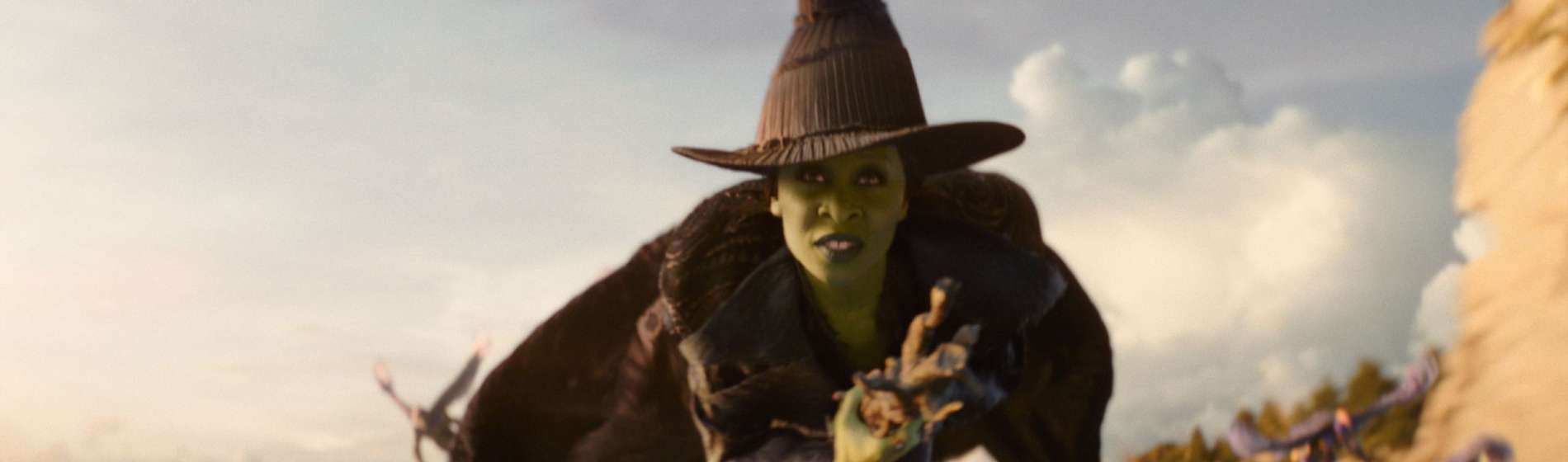


Goodbye, Yellow Brick Road. It’s been two years of Wicked fever with audiences soaring to the heights of “Defying Gravity” and then shedding a tear with the soulful farewell, “For Good.” But the whirlwind dual release of Wicked and Wicked: For Good makes only half the journey for the films’ star, Cynthia Erivo, who relishes the role of a lifetime as Elphaba, the Wicked Witch of the West. She earned an Oscar nomination and a Golden Globe nomination for the first Wicked and she’s a nominee for the latter once again with a second Oscar nomination likely on the horizon.
Erivo, speaking with That Shelf via Zoom, says that if “Defying Gravity” gives Elphaba’s defining moment of Wicked, then the key to finding her character’s voice in Wicked: For Good comes in the number “No Good Deed.” It’s a showstopper in the film, arguably the most cinematic sequence in For Good. It’s also the most powerful one emotionally as Elphaba casts a spell with hopes of saving of loved one. “I think ‘No Good Deed’ was a really eye-opening song,” says Erivo. “It’s interesting because I’ve always loved the song, but when you get to work on something, you can excavate it. You can really dig in and pull it apart.”
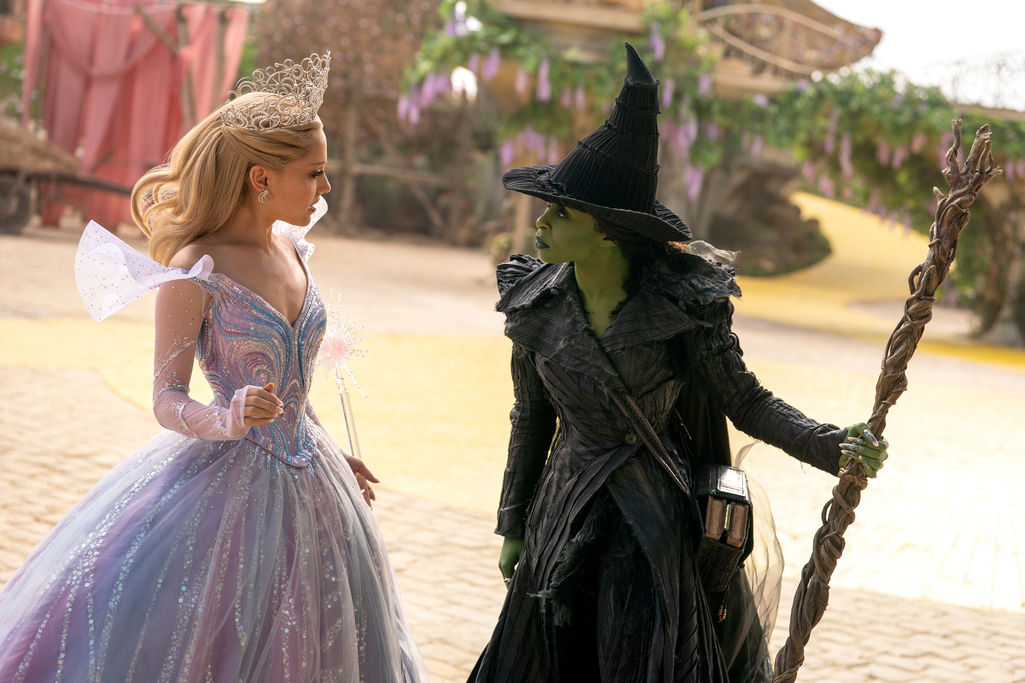
The star clearly appreciates the gravity that her character defies. If the first Wicked is more playful with a traditionally showier part, then For Good completes Elphaba’s arc quite spectacularly as Erivo goes darker and hits deeper notes as the witch becomes the scapegoat for the Wizard of Oz (Jeff Goldblum) and Shiz headmistress Madame Morrible (Michelle Yeoh) in their plot to rule the masses. This film also sees Elphaba part ways with her former BFF Glinda (Ariana Grande), while Oz’s resident loverboy Fiyero (Jonathan Bailey) becomes a wedge between them. That’s a big journey for one actor to convey through song, but Erivo handles it like witch with, well, a broom.
“I think it’s where I discovered that, actually, [‘No Good Deed’] is her weakest, most vulnerable moment,” Erivo continues. The song arguably has the most levels in Wicked: For Good, as the spell inspires Elphaba to revisit magic tricks of the past and confront the label of wickedness that’s been thrust upon her and the power she wields.
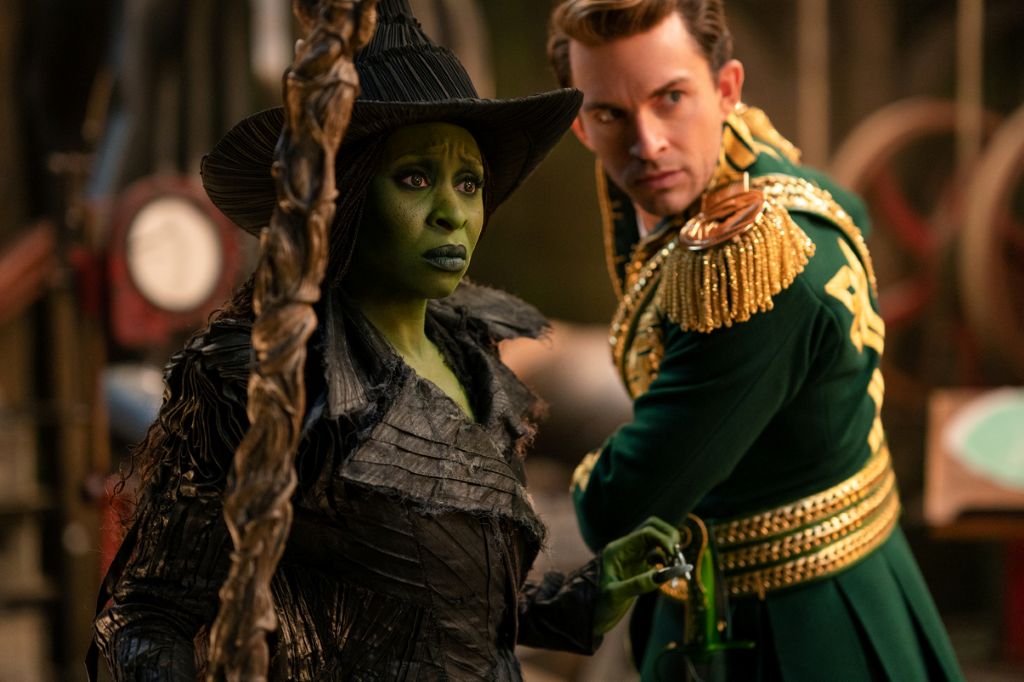
“I loved the idea that we could look at this piece as something where she has to surrender to the thing that people have been calling her, to the thing that people have believed of her,” says Erivo. “We got to show what it looks like when she’s truly heartbroken, when it’s all gone, when she has nothing left. I think previously people might believe that that song is a power ballad, that it’s about all of her strengths, but actually, it’s the opposite. And in discovering that, I got to learn a little bit about where she hides her pain and how she hides it, how she uses it, and what it shows up as, and the she puts up to defend herself.”
This other side of Elphaba invites audiences to further explore the iconic character anew, especially as For Good arguably delivers more fan service to Wicked lovers and devotees of The Wizard of Oz alike. Part two of Wicked features more direct callbacks to the L. Frank Baum classic and Victor Fleming’s 1939 film that it inspired as Dorothy, that pest who steals Elphaba’s sister’s shoes, trots down the Yellow Brick Road with a lion, tin man, and scarecrow, among other famous sights. Audiences might see some echoes of the classic cackling witch here, yet Erivo still distinctly makes the character her own.
“What I love is Elphaba has been derived of the Wicked Witch because there’s the brainchild of Gregory Maguire [who wrote the book Wicked] and what I love is that you get to build her from the beginning, whereas when you see the Wicked Witch of the West, you don’t know anything about where she’s come from,” says Erivo. “It’s almost like going backwards to come forwards. So you build who she is. You build her childhood. You build her teenagehood. You build who she is as a woman and what she wanted to be, and then you build what people have said about her. And what it does is it spins it on its axis, which I love doing because it means that people have to look at things in a slightly different way.”
Erivo clearly feels a moment with her character here as she mimes the gesture of the axis spinning and closes her eyes. One can only imagine how much speaking about the Wicked world on such an extensive press tour—twice—as made her truly live within Elphaba’s skin.
“What happened to her to become this? Where did it all go wrong and where did it become twisted?” Erivo asks. I think that the combination of being able to knit those two things together was a fascinating exercise to be able to be a part of.”
Erivo doesn’t miss a beat as the axis keeps spinning and her answer transports her to 1939 and back again like a tornado whipping Dorothy through place and time. “Obviously, Margaret Hamilton’s Wicked Witch will always be iconic, but I love that now we give her a background,” she says passionately. “Now we know where she’s come from and now we know what she’s experienced. She’s fully three-dimensional. She’s isn’t just a villain of whenever. She’s a person who tried her best and ended up relenting and becoming something that was forced upon her. And then we see her out. We see her let that go. We give her an ending, which is such a wonderful, satisfying thing to do—to be able to see how she comes out of the thing that people have believed of her as well.”
She’s been changed for good, one could say.