


Romanian director Cristian Mungiu is no stranger to making his audiences uncomfortable. In his Palme d’Or-winning film, 4 Months, 3 Weeks, and 2 Days , he drew attention to the realities of abortion. In Graduation , he turned his attention to a corrupt government that shuts out justice in order to protect the rich and powerful. With his latest feature, Fjord, he tackles assimilation, progressivism, and conflicting values.
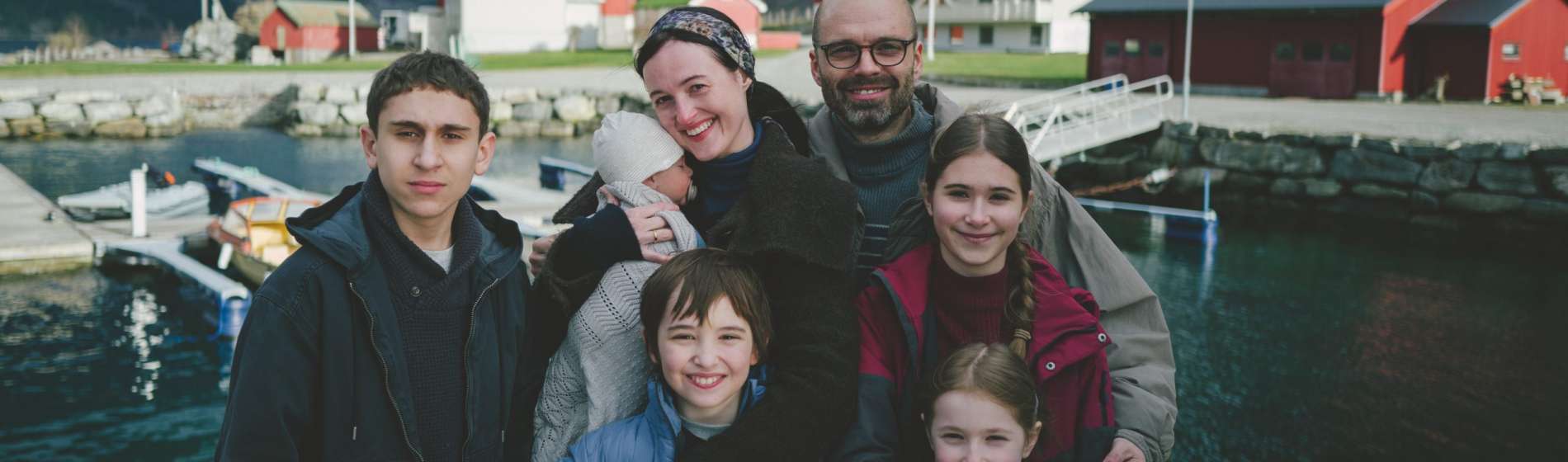
The drama follows the Gheorghius, a Romanian Catholic family of seven — led by father Mihai ( Sebastian Stan ) and mother Lisbet ( Renate Reinsve ) — who move back to the mother’s hometown. They quickly bond with their neighbours and integrate into the remote, progressive Norwegian community, despite their very different cultures and beliefs. But when the Gheorghius are suspected of physically hurting their own children, the lines between justice and persecution begin to blur.
The family at the heart of Fjord is very religious and conservative. They live and breathe the words of the Bible. They do not allow their children access to the internet or video games. They do not dance, and they believe homosexual relationships to be a sin. They are told that if they do not behave piously, they will go to Hell. And when the children act out, they are spanked.
From an outsider’s point of view, the situation feels very cut and dry: the Gheorghius are abusing their children in the name of their religion. Child Protective Services (CPS) is right to take away their children. But as it is a Mungiu film, things are not so simple morally and ethically. The Gheorghius use corporal punishment and teach some questionable beliefs to their children, but they are also one of the most generous families in town, known for their kindness and charity. And despite being incredibly proud of their religion, they do not seek to impose those beliefs on anyone else. In fact, the family abides by all of CPS’s instructions, but it doesn’t seem like it’s enough. The Gheorghius feel like they are being religiously persecuted.
From CPS’s perspective, they have every right to be concerned. The children stated that they were hit by their parents, and their parents openly admit to having done so, too. They also hold some questionable beliefs that make other children and families uncomfortable. From a Norwegian cultural perspective, the Gheorghius do not live a “normal” life, nor do they let their children have a “normal” childhood.
That said, the progressive CPS is not perfect either. The organization seems to have a massive moral superiority complex and feels it is always right, no matter what. Despite preaching tolerance, they are among the most intolerant people in town. They believe people are incapable of change if they don’t instantly adapt to the Norwegian way of life. And though they are purportedly saving these children from abuse, they are actively abusing these children, too. But instead of physical abuse, it’s emotional. In fact, CPS separates the siblings and gives them very limited contact with their family.
So the question becomes: did the Gheorghiu family actually abuse their children, and should those same children be returned to them? Mungiu leaves that answer entirely in the audience’s hands. Through long, deeply intimate conversations and the suffocating confines of the courtroom, he drops you directly into the middle of this conflict, examining the collision between religious and progressive extremism. Every time you think you’ve finally found solid ground, Mungiu unbalances things and forces you to reevaluate this deep and morally grey situation.
Sebastian Stan delivers the best performance of his career as the patriarch of the Gheorghiu family. He is restrained and quiet, but brings just enough unpredictability that you’re constantly unsure whether he’s about to explode or continue burying everything beneath the surface. Renate Reinsve is equally strong as the family’s matriarch, giving a performance that feels just as controlled and emotionally repressed.
Overall, Fjord is one of the most intellectually gripping films of the year, tackling an incredibly difficult subject with an objective lens that never pushes the audience toward an easy answer. Mingiu allows his viewers to come to their own conclusions, and that’s as unsettling as it is intriguing. The narrative constantly forces you to confront not only your own biases but also the discomfort of examining your own moral boundaries.
Fjord screened at the 2026 Cannes Film Festival and won this year’s Palme d’Or.
It will hit theatres this fall.
For Editor-in-Chief Jason Gorber’s Fjord video review, head here .