


Science fiction has presented countless theories about the existence of time. It’s been proposed to unfold in linear, circular, or parallel patterns. Most of these narratives explore a disturbance to the timeline that could have dire consequences, ranging from self-destruction to world annihilation. The stories in such cases centre around trying to repair the error and prevent the impending calamity. These films tend to be thought-provoking and stimulate lively debates. The details are therefore key to making a successful picture. In Junk World , a dimensional tear results in a number of intersecting timelines.
In this time-conscious story, Humans and the rogue Mulligan clone race have enjoyed peace for 150 years. But this joint exploration of an unknown anomaly is their first since the war ended. Human investigator Tris is joined by her guardian robot, Robin. A rare woman military leader, she demands respect. She, on the other hand, does not revere the Mulligans, making an alliance with the clone Dante fragile. In the meantime, an antagonistic cult threatens the delicate truce with its own agenda that could upend the whole mission.
This stop-motion animation film is a prequel to the 2017 post-apocalyptic picture, Junk Head . The first movie sought a cure for human sterility among the world’s subterranean clones. Director Takahide Hori expands the story’s universe by exploring a more prosperous past in which the surface and air are still habitable. Most of the characters still hold recognizable forms and don’t yet need to be concealed in protective suits. However, frighteningly familiar mutants from the previous picture also make appearances.
It can be difficult to find unexplored ground in such a popular subgenre, but Hori has a remarkable imagination. While the first film is linear, this one advances in three acts that frequently overlap. The dimensional tear creates a circular narrative in which each chapter answers questions and reveals more story details.
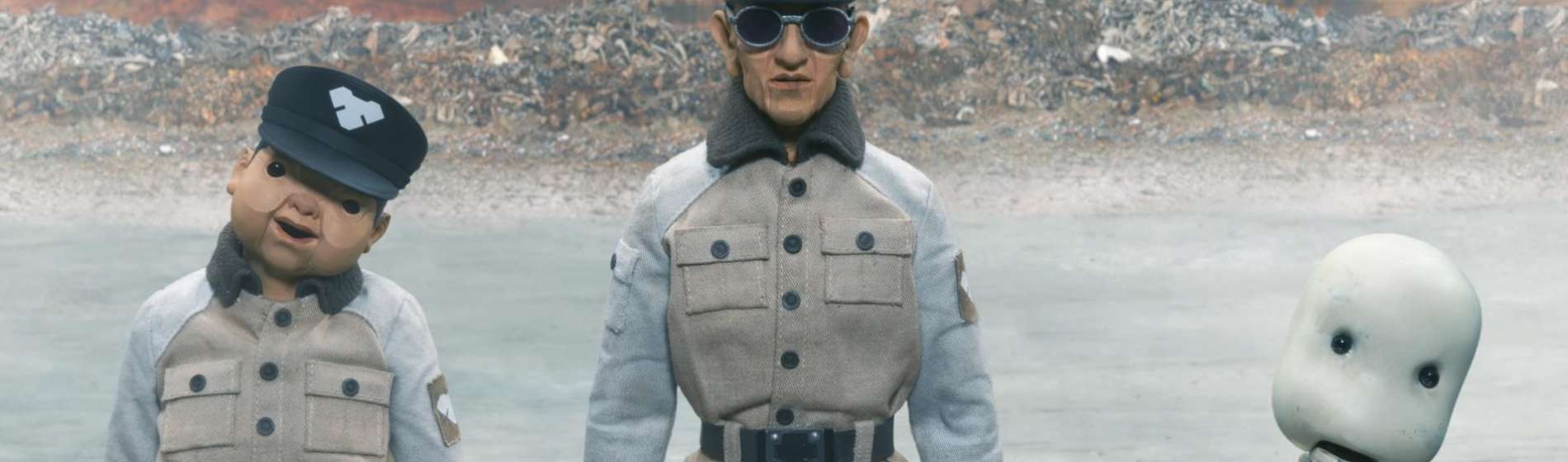
The characters are uniquely bizarre in more than just their appearance. Tris’ ambitions build a wall of armour around her that only Robin can penetrate. This shield is exemplified by her actual armour and the hat that cloaks her expressions. The ambassador and his assistant are in more traditional yet somewhat casual outfits, touting military insignia. However, they both have whiny personalities not conducive to their survival.
Meanwhile, the clones have no eyes — a genetic design intended to subordinate them. Dante wears an unusually equipped visor that complements his tactical uniform. Yet, he’s unexpectedly thoughtful and almost more person-like than Tris. The cult embraces bio-upgrades, so their appearances vary. But their body positive attitude also leads to some very revealing ensembles, akin to S&M gear.
In some ways, this is Robin’s origin story as he will eventually become the protagonist in Junk Head . In spite of being a robot, he experiences a lot of growth in this narrative, which is bittersweet in light of his future. The narrative traces his evolution over space and time, travelling a difficult path to achieve his goals. While the film seems to end without bridging the gap between films, an end credit sequence shows how the robot ends up in the sci-fi nightmare.