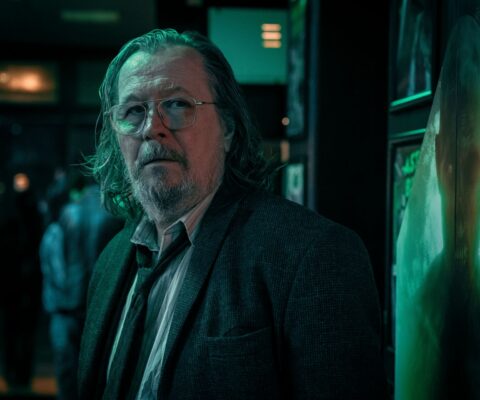
Nicolas Cage has built a career and reputation on unhinged, over-the-top characters. And yet, it’s nothing compared to what he delivers as the titular serial killer in Longlegs .
More unnerving than terrifying, Osgood Perkins (son of Psycho star Anthony Perkins) directs the 1990s-set thriller that oozes Silence of the Lambs . Maika Monroe is Lee Harker, a junior FBI Agent with an uncanny knack for sniffing out complex crimes that have baffled her more senior FBI colleague, Carter (Blair Underwood). With the Oregon bureau perplexed by a series of family murders spanning three decades, Harker joins the fray, easily solving cryptogram messages reminiscent of the Zodiac killer that have been otherwise indecipherable save for the signature, “Longlegs.” As Harker digs deeper into the Longlegs case, she finds she is more intertwined in the story than appears as occult elements in the crimes begin to surface.

Harker is a loner which lends itself to her workaholic ways. Monroe plays her like a tightly wound violin string, unsure if she’s going to break. She’s no Clarice Starling, who was full of agency and bite when faced with Hannibal Lecter. Harker is detached, almost sleepwalking through her daily existence. Unlike Clarice Starling, it is hard to care about the junior FBI Agent since everything we learn about her is directly related to the plot. She seems hardly more than a story device, haunted by familial trauma that simmers just below the surface. The character is a dry and muted counterpoint to the creepily deranged Longlegs.
Cage is physically unrecognizable under prosthetics, looking more like a stringy-haired, white-faced Bette Davis’ in What Ever Happened To Baby Jane? than anything else. If there are any faults with his performance, it is that he comes off as a bit too camp for the low-key, unnerving tone Perkins employs in the rest of his storytelling. He’s a character from another film entirely. Adding a high-pitched voice and a memorable interrogation scene, Cage does a lot in the role despite being barely visible in the film.

While I might hold the opinion that every film would be better with more Nicolas Cage screentime, having Longlegs remain off-screen for most of the story allows for his mystique to build within the ranks of the FBI, adding to the suspense and intrigue of the story. It’s not that the character is hidden from sight – he’s quite known around town as the “gross guy” – which begs the question why the FBI has had such a hard time tracking him down. Surely seasoned agents would interview the local weirdos following so many family massacres. But how exactly he’s involved escapes them. Their case files conclude that Longlegs somehow exerts his will over the fathers of the murdered families, encouraging them to kill their wives and daughters without laying a finger on them himself. It’s a bizarre series of crimes for a bizarre killer that only works with some suspension of disbelief on the part of the audience.
There are some tired genre elements at play in Longlegs that horror aficionados will no doubt recognize, but Perkins, who also wrote the script, manages to successfully recalibrate them into this slow-burning tale, albeit one without much rewatchability. Audiences will see where the story is going long before its characters do, but nevertheless, the climax unfolds in a satisfying way, thanks in part to a surprise performance by Alicia Witt as Harker’s mother.
With muted tones throughout the film interrupted by nightmarish flashes of red, Perkins knows how to squeeze out every inch of tension to build to this claustrophobic climax. Light on jump scares, the movie marks a steady throughline from his excellent 2015 psychological thriller The Blackcoat’s Daughter and 2016’s I Am The Pretty Thing That Lives In The House . Punctuated with effective sound design by Eugenio Battaglia, Longlegs is a film that slowly creeps into your brain, nestling in like a forgotten nightmare.
Longlegs is now playing in theatres everywhere.