

I know it’s only March, but this may just be my favourite movie of the year…so far. Certainly, Project Hail Mary , the latest from directors Phil Lord and Christopher Miller ( 21 Jump Street , The Lego Movie ), is among the funniest and most thrilling movies audiences will see this year, but also one of the most heartfelt.
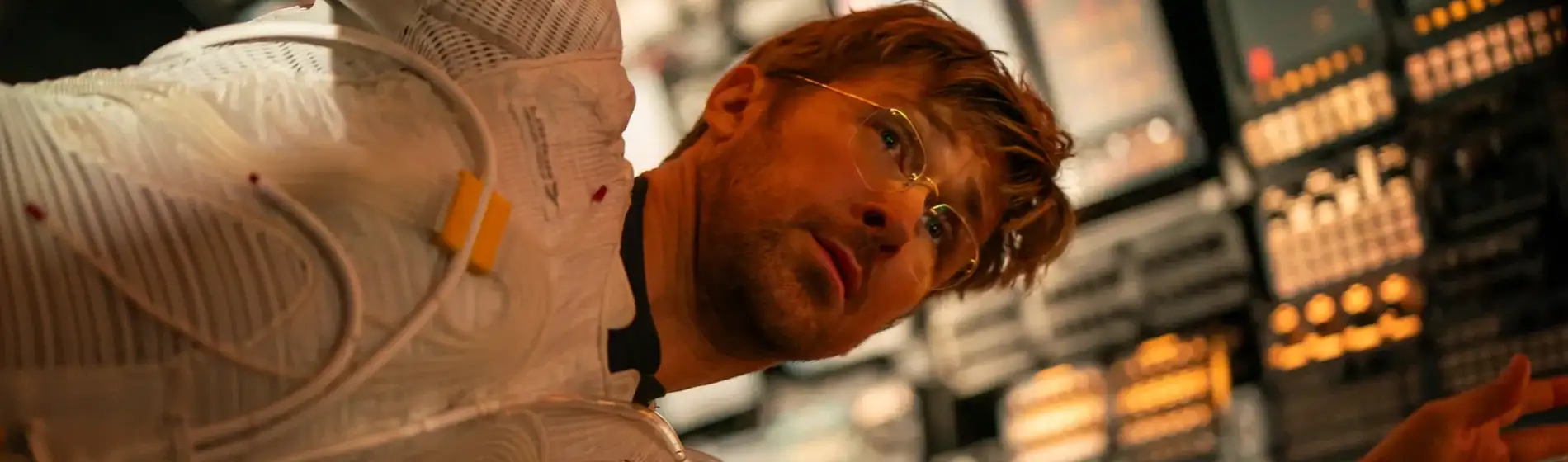
Based on the 2021 novel by Andy Weir, Project Hail Mary tells the story of elementary school science teacher Ryland Grace ( Ryan Gosling ), who wakes up on a spaceship light-years from home with no recollection of who he is or how he got there. As his memory returns, he uncovers his mission: to solve the riddle of why the sun is dying out. He has to call on his scientific knowledge and unorthodox ideas to save everything on Earth from extinction”¦ but an unexpected twist may mean he doesn’t have to do it alone.
The film marks a return to live action for directors Phil Lord and Christopher Miller — their first full-feature effort since 2014’s 22 Jump Street (not counting whatever material they shot for Solo: A Star Wars Story , or their AppleTV+ series The Afterparty ). And the directors show a remarkable level of confidence here, despite a rather limited (live action) filmography. It helps that they’re not afraid to borrow from the best of the best. Project Hail Mary pays tribute to the several space odysseys of the past, with at least one near-direct recreation of a moment from Kubrick’s classic film, and a delightful direct quotation of Spielberg’s Close Encounters of the Third Kind . But the film manages to hold its own with the sci-fi giants that preceded it, too, creating a film that will undoubtedly withstand the test of time. And the duo’s ability to balance comedy with tension and drama is, quite simply, unmatched.
This is, in part, thanks to the truly (inter)stellar cinematography from Grieg Fraser ( Dune , Rogue One ). Once again employing the digital film-out technique he has previously used in The Batman and Dune: Part 2 (the film is shot digitally, but then printed to film and scanned back before final distribution), Fraser and the filmmakers also employ the IMAX imagery in a truly unique way. Unlike films like Oppenheimer or Sinners, where the IMAX frame can sometimes be used seemingly at random, Lord, Miller, and Fraser specifically only use it during present day scenes set in space. All flashback scenes on earth are presented in “scope”, so there is a clear through-line in the visual style. The filmmakers also, apparently, employed different film stocks for both, allowing textures to set apart the earth scenes from the scenes set in space. This use of the IMAX frame as an actual mode of storytelling is brilliant, and it helps to continuously ground the audience in the narrative and understand chronologically where they are in it. It actually “justifies” its use outside of mere aesthetics.
Speaking of aesthetics: The optics here are, quite frankly, some of the most breathtaking images I’ve seen in some time. The 2001: A Space Odyssey comparisons may sound hyperbolic, and yet I think this truly is one of the few films whose visuals can stand alongside that monumental piece of cinema. You owe it to yourself to see it on the biggest screen possible; I was lucky enough to see it in dual-laser IMAX in the full 1.43:1 aspect ratio, and it looked absolutely sensational, though both Fraser and Miller assure me it’s even better in 70mm IMAX.
But the images are only part of the story. It’s not enough to just have pretty pictures; you need a winning story. Thankfully, Andy Weir’s source material provides plenty of that. The novel was adapted by Drew Goddard ( The Cabin in the Woods, Cloverfield ), who had previously adapted Weir’s novel The Martian into the critically-acclaimed film directed by Ridley Scott, and you’d be forgiven for drawing numerous parallels to that previous novel and film. Truth be told, there are quite a few overarching story beats that recur here: namely, the repeated cycle of success undermined by accidental failure. This is not meant as a criticism of the film, merely an observation that the two films are in many ways in conversation with each other, and that this film improves on an already winning formula.
Goddard also recycles the (very clever) conceit of having our protagonist narrate via video logs. This gives the audience not only a direct line into what Grace is thinking at all times, but also provides plenty of opportunities for Gosling to flex his comedic chops. The screenwriter distills the scientific concepts into ones that even those of us who barely passed our high-school science classes can easily understand. He perfectly weaves theory with laugh-out-loud comedy and truly emotional gut punches.
Of course, words can only do so much; you need outstanding performers to bring those words to life. Once again, Gosling ( La La Land , Blade Runner 2049 ) proves himself to be up to the task. From his first moments on screen — metaphorically hatching out of a chrysalis and flopping around on the floor to great comedic effect — you are utterly transfixed by his presence. The audience is going to spend the bulk of the film with this one person, and so they need to have as much charisma, charm, and humour as possible, and it is hard to think of an actor better suited to that than the Canadian. But it’s not all fun and games, and when he has to, Gosling taps into the well of human emotion and elicits fear, shame, and cowardice in a way that is so completely believable and heart-wrenching. It’s a remarkable performance.
And yet the real star of the show is Rocky, the alien life-form that Gosling’s Ryland Grace teams up with in an attempt to save the Earth. Voiced and puppeteered by James Ortiz, this bizarre crab-like creature manages to become an endearing screen presence, and the chemistry between Grace and Rocky is palpable. The latter brings out both laughter and tears on more than one occasion. Lord and Miller’s decision to build Rocky as a physical puppet pays off over and over again, and Gosling and Ortiz play beautifully off of each other in a way that’s simply not possible with a CGI character.
Sandra Hüller ( Anatomy of a Fall , The Zone of Interest ), who plays Eva Stratt, the head of the “Hail Mary” project, also deserves several shout-outs. In a recent press conference, Goddard said he was worried they would never be able to find the right actor to convey the character’s confidence, wisdom, and strength. When Lord and Miller told him they had already cast Hüller, his immediate reaction was, “Oh, well, never mind, then we’ll be fine”. And he’s absolutely correct. There is a quiet certainty that Hüller emits. You completely understand how she could convince these astronauts to embark on a one-way mission to nowhere. She is the steady hand that perfectly counterbalances Gosling’s more comedic performance.
The pacing here is also impressive. Editor Chris Dickens ( Shaun of the Dead , Slumdog Millionaire ) clearly understands when to let the more comedic moments breathe, but he also knows how to keep the epic film moving forward. In fact, Project Hail Mary passes at such a clip that you never notice its sizeable runtime. This absolutely does not feel like a 156-minute film. And that’s also thanks to Daniel Pemberton’s ( Steve Jobs, Spider-Man: Into the Spider-Verse ) score, which captures the grand scale of the film’s mission, while also creating tension and momentum.
Project Hail Mary is an out-of-this-world adventure that will keep you on the edge of your seat, laughing until your sides hurt, and fighting back tears during its many emotional moments. It is a film that acts as a much-needed reminder of how we can overcome our greatest adversities when we work together, and a powerful tribute to the awesome power of science, humanity, community and cooperation. In weaving all of that together so capably, Lord and Miller have given us the exact movie we so desperately need right now.
Project Hail Mary opens in theatres and IMAX on March 20.