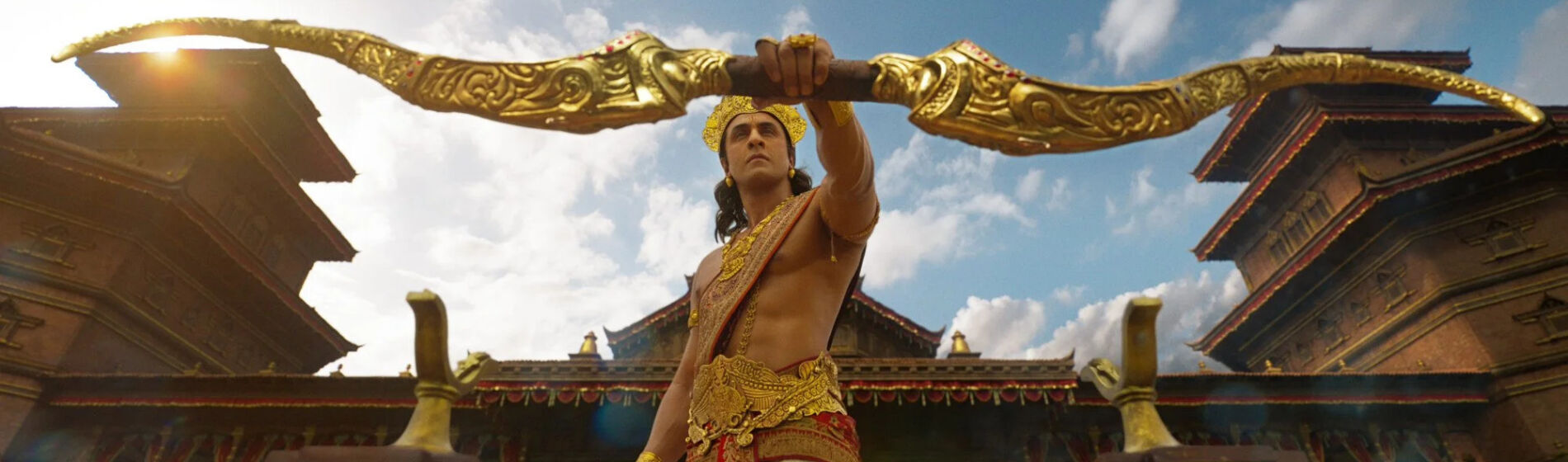



Ramayana: The Rise of a Legend receives the full blockbuster treatment in a visually extravagant adaptation of an ancient Hindu tale that both captivates and overwhelms.
They used to call them epics—grand historical dramas drawn from mythological and biblical sources, a genre Hollywood once mastered with its penchant for cinematic excess. These were monumental productions, complete with massive sets, hundreds of extras, lavish costumes, and larger-than-life storytelling that kept audiences enraptured. They were unapologetically extravagant, and therein lay much of their appeal.
Director Nitesh Tiwari’s Ramayana is a contemporary reimagining of one of India’s most revered ancient narratives, presented in all its fantastical glory, but with an overwhelming abundance of technological wizardry, mostly in the form of CGI. Where the epics of yesteryear relied on the sheer physical scale of their productions to inspire awe, this modern extravaganza turns to digital technology to conjure its extraordinary world.
Not that such reliance on technology distinguishes Ramayana from countless contemporary blockbusters. Computer-generated imagery has become the prevailing language of cinematic spectacle, often replacing the tangible grandeur that once defined the genre. In many respects, Ramayana is the Hindu equivalent of The Ten Commandments—a sweeping, larger-than-life retelling of a sacred narrative, conceived on a monumental scale and designed to inspire wonder and awe.
And spectacle is certainly the operative word here.
The title translates roughly as “The Journey of Rama,” an apt description of the ancient, lengthy Sanskrit epic. That may partly explain why this cinematic adaptation constitutes only the first instalment of a two-part extravaganza. The other reason, of course, is the irresistible lure of the box office.
For audiences unfamiliar with the source material, Ramayana chronicles the journey of Prince Rama (Ranbir Kapoor), an incarnation of the Hindu god Vishnu, whose exile from his kingdom, accompanied by his devoted wife Sita (Sai Pallavi) and brother Lakshman (Ravie Dubey), sets in motion an extraordinary series of events. When the powerful demon king Ravana (Yash) abducts Sita, the conflict escalates into a struggle between good and evil. At its heart, the narrative explores devotion, duty, loyalty, sacrifice, and the moral choices that define humanity, unfolding in a fantastical world populated by gods, demons, warriors, and extraordinary creatures.
Producer Namit Malhotra conceived the two films on a staggering scale, with a reported combined budget of approximately US$500 million. Released internationally to coincide with the Diwali season, Ramayana is an ambitious undertaking that seeks to introduce one of Hinduism’s foundational narratives to a global audience.
Its appeal, however, extends beyond religious and cultural familiarity. For viewers who recognize the spiritual symbolism, the film offers an opportunity to experience a revered narrative through the grandeur of contemporary cinema. For others, it can be enjoyed as an elaborate sword-and-sandal fantasy infused with sorcery, adventure, and mythological intrigue. Both interpretations can comfortably coexist, and therein lies much of the production’s potential mass appeal, particularly among younger audiences drawn to its fantastical imagery.
The performances are generally passable, although frequently bordering on the cartoonish. At times, the actors appear so thoroughly absorbed into their digitally manufactured surroundings that they seem less like flesh-and-blood characters than extensions of the animation itself. The result is a curious disconnect between the emotional weight of the narrative and the artificiality of its presentation.
The costumes, meanwhile, are lavish in the grand Bollywood tradition, often stunning in their elaborate detail, rich textures, and dazzling ornamentation. Yet even here, the film’s overwhelming digital aesthetic raises an amusing question: were some of these magnificent creations actually worn by the actors, or simply added in post-production? Such is the pervasive influence of CGI that distinguishing the tangible from the computer-generated becomes something of a guessing game.
There is no shortage of action, with elaborate confrontations and enormous battle sequences punctuating the narrative. Yet the violence is largely rendered through digital imagery that minimizes actual gore. The action may occasionally frighten, but it rarely feels gratuitous. Conversely, the artificiality is often so pronounced that the danger scarcely seems real, with some encounters bordering on the preposterous. But isn’t that what spectacle has always been about?
The 3D presentation beautifully renders the film’s grand imagery with impressive depth. Elaborate landscapes, monumental architecture, and fantastical environments occasionally achieve a visual splendour that justifies experiencing a production of this magnitude on the largest screen possible. The effects work by DNEG is undeniably ambitious, although the sheer quantity of digitally manufactured imagery can become exhausting. When virtually everything appears possible, even the most extraordinary sights risk losing their capacity to astonish.
Equally noteworthy is the collaboration between acclaimed composers Hans Zimmer and A. R. Rahman, whose powerful score becomes an essential component of the film’s sensory experience. At times, the music threatens to overpower the imagery, yet its notably melodic passages provide an emotional counterpoint to the relentless visual extravagance. It is a soundtrack as ambitious as the production itself, sometimes to magnificent effect, at other times simply too much of a good thing.
To love Ramayana is to surrender to its spell. At times, the film succeeds in casting that spell, but more often than not, its excess becomes a distraction. Go big or go home might well have been the guiding motto of Tiwari, although the sheer ambition of the undertaking seems equally attributable to Malhotra, whose determination to mount a cinematic event worthy of Rama’s legendary stature is evident in virtually every frame.
Ultimately, appreciation of Ramayana may depend as much on an understanding of its significance as a parable and morality tale as on a willingness to embrace the child within—the one who can still be enthralled by impossible adventures, fantastical worlds, and the sheer audacity of cinematic make-believe.
Ramayana is monumental fantasia, at once accessible and excessive, capable of inspiring genuine wonder even as its technological wizardry threatens to overwhelm the very story it seeks to celebrate.
Ramayana: Rise of a Legend is now playing in theatres, including in Hindi with English subtitles and in 3D.