

“They’re all gone.”
The words uttered by sports broadcaster Jim McKay in a 1972 newsflash aren’t new, but they haunt over 50 years later. His report for ABC Sports serves as an historic endnote to a tragic story, as 11 members of the Israeli Olympic team were murdered by the Palestinian terrorist group Black September after being taken captive on September 5 during the ’72 Olympic Games in Munich, Germany. That clip offers a defining moment for live journalism. Everyone who recognizes the line knows how the story ends. And yet, as the riveting newsroom drama September 5 recounts what happened in the ABC Sports newsroom that fateful day, the saga proves extremely suspenseful and timely. September 5 is a period piece that feels as if it unfolds in the present tense.
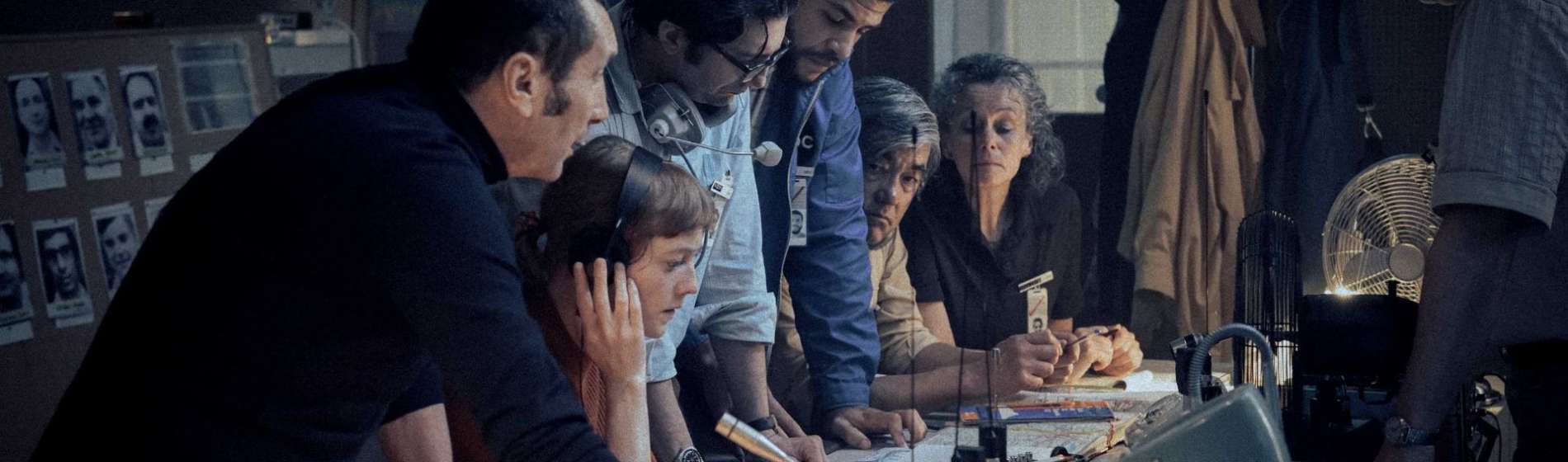
Director/writer Tim Fehlbaum and writers Moritz Binder and Alex David deliver a taut newsroom thriller with September 5. The drama unfolds almost entirely within the tight, brightly lit Munich studio of ABC Sports. These Games are a moment of global significance as Germany hopes to present a positive image to the world. The Olympics serve as a fresh start after the horrors of World War II. 24/7 coverage by teams like the ABC Sports crew lifts spirits worldwide.
It starts like any other day, too, as overly eager junior producer Geoff Mason (Ben Magaro) pitches boxing, soccer, and volleyball to Roone Arledge (Peter Sarsgaard). The President of ABC Sports responds wearily. He wants Geoff to keep ABC’s cameras on American athletes. The world is watching through their feed. He doesn’t want to shift airtime to the Cubans, Danes, or Moroccans unless necessary.
That nationalism amounts to a hill of beans, though, when technical producer Jacques Legard (Zinedine Soualem) and translator Marianne Gebhardt (Leonie Benesch) hear strange noises during a smoke break. They recognize gunshots.
The rest, they say, is history as reports confirm the gunfire. The newswire rattles and intern Gary Slaughter (Daniel Adeosun) reads aloud information that shakes the crew: two athletes are dead and others are captive. The newsroom scrambles and quickly accepts the challenge at hand.
The crew might be sportsfolk, but they’re still journalists. The sports crew defends itself from a hijacking by ABC News, while dealing with real-time decisions that don’t usually arise when covering hockey or volleyball. They pivot and use their skills for hard journalism to ferret information, find sources, and check facts. Intrepid reporter mode kicks in quickly. The crew guides hefty studio cameras outside to observe the housing quarters where the Israeli team is held hostage. Reporter Peter Jennings (Benjamin Walker) gets closer to the action to report from the ground.
One thing becomes alarmingly clear, however, as the day goes on: no other station is airing the story. The Games just continue.
What unfolds in the ABC Sports room, however, proves as intense as a tennis set nearing match point in a gold medal game. But this is what great journalism is all about. September 5 knows that audiences are likely familiar with the story, so it finds great drama in the story behind the story. Word nerds will enjoy the great suspense that arises when Geoff needs to make a major call and word it cautiously. Phrasing rarely inspires one to break such a sweat.
The clock ticks away as the hostages lives hang uncertainly, while the journalists’ increasingly feel the weight of responsibility knowing that everyone is tuning in to ABC and ABC alone for updates. Every decision could splatter blood on their monumental live feed, while sharing resources and feeds with another networks as Germany manages its post-war recovery adds another tidbit of broadcasting history. It’s a drama about the integrity of telling a story—the importance of getting it right, rather than breaking it first. In telling the story of these sportscasters, September 5 observes both a marathon and a sprint. They’re doing the Olympics of live journalism.
Fehlbaum keeps the story propulsive as adrenaline fuels the reporters through the night. Every detail in the production design salutes the analogue days of broadcasting, and the old school technology underscores the significance of the reporting at hand—and the pace at which it happens. In an age of remote reporting, September 5 reminds viewers what the importance of one’s proximity to the story one is tracking. When members of the team go out into the field and provide updates only through payphones, the limits of technology make the effort all the more commendable. As far as newsroom dramas go, September 5 holds its own with Broadcast News and Spotlight.
At the same time, though, something gets lost in the story. It’s apparent that Fehlbaum and company are gymnasts unwilling to risk a nine in search of a perfect ten from the judges. For such an ostensibly urgent movie about Israeli hostages—titled September 5—it’s a relatively apolitical film. The parallel is fairly obvious, but the question of “why” doesn’t arise as clearly as the “who,” “what,” “where,” and “how” do. It engages audiences with questions of semantics as the reporters and producers debate whether to call the Palestinian hostage-takers to be called “guerrillas,” “terrorists,” or simply “Arabs,” and the responsibility that each loaded term brings. For all the emphasis on telling the story, September 5 doesn’t give much airtime to the context for the siege.
“Are you sure you want to bring in the politics?” Geoff asks Roone.
“It’s not about politics. It’s about emotion,” his boss replies.
If September 5 purely wants emotion, though, it delivers it even if it misses the opportunity for a fuller story. This is a heart-pounding thriller with a crackerjack cast performing with note-perfect synergy. Magaro (Past Lives) especially excels as the script finds in Geoff a character with more agency than the actor is usually afforded. He’s something of a surrogate for the audience, the eyes and ears through which one hears bits and pieces of information and weighs the stakes. Benesch, a true breakout in last year’s The Teacher’s Lounge, offers the emotional core of the film with her captivating turn as Marianne, while Sarsgaard and Ben Chaplin (as ABC Sports VP Marvin Bader) are characteristically solid. Every actor in the ensemble, from the small players as the camerapeople and fact-checkers, to those with smaller speaking parts, bring the newsroom collective to life.
The performance that holds it all together though, is McKay himself. The newsman plays himself in archival footage that peppers September 5. The film cuts sparingly to newsreels of the reliable figure updating the audience with his measured anchoring. Similarly, cutaways to the balaclava-clad terrorists offer cautiously but effectively used inserts of the hijackers in action. The editing by Hansjörg Weißbrich is a riveting feat. Like live news, it doesn’t miss a cut or waste a second. But the interplay between fiction and non-fiction images offer not shots of adrenaline, but jolts to remind us that the stakes are real. The brisk “just the facts” approach proves intensely thrilling.