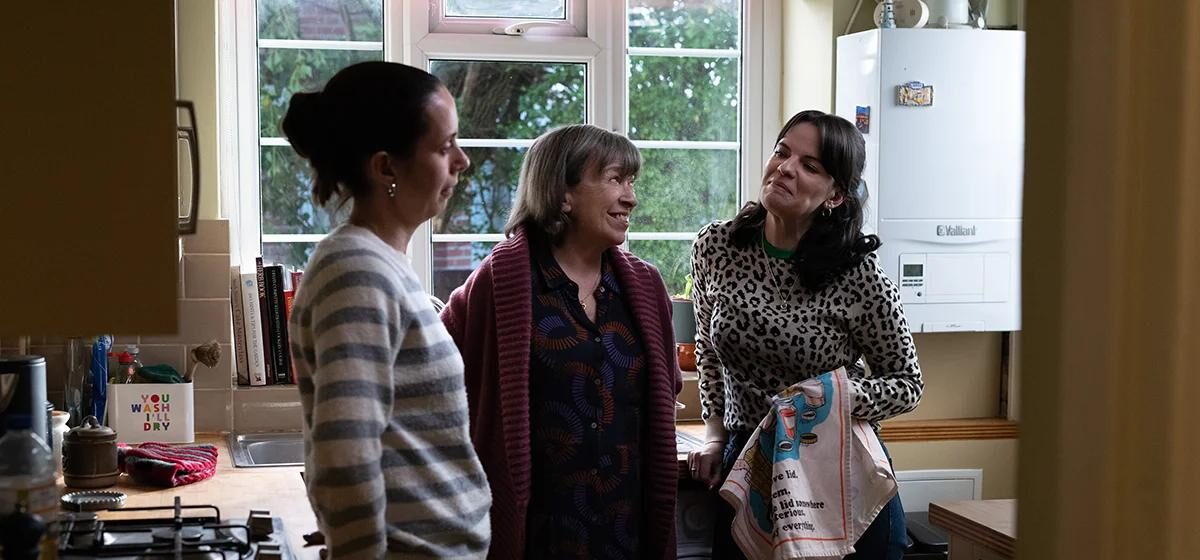



What grabs hold in the best of Mike Leigh’s films is the realness of the dialogue between genuine, working-class characters who feel relatable, even when their lives may bear little resemblance to our own. There is something so familiar about their conversations, their silences and even their awkwardness that makes Leigh’s worlds simply feel real.
The same rings true with his latest, Tender Loving Care—a film at once tender yet raw, and funny yet quietly tearful. It’s a drama about best friends Amy (Kate O’Flynn) and Rosie (Alice Bailey Johnson), two social workers who spend their professional lives caring for people who often have nowhere else to turn. Amy’s elderly parents, Birdie (Marion Bailey) and Geoff (Paul Jesson), round out the central foursome, while Rosie, estranged from her own family, has essentially become part of theirs.
It’s all very ordinary. And in Leigh’s hands, that’s what makes it so affecting and extraordinary.
The performances are wonderfully natural, with nothing ever feeling forced. O’Flynn and Johnson have the comfortable rapport of two people whose friendship existed long before the film started. Bailey and Jesson are equally convincing as a couple who have spent a lifetime together and settled into all the little rhythms, irritations and dependencies that come with it.
Leigh effortlessly balances the humour with the pathos, too. Something funny doesn’t necessarily exist to set up a punchline, just as something sad doesn’t feel designed to make an audience cry. One simply lives alongside the other. That simplicity extends to the film itself. There are no great cinematic flourishes announcing that something important is happening. Leigh observes these people and lets seemingly insignificant moments gradually add up to something weighty.
It’s also where Amy and Rosie’s work as social workers becomes important without taking over the film. They spend their days helping vulnerable people who need somebody. Meanwhile, their own lives increasingly demonstrate just how much everyone needs somebody.
The Fear of Having No One
There’s something particularly affecting in the way Tender Loving Care contrasts the connections of family and those close to us with the loneliness of people who have no one else to rely on. Amy has her parents. Birdie and Geoff have one another. Rosie may be estranged from her own family, but she has found another kind of family through Amy and her parents.
But not everyone they encounter is so fortunate.
That is where the film excels and quietly gets under the skin. The fear of being alone isn’t presented as some grand statement about ageing. It simply exists around these characters. Sometimes it’s sad. Sometimes it’s funny. And sometimes it’s uncomfortable because it feels so recognizably human. Even the title begins to take on greater meaning. Tender loving care isn’t only something Amy and Rosie provide through their work. It’s what these characters give one another, often without making much fuss about it.
Funny, Sad and Never Manipulative
The film is very subtle in how it presents its endgame and the message it wants to deliver. Revealing too much would spoil some of what makes its final stretch so effective. What matters is that Leigh never seems interested in manipulating an audience into feeling something. The emotions accumulate naturally, until conversations and relationships that initially seemed almost mundane carry considerably more weight.
At 83, Leigh has acknowledged that Tender Loving Care will very likely be his final film, as myositis has made the physical demands of filmmaking increasingly difficult. If this is indeed his swan song, there is something especially fitting about a filmmaker who has spent decades observing ordinary people ending his career with a story about ageing, relationships and loneliness.
And he does it with breadth and sensitivity, all without the atmosphere becoming maudlin.
Tender Loving Care is ultimately about connection: the family we are born into, the family we create and the people who happen to be there when we need someone most. Its characters aren’t extraordinary people overcoming extraordinary circumstances. They are simply people getting older, caring for one another, laughing, hurting and carrying on.
For all its sadness, Tender Loving Care leaves behind something surprisingly comforting. The fear of being alone may be very real, but so is the difference one person can make simply by being there.