

Despite what you might have heard, Quentin Tarantino and David Fincher’s first collaboration as screenwriter and director, respectively, The Further Mis-Adventures of Cliff Booth, isn’t “wildly entertaining,” “an absolute triumph,” or even “one of this year’s best films.” At best, it’s mildly diverting, sporadically engaging, and passably watchable. Simply put, it’s a mid-tier effort by one Oscar-winning filmmaker, Tarantino (Inglourious Basterds, Pulp Fiction), in self-parody mode, and another Oscar-nominated filmmaker, Fincher (Zodiac, Se7en), in journeyman mode.
The Further Mis-Adventures of Cliff Booth opens in the summer of 1977, eight years after Booth (Brad Pitt, in an Oscar-winning turn) and Rick Dalton (Leonardo DiCaprio) inadvertently saved Sharon Tate (Margot Robbie) and company from the murderous Manson family. Booth and Dalton became national heroes, but their fame, like most fame, didn’t last. Dalton didn’t become an A-list movie star, and Booth, Dalton’s regular stuntman, driver, and professional friend, all but retired from the movie business.
Unfolding as a series of loosely connected vignettes better suited to episodic TV or a premium-level cable series, The Further Mis-Adventures of Cliff Booth follows the titular character across the better part of a week and in and around Hollywood, the epicentre of the movie business. Every time Booth or another character travels to another location, up pops an onscreen explainer noting the proximity – or lack thereof — of the destination to Hollywood. Like so much else in The Further Mis-Adventures of Cliff Booth, the location joke quickly outstays its welcome, but obviously Fincher, following Tarantino’s haphazardly constructed screenplay, felt otherwise.
When we first meet Cliff, though, he’s wrapping up projectionist duties at the New Beverly Cinema (Tarantino owns the current real-life theatre). As a late-stage Blaxploitation flick plays onscreen, Cliff mouths the words, all except, we assume, Tarantino’s favourite word in the English language. You know the one. Cliff, though, isn’t just a projectionist. He’s also, among other things, a bartender at a local tiki bar, and for a not inconsiderable fee, an all-around fixer for an old-school Hollywood director who badly misjudged a young man’s interest, allowed him into his home in the Hollywood Hills, and “lost” several priceless mementos, including an Academy Award for Best Director.
Said young man, Joey (Corey Fogelmanis), isn’t alone. He’s brought his pimp and/or muscle (Karren Karagulian), who Cliff derisively dubs “Chicken Hawk.” When negotiations for the director’s mementos go wrong, Cliff doesn’t hesitate to use lethal force, a reminder of Cliff’s actions in the last film and his service in the Pacific Theatre during World War II several decades earlier. Playing Good Samaritan, Cliff sends a suitably contrite, not to mention frightened, Joey back home to the Midwest on a one-way bus fare.
It’s not the first, nor the last scene punctuated by Tarantino-style ultra-violence. Another seemingly disconnected subplot follows Filipino brothers Eddie (Matt Groove) and Fernando Verdusco (JB Tadena) on a mission of payback for their gangster uncle, Bobby (Ariel Felix), back home in the Philippines. They’re ruthless, cutthroat killers, utterly irredeemable and, thus, perfectly poised to serve as deadly antagonists for Cliff when their paths inevitably cross in the predictably violent third act. Until then, they’re cast adrift in LA, threatening to derail one Hollywood star’s future in the land of the living, gruesomely kneecapping a tangentially related character, and awaiting their casting call for the film’s finale.
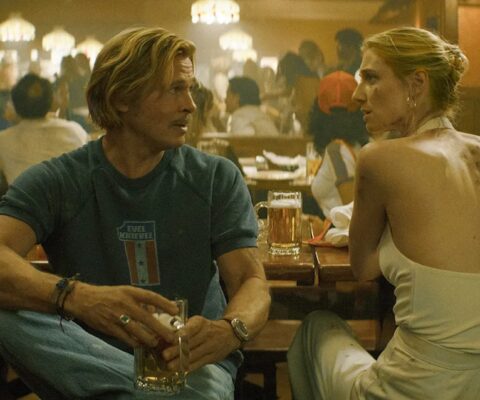
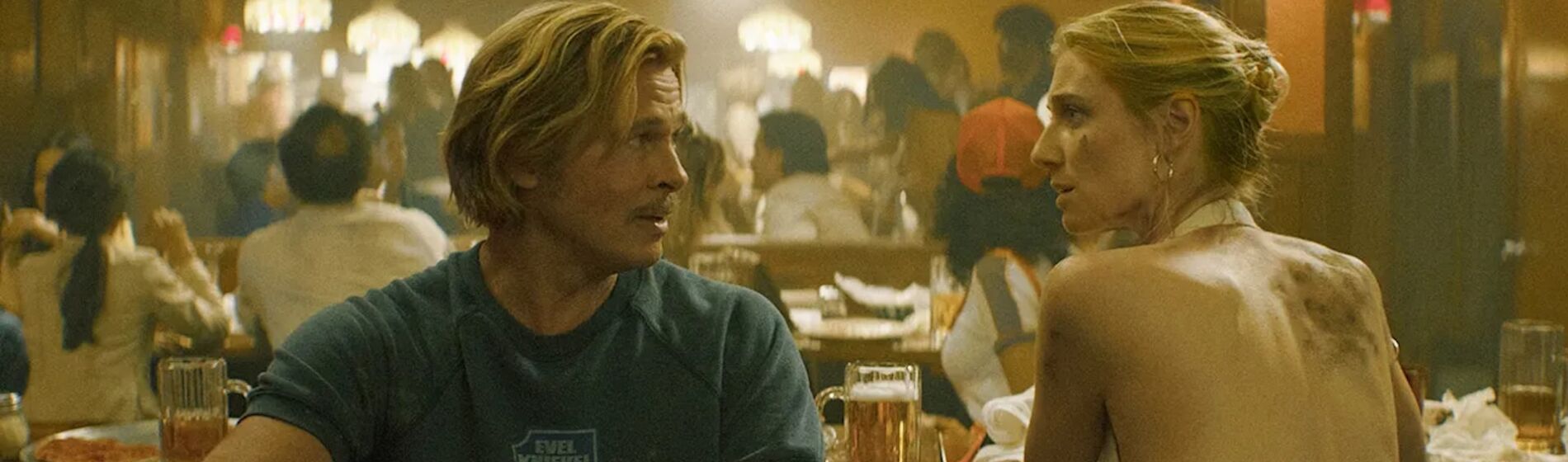
By far the longest, most substantial storyline involves Charlie Peters (Scott Caan), like Dalton, a one-time star of TV Westerns and war dramas, Peters’ wife and Cliff’s ex-lover, Toni (Carla Gugino), a semi-retired actress, and Karen Crosby (Elizabeth Debicki), Peters’ talent agent and subsequently, Cliff’s romantic interest. A flattered Cliff accepts Peters’ invitation for lunch and later, tennis at the local country club, eventually learning the “why” behind Peters’ sudden interest: Peters has a problem that only Cliff and his talent for extra-legal negotiation and lethal force can resolve in Peters’ favour.
Between languidly developed scenes of Cliff indifferently romancing a dubious, if curious, Karen and of Cliff and Peters shooting the proverbial sh*te off-set, Tarantino and Fincher pause the film to include Cliff’s modestly humorous interactions with his curmudgeonly father, Gus (Peter Weller). At his age, Gus should be comfortably retired, enjoying his final years in a beachside community, but he either lacks the necessary resources (he owns and operates a pawn shop) or prefers his son’s company. Gus, it seems, fills a Rick Dalton-sized hole in Cliff’s life. Despite his macho posturing and occasional lethality, Cliff is nothing if not a caregiver at heart.
Not surprisingly, given Tarantino’s involvement and his preference for digressive storytelling, some plot strands go nowhere, others end abruptly, and others never get resolved. Instead of building organically to a climax, pulling key characters and their respective subplots into a coherent conclusion, The Further Mis-Adventures of Cliff Booth ends on a perplexing, fantastical note, suggesting Tarantino and Fincher want nothing more than to bring Cliff Booth back for another series of mis-adventures. They should, like Cliff, quit while they’re behind.
The Further Mis-Adventures of Cliff Booth opens theatrically on Wednesday, November 25, and streams on Netflix for a two-week engagement, beginning December 23.