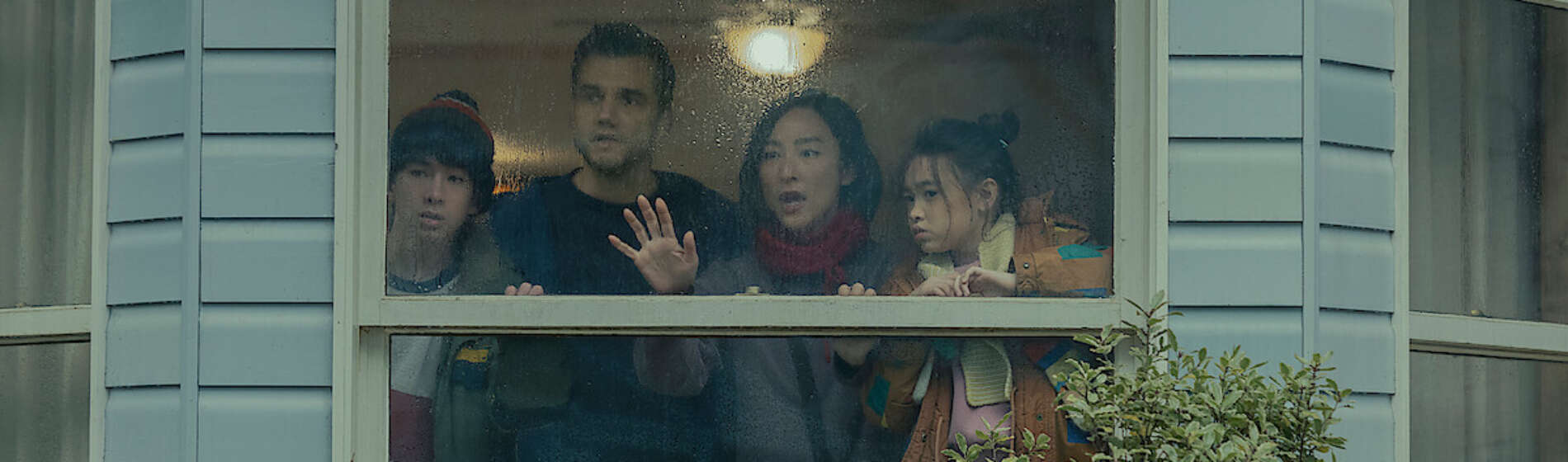


Ever since the pandemic, studios have been churning out dozens of movies in a new horror subgenre where people find themselves indefinitely stuck in their homes. These movies – often referred to as ‘Covid-coded’ – can get old real fast. After all, there’s only so much that can be done in a single location and with such a simple premise.
Yet, that hasn’t stopped Netflix from trying (for the second time) to add something new to the already overdone idea. Their latest lockdown-adjacent movie mushes together the classic, schlock-infused monster flick with a post-apocalyptic family drama. But does it work? And the answer is, sort of.
The Last House brings us husband Jason Delgado (Wagner Moura, Narcos, The Secret Agent ), wife Riley (Greta Lee, Tron: Ares, Russian Doll ), and their two children, Graham (Noah Alexander Sosnowski and Gabriel Barbosa) and Ruth (Riley Chung, Emma Ho, and Arden Cho), as they attempt to survive being inexplicably sealed inside their house with no way out.
The first few days and weeks of their forced stay-cation bring about strangely blissful moments amidst the chaos. The family dances to a scratched-up The Cure vinyl and watches Annie on DVD – joy-filled, long forgotten pastimes in a busy world where young people are constantly glued to their iPads. Christmas arrives, and the four craft a makeshift tree from household junk and eat improvised holiday cookies. The film’s consistency is sacrificed for those joyous bits. The mood fluctuates erratically when such comforting moments shove the family’s looming struggles to the wayside. Viewers are acutely aware that their fear should never really dissipate, as the threat of death is ever-present.
Starvation. Dehydration. Boredom. These are the biggest killers for a captive human in long-term survival mode. Here, the tension gets pleasantly tight while the Delgado family scrambles to consume enough food, collect enough water, and fulfill their mental and emotional needs. Their issues aren’t confined to their humble abode, though. On the outside is a mysterious monster who lurks on the rainiest of nights, scratching their foggy windows and erratically wiggling the door handles with its many limbs. It seems the age-old adage of home sweet home doesn’t quite account for apocalyptic quarantine.
Wedged in the action-packed thick of the plot are the movie’s themes. The first is more obvious. Jason is a tireless blue-collar worker; a traditional family man. He is hell-bent on ensuring his family’s safety no matter the mental or physical toll it takes on him. He prefers to huddle and hide away in their home, and believes it’s better to be together in their small, cramped space than it would be to fight for a way into the vast and newly frightening outer world.
Riley, his wife, is also determined to protect their children, but believes that seeking freedom is worth the risks. Their children – who are robbed of any sort of normal adolescence – cope with their dire situation in their own ways. Graham becomes justifiably sullen, ornery, and pessimistic, while the maturing Ruth holds on tightly to her childlike sense of imagination and wonder. These character developments garner some sympathy for the protagonists, but they aren’t particularly profound or revolutionary. It’s almost like a sanitized, optimistic version of what would really happen to the human spirit in ceaseless, caged isolation.
The second, arguably stronger, message within The Last House is about humankind’s abuse of the natural world. Throughout the run time, this sentiment comes through in more subtle ways. That’s when it works best and fosters nuance. In the concluding scene, though, that nuance is squandered thanks to explicitness and a preachy voice-over. To exacerbate those issues are the many plot holes. There are quite a few instances that make little sense. A handful of moments leave loose ends, and too much mystery clouds the mentioned compelling themes.
It’s unfortunate that a movie with such a great cast and concept – a concept which naturally has strong, pertinent philosophical undercurrents – falls so flat. Glaring flaws turn what could have been a serious psychological horror about familial duty, human limits, environmental colonization, etc., into an overly sappy, horror-adjacent family drama.
It’s understandable why Netflix wouldn’t release a properly dark, disturbing tale of human internment. Such a tale would easily overwhelm and alienate a large chunk of viewers. Yet, it’s exactly what The Last House needed to be. With its unfulfilled potential, The Last House is just another movie that will enter the vast graveyard of could-have-been-greats.
The Last House is currently available on Netflix.