

Originally published under his Richard Bachman pseudonym, Stephen King’s 1982 dystopian thriller, The Running Man, depicted a totalitarian hellscape set in a far-flung future (2025). Ruthlessly repressed by a media-controlling oligarchic cabal that keeps the lower classes pacified, narcotized, and anesthetized through televised slaughter games, King’s all-too-plausible future feels uncomfortably close — maybe too close for surface-deep entertainment seekers — to present-day reality south of the U.S.-Canadian border.
A loose adaptation (operative word being “loose”) tailored to Arnold Schwarzenegger’s particular strengths as a performer arrived in multiplexes five years later to an indifferent response from critics and audiences. Schwarzenegger’s hyperbolic presence, action-star success, and ubiquitous presence on basic cable, though, kept the 1987 adaptation from disappearing into the cinematic ether. The Paul Michael Glaser-directed adaptation kept the novel’s premise intact. Still, it changed practically everything else, including a finale that swapped the novel’s bleak, nihilistic climax for an upbeat, optimistic one aligned with Schwarzenegger’s superheroic persona of the time.
Rumours of a more faithful adaptation of the source material drifted in and out of Internet chat rooms and social media over the next four decades. It took filmmaker Edgar Wright’s (Baby Driver, The Cornetto Trilogy) obsessive, decade-long quest with King’s novel to give audiences, casual fans and Constant Readers alike, a fresher, more reverential take, closer in terms of themes, ideas, and tones to King’s prescient thriller, they rightly deserved.
And that’s exactly what Wright delivers with his smartly attuned, if deliberately unsubtle, adaptation. He brings us a near-future/alternate present where economic and political collapse has turned the social contract inside out, leading to a two-tiered society—the haves-everything and the haves-nothing. The undifferentiated masses are kept from revolt and rebellion through televised games of desperation, humiliation, and death—with the last central to the titular “Running Man,” where three contestants enter a monthly game with a $1,000,000 prize if they avoid dying onscreen for thirty days. So far, no one has lasted past the 29th day.
Using both the original novel’s publication date and the 1987 adaptation, Wright and his collaborators, especially production designer Marcus Rowland and cinematographer Chung Chung-hoon, imagine a brutalist, retro-future extrapolated from Reagan-Era America into an alternate present. Portable computers and smartphones don’t appear in the world of The Running Man, but flatscreens and CRTs do. Recording technology hasn’t advanced past videotapes, but floating, orb-like cameras capture every action, reaction, and inaction of the contestants once they start their runs.
For the contestants, The Running Man game may equal an all-but-certain death sentence. But for their families and heirs, it’s a potential means of escaping grinding, oppressive poverty and a hopeless future. The longer they survive, the more their families earn. Still, with the odds of surviving nonexistent, only the most desperate, reckless, or suicidal will volunteer to have their “runs” broadcast into the televisions of non-paying audiences.
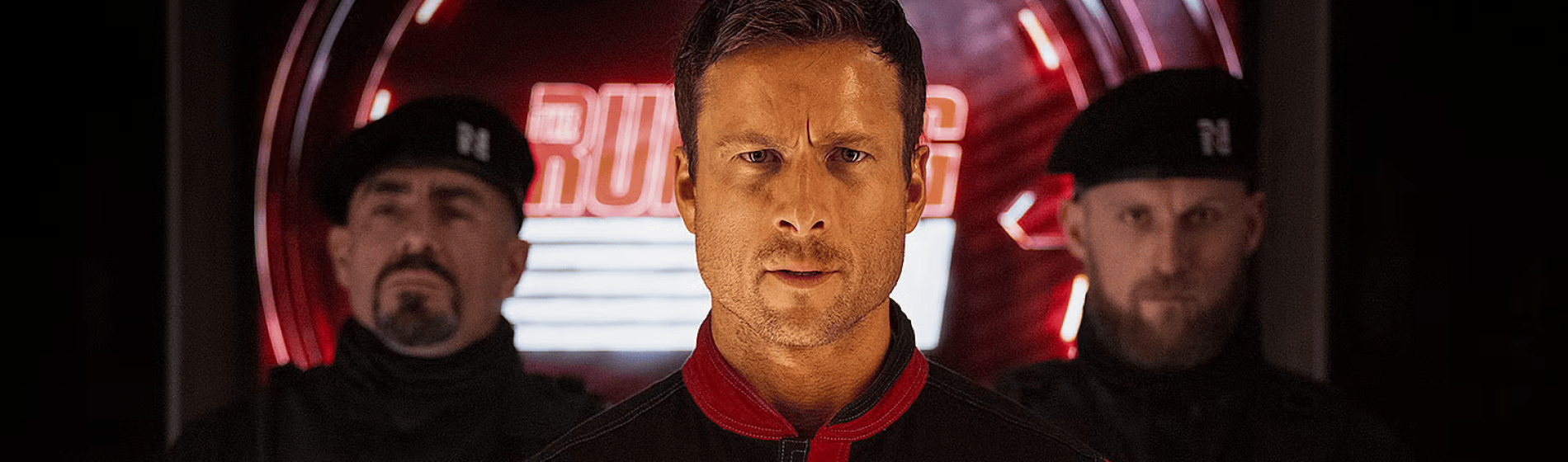
That includes Ben Richards (Glen Powell), a not-quite-everyman, anti-authoritarian rebel without a cause, and an oppositional moral code who, despite promises to his wife, Sheila (Jayme Lawson), volunteers to become a contestant on The Running Man, a decision that network CEO Dan Killian (Josh Brolin) sees as a win-win for him and the Powers-That-Be. By turns channelling audience interest in the Richards as hero and villain, Killian expects a long-running ratings bonanza. Richards’ wife and daughter will escape poverty, and Richards will die spectacularly onscreen, leaving audiences fully satiated. Whatever revolutionary impulses audiences harbour will be fully suppressed, at least until the next edition of The Running Man.
In choosing to closely adapt King’s novel, Wright and co-writer Michael Becall retain both the 30-day runtime for the show and the novel’s episodic nature. While a net positive on paper, extended runtime for the contest often works against the premise: Richards runs when needed, but more often than not, he’s hiding, sometimes in a posh hotel, sometimes in a rundown one, sometimes on a frieght train, all while the inherent tension of men and women being hunted for televised sport slowly dissipates across The Running Man’s two-plus hour running time.
In both the novel and Wright’s adaptation, civilians can earn cash prizes by spotting and reporting the contestants, making survival even more challenging. With that added detail, it strains credulity that Richards survives at all once the hunt officially begins. Given the combination of extreme poverty and scarce cash, reporting Richards becomes a near given. Yet, King and Wright posit that helpers pop in and out of the story to save Richards when he needs it most—a positive, overly optimistic view of human nature that is difficult to accept in a world as brutally divided as The Running Man.
Along the way to the far-off finish line, Richards crosses paths with potential allies, including an African-American family with pro-revolutionary views, a sometime journalist, a borderline suicidal bombmaker, Elton (Michael Cera), and a stray upper-class driver, Amelia Williams (Emilia Jones). Richards somehow convinces them all to support him and the new, pro-revolutionary cause (“Richards Lives!”) that’s turned him into its symbolic leader.
Where The Running Man really stumbles, though, isn’t in the pacing or the odd, credulity-stretching plot point, but in a finale that, like the 1987 adaptation, sets aside King’s consciously provocative, ambiguous ending for a slicker, audience-friendly, cheer-worthy one. The final moments embody the idea of revolution through a singular heroic act rather than mass movements or protests.
While The Running Man doesn’t qualify as a failure (far from it), it’s closer to a misfire than a success. Individual elements, including Wright’s nimble direction, retro-futuristic production design, and Glen Powell’s personification of a rage-filled anti-hero-turned-hero, make Wright’s adaptation a worthwhile, if ultimately frustrating, experience on the big or small screen.
The Running Man opens nationwide on November 14, via Paramount Pictures.