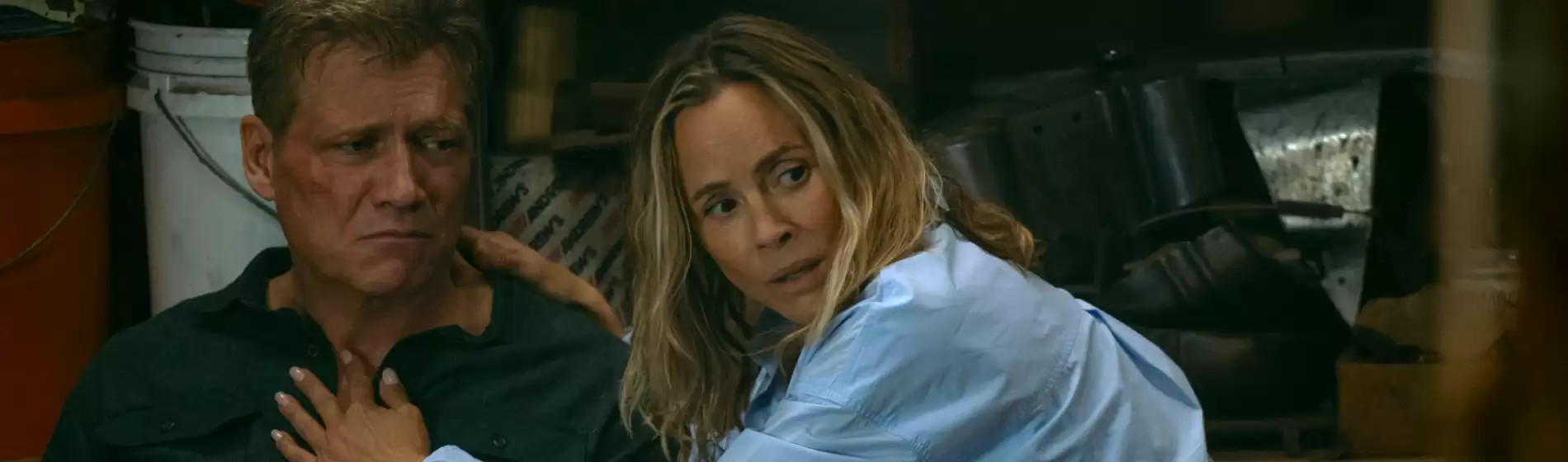


If The Waterfront , Netflix’s sexy new crime thriller series, is guilty of something, that charge is being a “meh” project inside a genre that regularly churns out the cream of the crop.
If it has a saving grace, it’s the cast.
Whoever decided to grant Holt McCallany more work after the unceremonious end of Mindhunter and after his much-lauded turn in The Iron Claw deserves a raise. After that, give a raise to whoever thought of Melissa Benoist ( Supergirl ) for the wealthy family’s black sheep role.
The cast — McCallany, Benoist, Jake Weary ( It Follows ) Maria Bello (Coyote Ugly ), Rafael L. Silva (9-1-1: Lonestar ), and Topher Grace ( That ’70s Show , Spider-Man 3 ) to name a few — can act circles around the material they’re given here. It’s not exactly cereberal, or truly curious, not compared to other legendary crime series, like Ozark .
But it’s not hard to see why they were attracted to The Waterfront , either. Dysfunctional family dramas ( Succession , Yellowstone ) on big streamers typically result in dollar signs. Unfortunately, the market is so saturated that a new show’s really needs to assert itself among deeper options in the streaming queue.
The best The Waterfront can hope for is sitting snugly next to and a little behind its deeper unofficial sister series Bloodline .

It’s only around the fifth episode mark of an eight-episode season that The Waterfront really gets going. The first four episodes laboriously explain the history of the Buckleys, the family at the core of the series, and their darkest secrets. The episodes preciously build the North Carolina world that is The Waterfront.
Narratively, the characters run in place until the plot needs them. This doesn’t quite result in deus ex machina , but more like long-lost so-and-so ex machina .
The biggest problem, however, is we (literate TV audiences) don’t need this amount of backstory. We know the ins and the outs of this streamer’s take on crime drama: Scenic setting, typically southern; strong patriarch, equally strong matriarch; a score made up of modern beer commercial Southern Rock; Adult children struggling in the shadow of self-centered parents’ sins, etc. Shows like The Waterfront need to give us the basics, and then get going.
In this case — like in the majority of these shows’ cases — the parents’ sins are tied to drugs. This time, it’s heroin (but it really doesn’t matter). The Buckleys are intertwined with the town’s history. They are like the Murdaughs, the South Carolina dynasty with a storied history of fraud, embezzlement, drug running, and violent crimes.
Long ago, the Buckleys struggled to make ends meet (or, at the very least, to keep up the quality of life to which they’d grown accustomed) above board, so they decided to descend into the locale’s drug underbelly, revitalize it with their money and reach, and become criminal, generational fixtures.
Holt McCallany, who plays the Buckley family patriarch, Harlan, is the same here as he is in the aforementioned projects The Iron Claw and Mindhunter . He is gruff, and tough, and capable of a glare so stern it makes talking seem redundant.
Jake Weary plays his all-American, Joshua Jackson-looking son Cane. He feels boxed in by his parents’ expectations, his deepening involvement in the family’s worsening crimes, and loooove. His high school sweetheart, Jenna (Humberly Gonazález), re-enters his life, and makes his wife Peyton (Danielle Campbell) feel Shakespearean levels of jealousy.
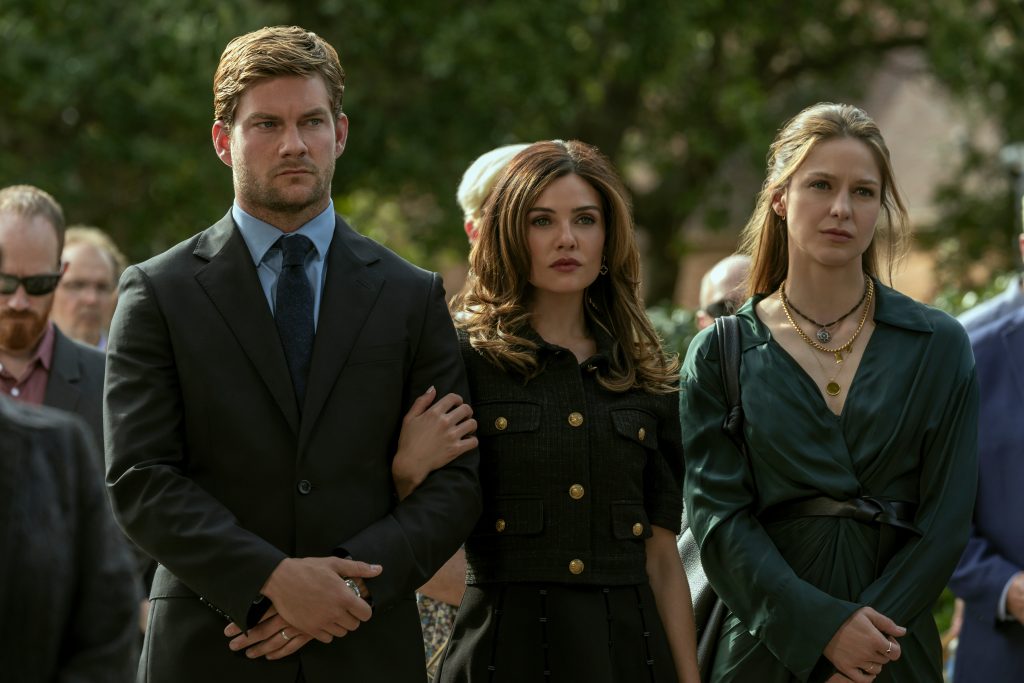
Meanwhile, Benoist makes the most of her decently melodramatic character, Bree, and her past. She’s a distracted, disappointing mother (she named her son “Diller”), a distant sister, a flirty and flaky romantic interest, an alcoholic, and, it turns out, one of the only Buckleys whose emotional range extends beyond lust and anger.
Bree isn’t wrapped up in criminal thoughts outside of those that serve her personally. She pursues her life actively. The rest of the family only thinks about power, and therefore drugs, and shipping, and more drugs, and shipping, and boats, and drugs, and shipping.
After a while it all feels like word salad, meant to amount to the idea these people are doing a lot of bad things for generally noble — or at least understandable — reasons. Benoist, at her best, pushes through all of that and grounds us in more relatable relationship drama.
Cue the Dawson’s Creek theme song.
Waterfront creator Kevin Williamson, whose claims to fame include Scream and Dawson’s Creek , takes what he learned from those series, wrings out all the excess, and packs in the most beige traits of centrist streaming juggernauts like Yellowstone with subtle nods to the current political and social atmosphere in the United States.
Williamson’s writing is (or was) famous for wry and self-aware genre observation. The Waterfront could have achieved that, but instead of firmly establishing well-tread TV archetypes and then satirizing them à la Scream , he seems content to mine pretty much what you’d expect (honour, lies, family, adultery) and go no further. There is also a notable lack of shock at death in this series, reminiscent of characters’ reactions in horror. People see a head explode, scream, and then they’re sipping an iced coffee in the next scene. It’s not quite that extreme in The Waterfront , but moments treated as life-changing in one episode serve as minor of memories the next.
Decide: Do deaths serve as comedic punchlines, or do they present opportunities to create dutiful, multi-episode explorations of morality and guilt?
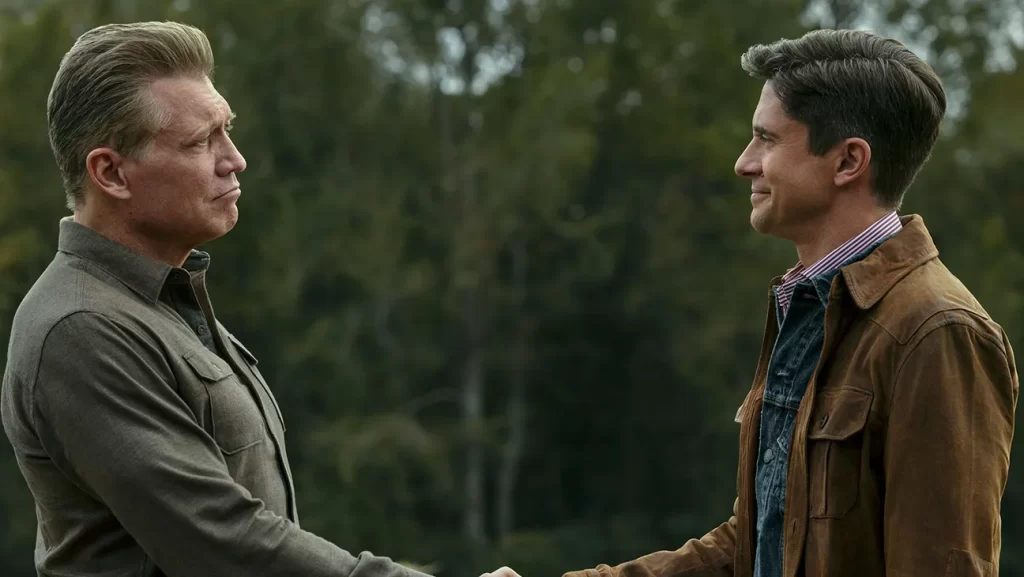
Thankfully, Topher Grace saves this series from being more than a future trivia question and gets a character who is the closest that The Waterfront gets to the old Kevin Williamson.
Grace plays against type as the season’s main villain, or frenemy, Grady. He’s quick-witted and smarmy, like Grace’s Eric Forman on That ’70s Show , but he’s angrier, unmoored, and unpredictable. He’s like a real world Joker .
Even when provided with the most hackneyed scene-sized metaphor to personify (Harlan teaches Grady how to hunt birds, and provides advice on how exactly to work the gun and take down the target…), Grace carries it well. He embodies this modern technocratic kind of male confidence perfect for foiling McCallany’s old-fashioned swagger and gusto. In fact, he makes that all seem kind of silly. The man is now middle-aged and, against, McCallany, still comes off precocious in a way that really works here.
Unfortunately, Grace doesn’t show up until halfway into the season. It is no surprise that his appearance is when the show picks up. It’s also doubtful that the majority of the half-interested prospective viewers will stick with The Waterfront long enough to see it reach its true potential. That’s too bad, but it is the logical response to such a structure.
What matters in The Waterfront is if you’re willing to kill. Grady is, and without hesitation, as long as it means that his business remains safe, or grows.
There’s always a bigger fish. Sometimes they just don’t appear that way. The Waterfront is all about appearances, and with a few exceptions, what you see is what you get.
The Waterfront season one is now streaming on Netflix.