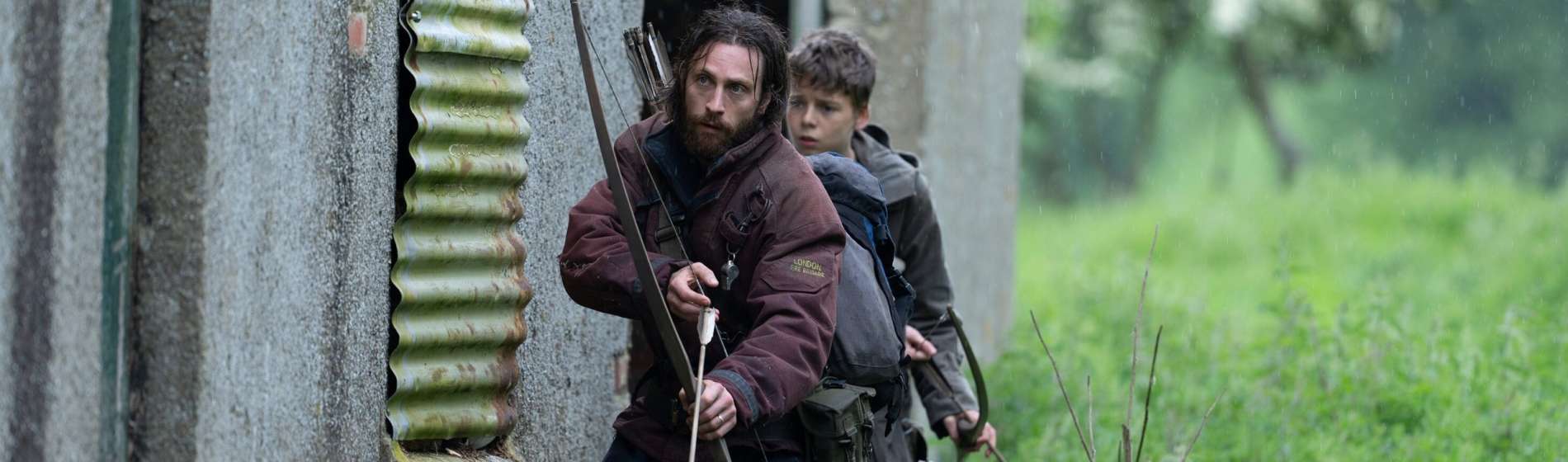


Just like any worthwhile zombie, this franchise is born to survive. With their latest offering, 28 Years Later, Oscar winner Danny Boyle and co-writer Alex Garland reinvent the zombie genre once more and manage to revitalize a 22-year-old franchise.
Like 28 Weeks Later was to 28 Days Later , the story isn’t a direct continuation of the familiar characters and plot. Set in the same world as the first two films, Great Britain remains under quarantine while life as usual has continued abroad. Those infected with the rage virus roam the main island, and any uninfected survivors have been abandoned by the world at large and left to fend for themselves. Less interested in the suppression of those infected, this latest instalment is more interested in the impact on the remaining human population. Small enclaves of survivors have popped up, including one on a small Scottish island connected to the Scottish mainland by a causeway only accessible at low tide. Here, free of electricity, modern technology, and running water, the supportive community works together in a way that almost seems blissful, save for the infrequent run to the mainland to scrounge for supplies.
After a chaotic opening sequence, 28 Years Later begins to reveal itself to be part family drama, part coming-of-age story. At age 12, Spike (Alfie Williams) is about to make his first trip to the across the causeway with dad Jamie (Aaron Taylor-Johnson) to bag his first infected kill. His trip off the island proves to be an eye-opener as he discovers new wonders and horrors, and perhaps the key to his mother Isla’s (Jodie Comer) deteriorating mental state.
For a visceral and often gory and bleak horror saga, 28 Years Later is surprisingly earnest and sweet. No doubt the film’s true arc will surprise many. As the first films dealt with anxieties over terrorism and external threats, this film unsurprisingly plays upon our fears in a post-BREXIT and -COVID world. The survivors have been cut off from the world they were once a functioning part of. They are now “the other”, the ones unlucky enough to still be living in the U.K. All of this is wrapped into one family’s domestic struggle. Deeply emotional, Spike’s bond with his mother is endearing, but Boyle and Garland never let it reach truly saccharine saturation. This is, after all, a horror movie.
Making his appearance two-thirds of the way into the film, Ralph Fiennes delivers a gonzo character that is heartbreaking and human. Fiennes and Williams are dynamite together, bonded by trauma and the deep desire for human connection. Young Williams is a star in the making, never feeling out of his depth against acting heavyweights or gory set pieces. He’s able to keep the intensity and thrill ratcheted up throughout his screen-time, communicating what it’s like to be born into a world full of rage, trauma, isolation, and fear, but also humanity. He is born into survival with the instincts of the generation before him bred into his very being, even if he can’t understand the true losses his elders have endured.
Zombie movies don’t often focus on motherhood, or indeed elevate the bond and love between a boy and his mother. Comer plays Isla with exhaustion, confusion, and a tenderness towards Williams that is remarkable. Emotionally raw and intense, Spike is a boy who wants to be brave for his mother—a mother whose brokenness is far more terrifying than the infected.
Feeling more of a reboot than a return to a franchise, the infected have also changed since their last big-screen appearance. They are no longer just the super-fast runners audiences will be familiar with, but have evolved into an Alpha version, with superior strength, speed, and intelligence, making them harder to kill. With these new super threats, the rules of survival have changed from the first film, adding new complex layers to the story. At times the story does feel unevenly paced as it swings between melodrama and horror, but it doesn’t really detract from the overall success of the piece.
Beautifully shot with wide scenes of the island and overgrown countryside, Boyle and cinematographer Anthony Dod Mantle mix beauty with the horror, setting the infected loose among wildflowers. There are subtle and brilliant transitions between chaotic handheld camera movements and eerie stillness that perfectly encapsulate the darkness that humans must not only endure, but are capable of inflicting. In this world, danger is ever-present, whether the emotional or the bitten-by-a-zombie kind.
There is enough here to quench horror seekers’ thirst, even though the payoff may not be what fans of the first two films expect. All told, Boyle and Garland have delivered another home run.
28 Years Later opens in theatres on June 20.