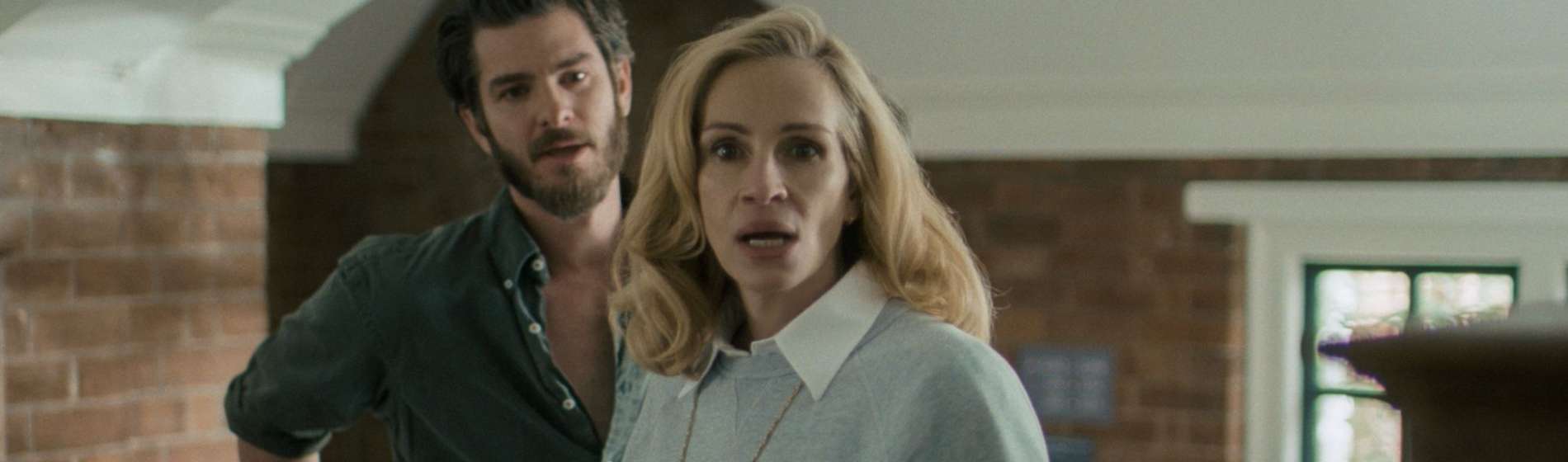


“There’s an inherent excitement when you see a movie that you think is going to be one thing and you realize it’s more than the sum of its parts,” After the Hunt star Julia Roberts tells That Shelf . Roberts, speaking at the New York Film Festival in September, embraces the passionate conversations that her twisty thriller generates. Roberts stars as Alma, a Yale philosophy professor who gets caught in the culture wars crosshairs when her student Maggie (Ayo Edebiri) accuses another faculty member, Hank (Andrew Garfield), of sexual assault. ( Read That Shelf ’s review of After the Hunt here .)
After the Hunt observes a nimbly dramatic ballet as Alma explores grey areas between political correctness and doing the right thing. She’s torn between trusting her star student in a #BelieveWomen climate and judging the character of her friend and co-worker. Audiences may find themselves divided if they experience discomfort with the not-entirely-woke sentiments that Alma expresses when challenging her students to engage in nuanced discussions about morality and human behaviour. But that’s also the point. After the Hunt ensures that audiences will experience discomfort as they wrestle with their own valuations of actions that unfold. It’s fuel for the year’s best post-screening discussions at a time when tough conversation seems taboo.
“Art exists for to provoke and to inspire and to mend and to hurt us,” says Roberts. “You sit in the dark with people. There’s an expectation that something is about to happen, and I think it’s so nice right now in this chaotic world that we’re living in to sit down and it gets quiet, it gets dark, and you kind of feel like, ‘Okay, this is a little bit of a therapy just to be away from the world.’ Whatever happens in there is going to be different for everybody, from my own life experience. But I think that little moment of quiet and calm and dark before it all starts to happen is such an elixir right now.”
The film directed by Luca Guadagnino ( Challengers , Queer ) and written by newcomer Nora Garrett shifts audiences’ perceptions of, and allegiances to, characters with each scene—particularly with Alma as her story reveals ulterior motives and a dark past. These twists complicate her relationships with Maggie, Hank, and her husband Frederick (Michael Stuhlbarg). Guadagnino, speaking with That Shelf in a separate interview, says he relished the chance to work against Roberts’ image as America’s sweetheart or, “national treasure,” as Garfield called her at the NYFF premiere.
“Our special effect was these people’s aptitude to utilize their brains to create a tug of war between one another,” he observes. After the Hunts unfolds as a battle of wits of sorts as the academics trade arguments, which play as pragmatic or self-serving depending upon the twists between which they’re sandwiched. “I think that every character in this movie is two-sided at least, and I think every one of them has motivations to hide and affirmations to be found over the other,” adds Guadagnino.
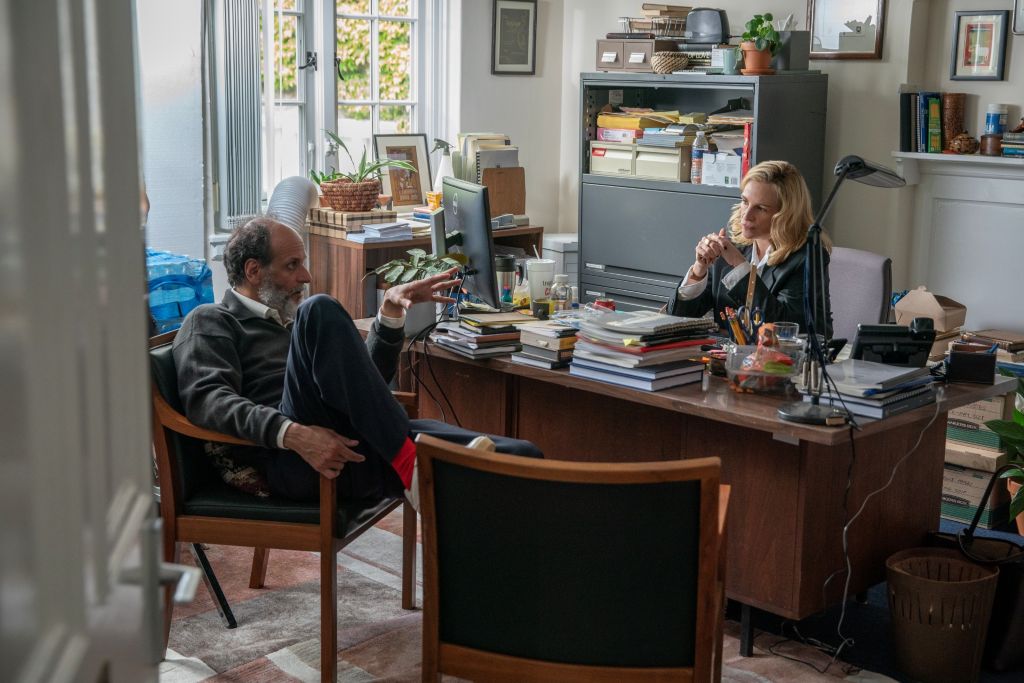
Roberts says that this aspect of Alma drew her to the role. She finds the competing perspectives reflective of contemporary society and the way that stories are filtered, curated, refracted, and altered. “We are so self-documenting as a culture now that if you do something, let’s say if I have a baton recital—as I could have, not to brag,” she says with her signature laugh, “and [her husband] Danny [Moder] videos it, I have my experience of this recital. If we leave and I get in the car and say, ‘Oh, let me see the video,’ my memory of it will never be what happened. It will then become a memory of this video and there’s nothing my brain can do to alter that.”
Roberts makes the point about the hypothetical baton twirling to stress her refusal to say which competing perspective in After the Hunt offers the ultimate truth. “You have this experience that you had [as a viewer] and that’s so cool and we don’t want to shift that,” she notes. The film ultimately invites different readings through the preconceived notions or experiences that one brings to the story.
The actress points out her own friend’s reaction to the final scene of After the Hunt , which provides a coda as Alma and Maggie reunite on campus. It ends with Alma looking out a window as Maggie strolls away from the building, a conclusion that opens up a conversation. “My friend had written this whole story about what looking out the window meant, and it was phenomenal,” Roberts says, noting the take differed completely from her own interpretation of the scene. “That’s what’s fun about movies. We forget to have fun even when they’re serious that there’s so much yummy stuff to talk about and dissect and take it apart and put it back together. It’s the Jenga.”
Guadagnino, meanwhile, sidesteps a question about the coda, which he created as a post-script to Garrett’s screenplay. “I think the answer is not for me to give, but for everyone to see in the way they see the movie. And I think it’s in the title After the Hunt ,” he notes.
Garrett adds that her inspiration for the title draws upon German Chancellor Otto von Bismarck’s quote, “ People never lie so much as after a hunt , during a war, or before an election.”
“It’s about persona and it’s also about the lies that we find socially acceptable and allow other people to tell us, both externally and interpersonally,” explains Garrett.
The writer adds that her take on Guadagnino’s expanded ending serves as an attempt to provide both ambiguity and resolution. “I think he wanted to see these characters move beyond the maelstrom of this temporal moment and into a space of how did they change and how did they come together, or how did they not change at all?” says Garrett. “I think he trusts the audience immensely and I think that he’s not afraid of the audience bringing themselves to the film and perhaps coming away with an opinion that is of frustration, perhaps.”
Guadagnino says he hopes that people recognize the characters’ fragility, as well as see their own. This sentiment plays into the often uncomfortable framing as the camera gets invasively close to his stars. The film opens up the characters’ psychology by letting audiences see things that others in the room might not be able to observe with their own eyes.
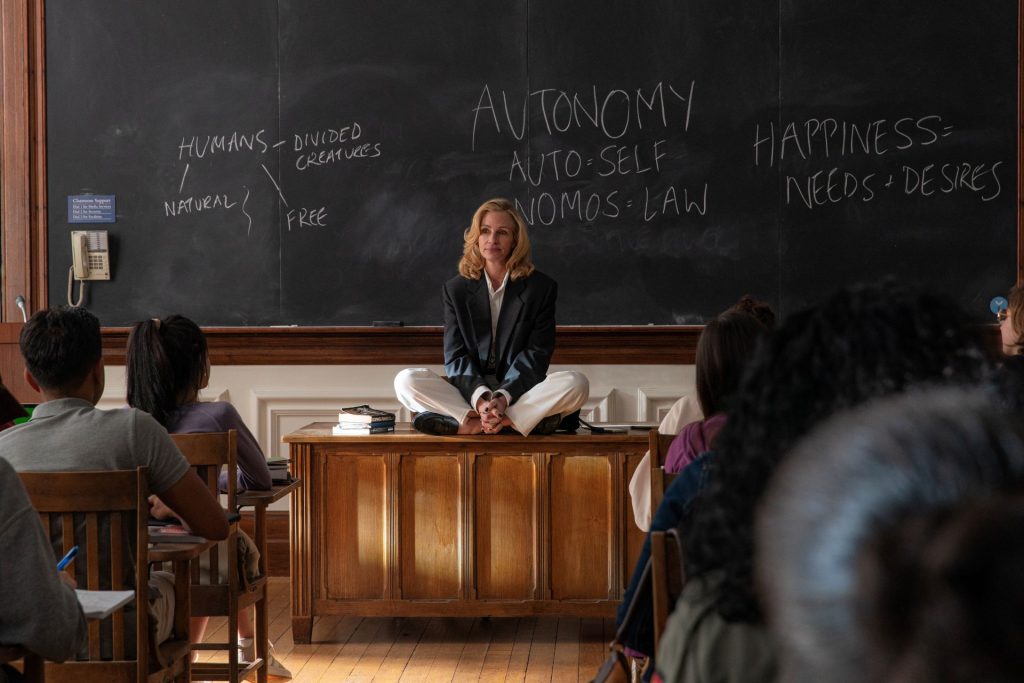
“I’m curious of their stubbornness [about] not listening to one another and why,” says Guadagnino. “It’s more about being in conversation with the actors and asking oneself: How do you deal with behaviour that might be read as feisty, complicated, or repulsive? And yet it might the signal of something else. Can we find the frailty? The great Jonathan Demme said that you have to make every character a character that you want to be with, even the most despicable one. One of the great example in his incredible filmography is Hannibal Lecter. He’s a cannibal. He eats people. And yet you love Hannibal Lecter.”
Alma only eats people metaphorically, and her complex psychology often plays out in non-verbal dialogue. Roberts’ reaction shots and subtle tells brilliantly let a secondary dialogue unfold with things unsaid competing with the acerbic barbs and heady philosophy traded by the academics. Roberts says that exploring the dramatic space in gestures and silence was a highlight of the collaboration with Guadagnino and the cast.
“Even in the very beginning [of the film] when we’re having the dinner party and Hank calls Alma over to the couch, [he gestures] ‘come sit here’ and she sits down and then there’s a hand on the knee,” Roberts says, describing a scene that introduces the intimacy shared between Alma and Hank that their colleagues fail to miss, assuming they’re merely friendly rivals for the same tenure-track position.
“From the very beginning, there’s a lot of dialogue with physicality and it’s so great because for me as a performer, especially with some of the more rigid dialogue that we had, you can really get in your head about it,” says Roberts. “But if Luca gives you twenty-eight-and-a-half things to think about besides your performance—“sit here, turn this way, touch this person and then reach for that and then have a cigarette, and then don’t forget that you’ve got your wine going”— then it becomes very much the moment of that evolution. It’s great to be in a scene like that with so many people and so many moving parts. It is like being in the world’s best circus.”
All these moving parts ratchet up the tension as characters weigh their desires and drives amid the shit storm that unfolds as Alma’s response to Maggie’s allegations becomes the headline. Through it all, Frederick somehow stands by Alma, playing the devoted husband, but also somewhat idolizing his wife as an entry point to an elite world he couldn’t otherwise access.
These emotions make After the Hunt something of a complicated addition to the exploration of desire and longing that’s generally been a through line in Guadagnino’s work. The cutthroat power plays are, in a way, extensions of that juicy prawn scene in I Am Love to the literal, metaphorical hunger of Bones & All , and that aching use of double exposure in Queer but After the Hunt feels both distinct and complementary in his oeuvre.
“You have the longing of Frederick for Alma. You have, in a way, the acerbic longing of Maggie for Alma. You have some messy longing from these people to this central character of Alma, which makes the longing less fruitful than in other stories that I told, and yet still powerful,” says Guadagnino. “There is some reflective energy from this movie and A Bigger Splash : this obnoxiousness that these characters are driven by.” Interestingly, Roberts notes in our conversation that her favourite Guadagnino film is A Bigger Splash .
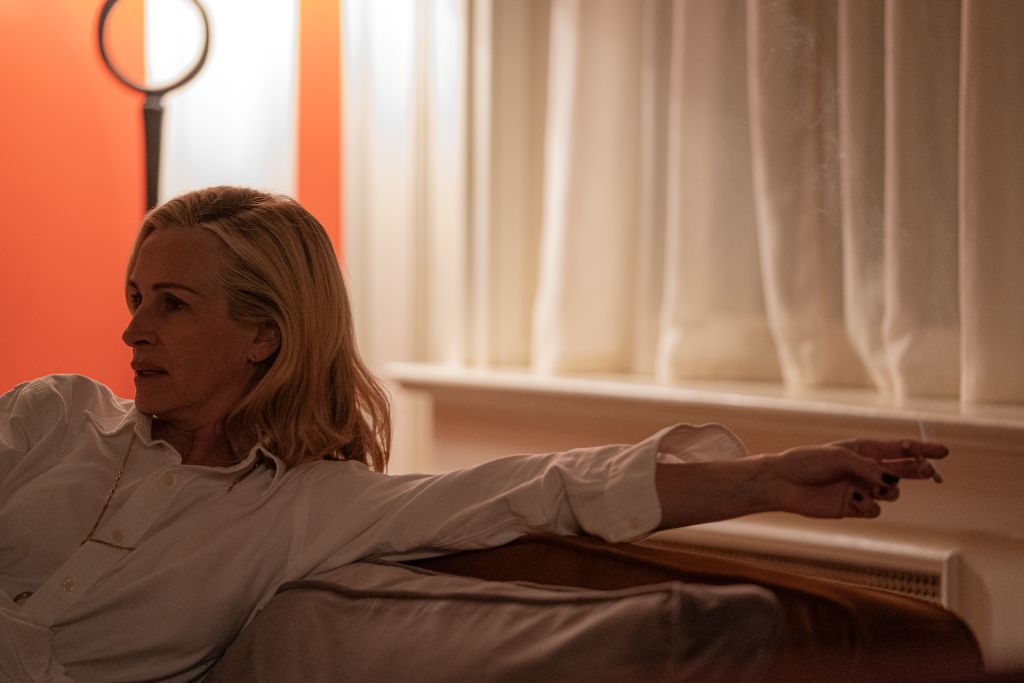
“Honestly, I don’t really engineer my movies to a conscious tapestry that continues what I’ve done already,” continues Guadagnino. “But at the same time, can the leopard change his spots? You are who you are and eventually you end up being in a place that maybe you didn’t really fully manage to figure out in your mind consciously. Then, unconsciously, they come out.”
Roberts agrees that leopards can’t necessarily change their spots. She points to Alma’s plight where the professor experiences life in a fishbowl after the scandal hits the internet. After the Hunt asks how we cope when every move we make or any word we say is analysed in the court of public opinion—or, worse, on social media. Roberts says she relates as someone constantly in the public eye, especially when doing press tours for her latest movie.
“With a surprising sense of peace,” she says when asked how she lives with the constant scrutiny. “Because it is what it’s. Everybody is entitled to their thoughts. I think that as long as you’re not trying to be intentionally unkind, you can like something or not like something.
“I don’t read things—of course, I bump into things now and then, but I don’t pursue it,” Roberts observes. “For me, the value I’m going to get from [a movie] is the calendar that ends on the last day of shooting. Whatever value-added service comes when people see it and they enjoy it, or appreciate it, or are moved by it, then that’s just the cherry on the cake. But the cake is still there for me no matter what you say.”
After the Hunt opens in Canadian theatres beginning Oct. 17.
It also screens as the closing night selection of the Windsor International Film Festival .