


It’s somehow been 20 years since Marie Antoinette premiered to an unfairly, if not unexpected, negative reception at Cannes. Many critics clutched their pearls at writer-director Sofia Coppola’s narrative (American?) liberties and anachronistic use of ’80s New Wave songs to tell the story of the doomed French queen. Her third film exploring the mystery, contradiction, and beauty of girlhood, she ruffled some feathers in the process.
Undeterred, and with the cultural capital earned from a screenwriting Oscar for 2003’s Lost in Translation, she embarked on a $40M, 57-day shoot that was as grand and wondrous as the final product would suggest.
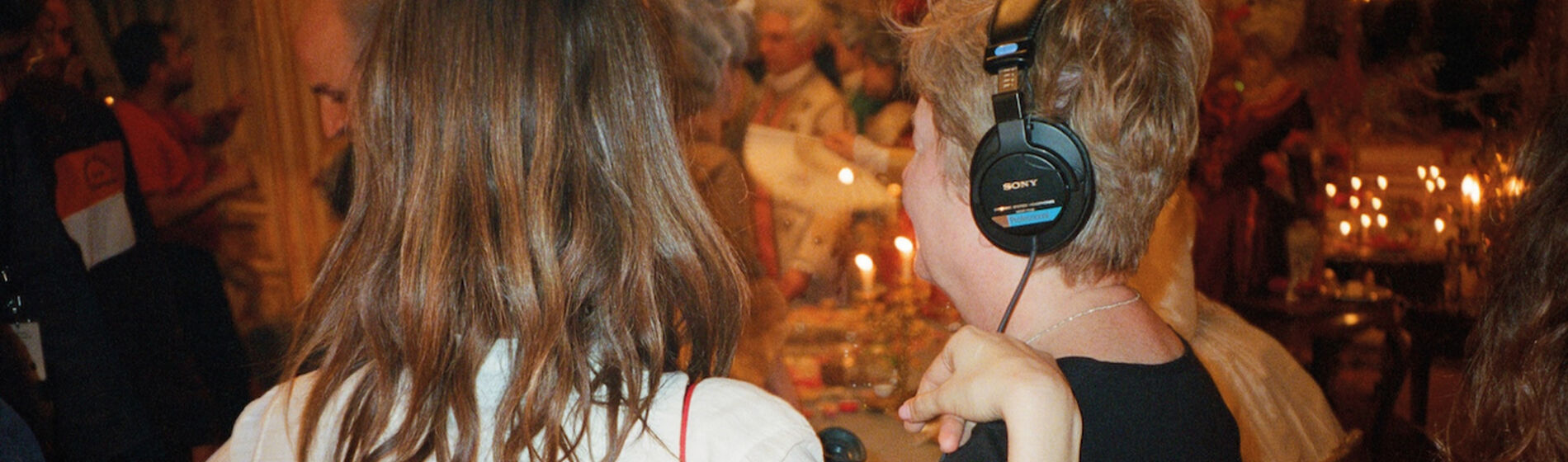
Two decades later, audiences get Making Marie Antoinette, a behind-the-scenes feast lensed by Sofia’s mom, Eleanor Coppola. Eleanor watches cautiously, wearing all black and happy to disappear into the background, not just with the understandable mix of pride and protection that any mother would have, but with a fellow filmmaker’s innate curiosity.
The film opens with a journal entry from Eleanor explaining that, after capturing 80-plus hours of on-set footage, the 2020 pandemic lockdown gave her and Sofia a reason to revisit it. But with Eleanor’s passing in 2024, Sofia and team took over, doing “their best to finish this for her.”
The scope and scale of Marie Antoinette are immediately palatable, and intimidating, to Eleanor. We hear journal entries brought to life by Diane Lane in voiceover where Eleanor wonders why her daughter is tackling an historical figure of this stature. She questions why her daughter’s shooting at Versailles for the first time ever with the French government involved and why she’s enduring countless 12-hour days. She initially sees her daughter as “too small and unprepossessing to be the director” of such an epic. A quiet, steady presence on-set, Eleanor starts to get the answers. Audiences do, too. Sofia’s interest in the story of a young woman entering a male world where everyone expects failure, turns their nose at her girlish interests, and misunderstands her desire for performance and privacy, makes what should be a straightforward period piece into something much more personal.
We also get an up-close look at what it feels like for a parent to see their child in charge, really in charge. Sofia’s leading a team of hundreds, making countless decisions, and responsible for a budget that most will never come close to. But of course, Sofia is not just any child and the Coppolas are not just any family.
Scale and scope are familiar to Eleanor, who directed the seminal making-of doc Hearts of Darkness: A Filmmaker’s Apocalypse about her husband Francis Ford Coppola’s famously chaotic movie shoot on Apocalypse Now. We see Sofia’s brother, Roman Coppola, join the Marie Antoinette shoot as the second unit director, and their easy connection and mutual respect is a singular source of pride for Eleanor. Sofia’s cousin Jason Schwartzman (Rushmore, Artificial), plays King Louis XVI and her niece Gia Coppola, who would go on to direct The Last Showgirl, also has a small role.
But the lens here is different. It’s not about seeing your partner in stressful situations, but your daughter. Their specific, tender bond is a constant. Eleanor alludes to the typical adolescent imperative when Sofia needed to separate from her but they’ve clearly found their way back. A deep connection and trust allow Eleanor to always be recording, putting her camera in front of the understandably exhausted cast, led by a sparkling Kirsten Dunst, who’d clearly love five minutes of her day not committed to film. When chatting with Eleanor, Dunst has a genuine a-ha moment, making a connection between herself, the titular role she’s playing, and Sofia, as women who’ve been observed their whole lives, sometimes at their behest, often not.
There’s also surprisingly little visible mother-and-daughter tension, considering the circumstances and stakes. We only see Sofia gentle rebuff her mother’s request for a sit-down interview once, and even then it’s nowhere near the kind of sharp interaction you’d understandably expect.
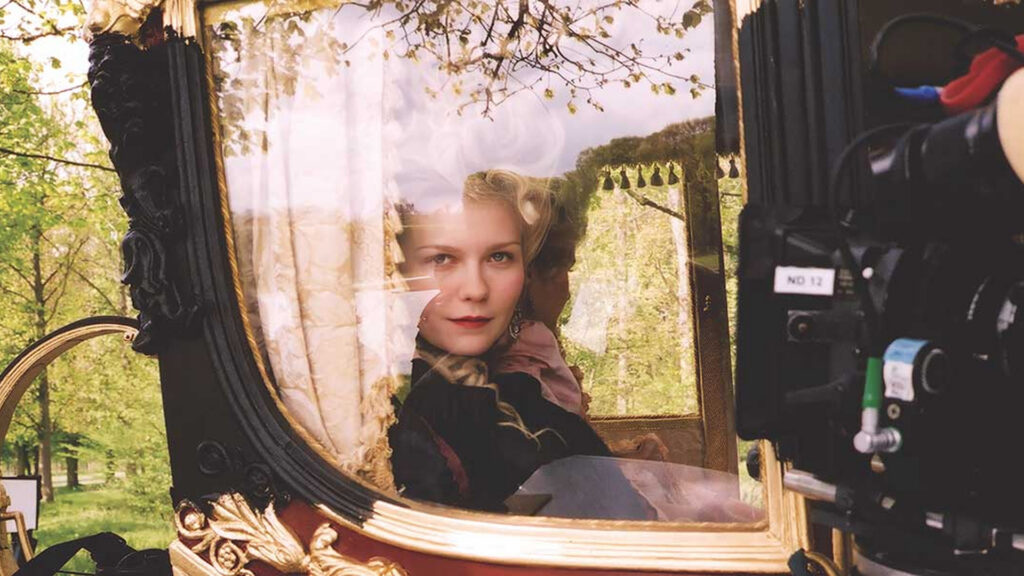
As a documentarian, Eleanor admits she’s most comfortable as the invisible observer. Her daughter, though, is a born boss, calmly and confidently orchestrating grandiose party scenes, lavish operas, and rain-soaked battles with hundreds of extras. When a persistent cough worries Eleanor, she asks for a doctor to visit set (moms are gonna mom) and Sofia is told she has bronchitis and needs antibiotics. Eleanor sees it all and is wowed by Sofia’s “grace, clarity and her own hip approach to history.” And she knows just how rare is it to have a woman take up this much space, putting her thoughts and ideas centre stage, and not apologizing for sticking to her vision.
The way that cinephiles hungrily pore over director Christopher Nolan’s every moviemaking choice, which hit a fever pitch with this year’s release of The Odyssey, isn’t easily afforded to Marie Antoinette’s equally elaborate period costuming, iconic wigs, and real flowers. The craft on display is exquisite, the details fastidious—everything on set was famously edible—and Eleanor’s footage makes a case for giving it due credit and kudos. It’s unlikely that film bros will see Making Marie Antoinette and course-correct, but the proof is in the pastel-coloured pudding.
Her naturally observant nature eventually makes Eleanor question if she should be honouring her own creative endeavours instead of recording the work of others. She admires that Sofia’s generation was able to prioritize their careers over family in a way that simply wasn’t available to her. Sofia is 34 years old during the shoot; by that age, her mom already had three kids. But Eleanor didn’t let that inspiration idle. A postscript tells us that, at 80, Eleanor became the oldest woman in cinema history to make her feature dramatic directorial debut.
In this way, the doc tells a dual story of two women at different phases of their lives, learning from each other, navigating what’s in front of them and what’s yet to come, and provides a beautiful opportunity to continue to tell a tale of mothers and daughters.