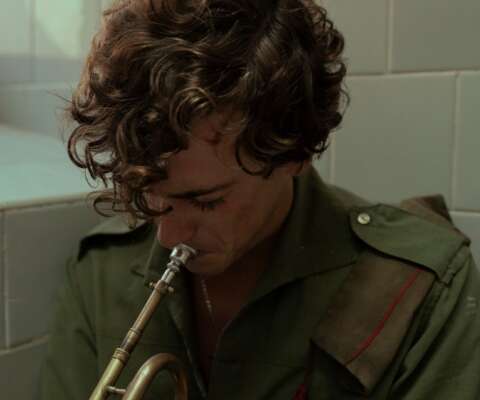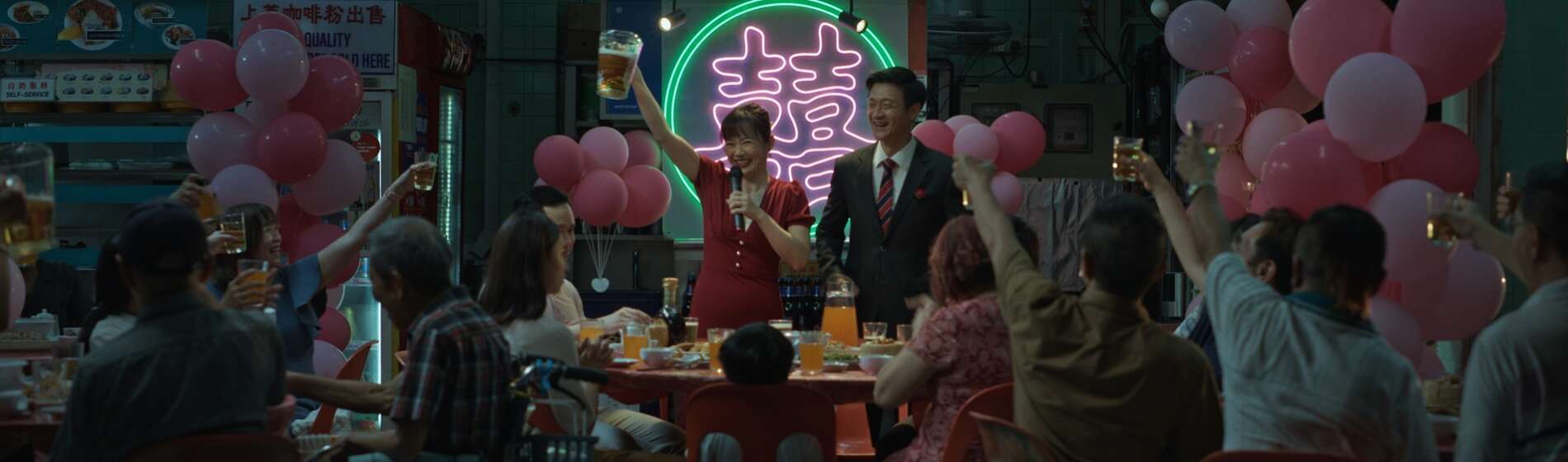


In Anthony Chen’s fifth feature film, he returns to his native Singapore to complete a trilogy of films dubbed the “Growing Up” series. Over 14 years, each instalment shows the actors and director maturing in technique and in their interactions with one another. Notably, the two leads remain consistent. Yeo Yann Yann and Koh Jia Ler play mother and son in Ilo Ilo, then teacher and student in Wet Season, and are now stepmother and son in We Are All Strangers . In Chen’s latest, it’s Boom Kiat (Andi Lim) who has to support his delinquent son, Junyang (Koh Jia Ler), by working at his modest food stall while the surrounding, slowly urbanizing, country pushes him out.
The cinematography casts a warm, patient light—as in a scene where Boom Kiat and his crush, Bee Hwa (Yeo Yann Yann), go on a cost-efficient date on an air-conditioned public bus, passing many luxurious storefronts and skyscrapers. The camera follows, taking the viewer along on a tour of Singapore that looks significantly different from what it did in Ilo Ilo during the financial crisis of the late ’90s.
Boom Kiat notes the frantic pace of life and its consequences: “Look at these people with cars. They are rushing all the time”¦ on the public bus you get to see so much more.” It sums up his character—a man perfectly at ease with his modest lifestyle, unbothered by a world outpacing him. Chen deftly contrasts the father’s and son’s attitudes toward life with juxtaposed scenes. While Boom Kiat is content to capitalize on the bus’s free air conditioning, Junyang prefers to take his high-school sweetheart, Lydia (Regene Lim), to a five-star hotel using her mother’s credit card. The young couple feign a fantastical lifestyle, jumping on their beds and swimming in the posh infinity pool to the tune of BTS’ “Dynamite.”
When Lydia finds out that she’s pregnant, these illusions of grandeur disappear. The couples are forced to marry and co-habit in a small government-subsidized apartment to financially support one another. Like many urban centres, Singapore faces a housing crisis as condo buildings are increasingly bought up by foreign investors. On the night of a national holiday, the four characters look out at fireworks from their balcony, each with mixed feelings about the future. They believe their country has grown to support only the wealthy and brushes the rest under the carpet, but the mood is lightened when the father grabs his son’s shoulder and says, “The best thing about old estates”¦ we get the best view.”
The rest of We Are All Strangers constantly teases the audience that things may get better for this small family, but that hopeful feeling is often hindered by the characters’ own actions. Tasked with supporting his wife, his sick father, and a child soon to be born, Junyang fails to keep a job because of his lazy, self-centred nature. His wife, Lydia, is frustratingly sidelined and reduced to her role as expectant or new mother. Her story could use more depth, particularly if the filmmaker wanted to emphasize movement between socio-economic classes. She comes from a much wealthier family than the other characters, but they seemingly refuse to support her after the wedding, and the film never properly explains why.
In the final act, the film shifts from a quiet family drama to a bizarre subplot about social media virality. One of Junyang’s money-making schemes to support his family involves smuggling foreign medications, with Bee Hwa selling the products over TikTok Live. The tactic really gets the money rolling, especially after she begins fake crying on camera while telling stories of the family’s economic hardships. Invoking vulnerability while livestreaming captures the modern phenomenon of influencer culture but dehumanizes the film’s characters in a way the director may not have intended. Watching Bee Hwa sell her dignity for a quick online transaction is reminiscent of Chen’s frequency of writing tragic characters just to garner sympathy. What the director has always lacked is the grace to let his characters grow in any meaningful way. He leaves no room for his characters to mature or develop complex depth, which feels antithetical to the trilogy’s titular purpose of “growing up.”
Chen’s previous films feature characters who try to hide from their problems, like in Ilo Ilo, where a laid-off father hides from his family in a stairwell, smoking a stress-relieving cigarette, or in Wet Season, where a woman stares absent-mindedly out of her car window after learning her eggs are infertile. We Are All Strangers makes similar problems uncomfortably public-facing. Instead of banding together as a family unit, they look to garner sympathy online, forgoing a proper resolution or narrative progression as the film largely ends the same way as it began, with the family labouring away at the food stall.
While Chen is adept at documenting hardship, his latest venture lacks enough light to balance Junyang’s jaded nature and his flaws. The best he can do is have Lydia, in the film’s final moments, look longingly at a Flipagram of a sun that Junyang made at the outset of their relationship. Back when they had high hopes for a luminous future and had no clue about the struggles that lay ahead.