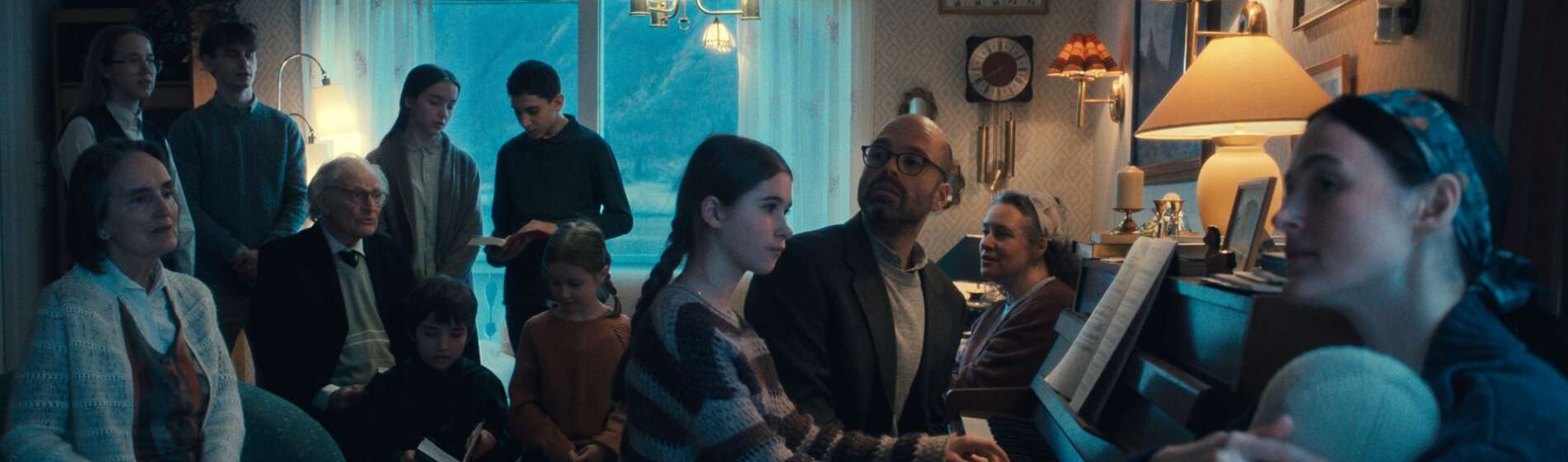


Parents Mihai ( Sebastian Stan ) and Lisbet ( Renate Reinsve ) Gheorghiu leave Romania after the passing of the Mihai’s parents to join the mother’s family in Norway. As Lisbet sends her four children (with a baby at home) to their first day of school, she is welcomed by some of the teachers who just happen to also be their neighbours.
“In our community we’re all practically neighbours,” they say. In any other context, this would seem like a warm greeting from people open to offering a helping hand because of their proximity and shared ideals. In Fjord, the Gheorghiu family will learn to be wary of these neighbours who use closeness to find idealistic differences and forcefully assimilate them into their community’s beliefs.
Mihai explains that moving to Norway was for “the children’s own good.” What is “good for someone’s sake” is an argument used throughout Fjord, but it quickly loses its objectivity when used as a means of defending a personal or cultural interest. When the family reveals that they are aggressively Christian, to the point that the children can’t use the internet or listen to non-religious music, the neighbours begin to question their parental authority, frequently prohibiting them from “evangelizing” in public.
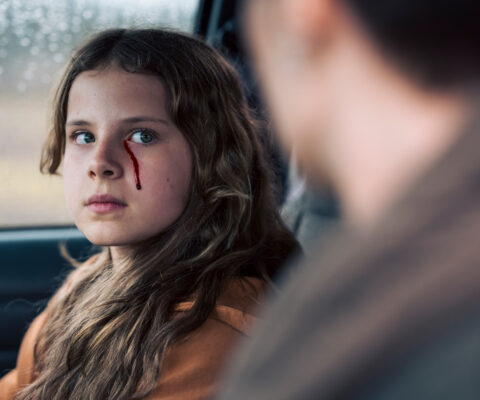
When Gheorghiu’s eldest daughter, Elia (Vanessa Ceban), shows up to gym class with bruises on her shoulders, it gives the local community the perfect opportunity to act as though their reservations about the family were correct. After the children admit that they sometimes receive slaps on the back as punishment—a different area from where the bruises are found—they are swiftly taken away by Child Protection “for their own good.”
What differentiates Fjord from many other legal dramas is that the plot doesn’t revolve around the mystery of “Did this family commit the crime?” Director Cristian Mungiu makes it clear early on that Elia is bullied at school by a girl jealous of her friendship with Noora (Henrikke Lund Olsen), with the possibility of a physical altercation. The investigation that transpires then becomes more about cultural and religious divides than it does parental habits.
Between these two families, their flaws balance each other. The progressive Norwegians are quick to judge a situation that they are not completely sure about while they neglect to listen to their own daughter. Mungiu ingeniously captures a few scenes within domestic households. A lot of the runtime is spent outdoors, in workplace offices, and in courtrooms. These neutral spaces restrict the audience’s access to personal spaces, reinforcing the notion that it isn’t anyone’s business unless a crime has been committed. The film’s most intimate and compassionate moments come when Lisbet looks after her neighbour’s grandfather, who opens up to her in a time of severe loneliness. A friendship that none of the other characters learn about and, in turn, doesn’t help Lisbet’s public approval.
Since the real world has been battling polarization for a few years now, Fjord feels like the obvious conversation of the moment, but the script rides the line between both cultural extremes and lands on a point of basic humanism without seeming preachy. For Mungiu’s first film outside of his native Romania, the fundamental lesson of looking at others as human rather than ideological opponents is his most widely accessible, especially when enlisting Hollywood talent such as Stan, who deftly provides an internally frustrated performance. The director’s perspective as a Romanian entering Norway himself adds an earnest dimension of curiosity as he unpacks the difficulties parents face in locating their own sense of “good” without outside criticism.
Fjord premiered at TIFF 2026 on September 10 and has additional screenings on September 11. It hits theatres, courtesy of Elevation Pictures, on October 16.