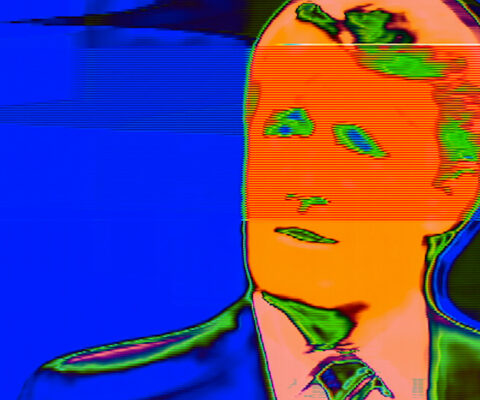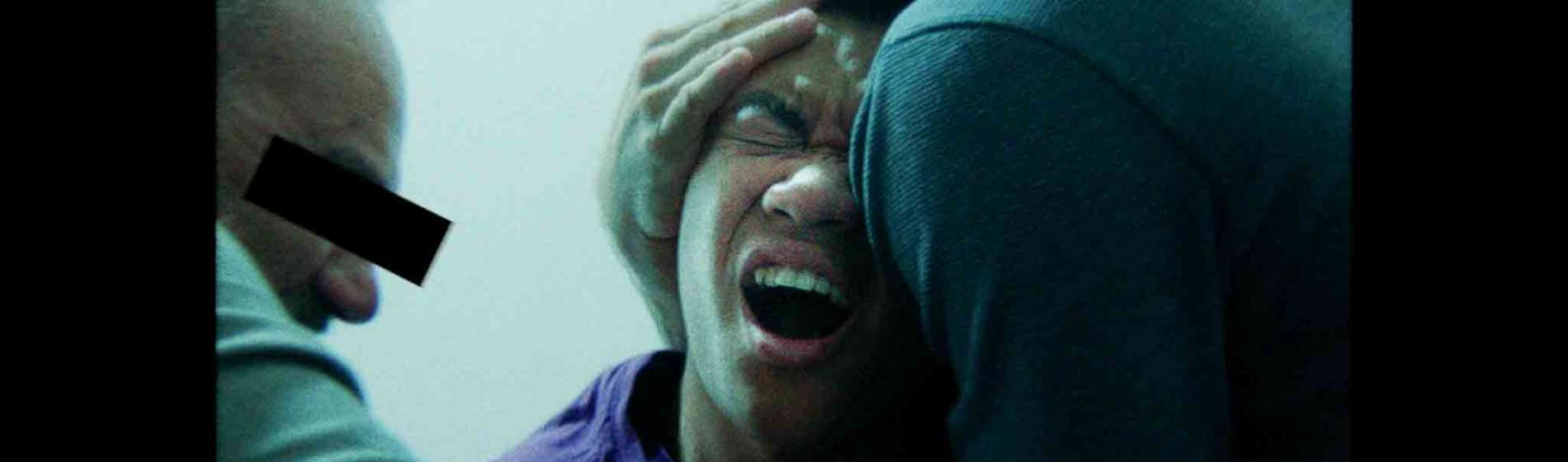


A young man facing a pale wall as he stands within an abusive lockdown centre is quickly contrasted by a playful opening credit sequence featuring upbeat folk music. It’s immediately apparent that Vancouver-born filmmaker Bryce Hodgson’s feature film debut is a piece filled with purposeful emotional swings. His film follows two teenagers who break out of said lockdown centre while under the influence of LSD. When they eventually set up camp to lay low in an abandoned parking lot, conversations are filled with nonsensical conspiracy theories and sporadic hallucinations that marry nostalgic Super 8 cameras with unnerving quick cuts.
Thanks to the Hard Work of the Elephants focuses on these two young men and treats them as victims of abusive parental figures and flawed support systems. Though heavy in its subject matter, the story finds levity in their immature humour and unrelenting hope despite the injustices surrounding them.
That Shelf’s Andrew Roberts was able to sit down with Hodgson before the locally shot film’s Toronto premiere at the 2026 Future of Film Showcase. Here’s their conversation:
Andrew Roberts (AR): The film’s plot is oddly specific. How did this concept come to be?
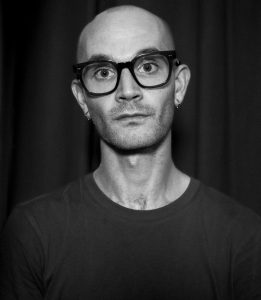 Bryce Hodgson (BH): The idea is based on a true story that happened to a really close friend of mine back in the ’90s who did, in fact, escape a youth lockdown detention facility, high on stolen acid that he and his friend had smuggled in. They stole the centre van and fled to a parking lot 400 kilometres away.
So that did happen, and it was a story that I’d heard many times. Over the years I had chatted with him about turning it into a stage play and then went through a series of recorded conversations with him, recalling things from that period of time.
It was adapted into a stage play in 2019, and then in 2020, the pandemic happened, theatre died, and my wife encouraged me to turn it into a film script.
AR: Was filmmaking always something on your palette that you wanted to pursue?
BH: Yeah, when I grew up as a child actor, I was watching and making skateboarding movies and playing around with a Super 8 camera that my uncle had given me. I made a lot of really weird experimental films when I was between the ages of 11 and 14. Around 20, I got really into theatre, so coming back to filmmaking felt pretty natural. The palette was already there.
AR: You have said that the Safdie brothers were a big inspiration for making Elephants, as it is very much a pressure cooker with its close-ups and fast dialogue.
BH: The Heaven Knows What and Good Time scripts were very helpful when writing this to understand pacing. All of the things I make are pretty talky-heavy. That is due to coming from theatre and writing people talking over each other. I’ve written a lot of plays but hadn’t written a film script before. I had read a lot of film scripts, but it was the first time where I was like, “How do you write action that feels like there’s pressure behind it?”
AR: Would you consider making films in this mode throughout your career?
BH: I don’t know if all my movies have to be pressure cookers. For Elephants, it has to be that way because they’re on LSD and in escape mode. When you’re 16 years old and high, you could be walking to the end of your block, and it feels like pressure cooking.
AR: Were there any alterations to the play script? This seems like the kind of film where there would be a lot of improv.
BH: No. It is all from the play. There was almost no improv in the film. There’s one improv scene, and it’s the one that nobody thinks of. It’s just a wide shot where they’re playing with a dog.
Everything else is word for word what was written. There was a lot of rehearsal that went into the preparation. So there was freedom for them to be able to play and experiment, but once we were shooting, it was definitely all on script.
AR: That’s really impressive when dealing with huge blocks of dialogue. The film relies almost exclusively on its two leads, Hunter Dillon and Kevin Nguyen. What was it like casting these roles and developing their chemistry?
BH: I met Hunter through a friend of mine who finished making a film that he was in. At that point Hunter had read early drafts of Elephants and knew I was making it. My friend called me right after they had booked Hunter, and he was like, “Yo, I think I found your Alex.” So I cast Hunter sort of sight unseen since I’d only seen him in my friend’s phone. I knew he could act, and I knew he could do this thing. So, Hunter was on board really quick.
We watched a lot of tapes before Kevin, but it was pretty damn clear that it would be him. There was a point where we did chemistry reads and brought everybody in, and it was like, “Well, that’s it.” There was an intimacy between the two of them that was easy.
AR: There was one scene I loved where Kevin walks into what appears to be a Canadian Tire and starts rapping into a portable fan. What were the challenges of shooting that in public?
BH: We didn’t shoot it in public. We were planning on shooting it in public. Then at the 25th hour, our incredible line producer found the location, which is a Canadian Tire not open to the public where they shoot commercials or stock shelves to look at displays.
AR: So it’s not a Canadian Tire? Wow, I didn’t even know that was a thing!
BH: We didn’t either; it’s crazy! It’s all the way up near the Ontario Science Centre, and we drove into a big industrial area. They led us into a bunch of offices, and then they were like, “Come this way.” It was pitch black, and after flipping on all the lights, it was a fully functioning Canadian Tire with checkout and everything.
AR: I think you found an indie filmmaking cheat code for anyone wanting to shoot interiors there.
BH: I know! We got super lucky with that. We just had a big Canadian Tire where we could do whatever we wanted.
AR: Is it a relief to finish the project and premiere the film at festivals such as the Future of Film Showcase that largely celebrates first-time filmmakers?
BH: The relief of finishing it is the relief of letting go. The film is now just a thing in the ether. And that’s cool. People get to experience it. It doesn’t have to do with, “Oh, my hope is people would feel X or my hope is people would think X.” Letting it go means it doesn’t matter what I’m hoping; the hope of what they’ll feel or experience has gone out the window. Now you just see what they experience. You built the painting, and then you’re like, “What do you see?” and that’s it.
I like this festival. When the director of programming, Zac Goldkind, reached out to me about watching the film, I thought it was a great fit in terms of me liking smaller festivals. I like festivals that feel like “the people’s festival.” As time goes by, finding the people’s festivals is really important because it’s about having an actual relationship between filmmakers and the audience. People coming together and watching things together. The first feature directors or second feature directors are where the most exciting shit happens and are the things I like to go watch.
Thanks to the Hard Work of the Elephants had its Toronto premiere at the Future of Film Showcase on July 24.
The interview has been edited for clarity and length.