
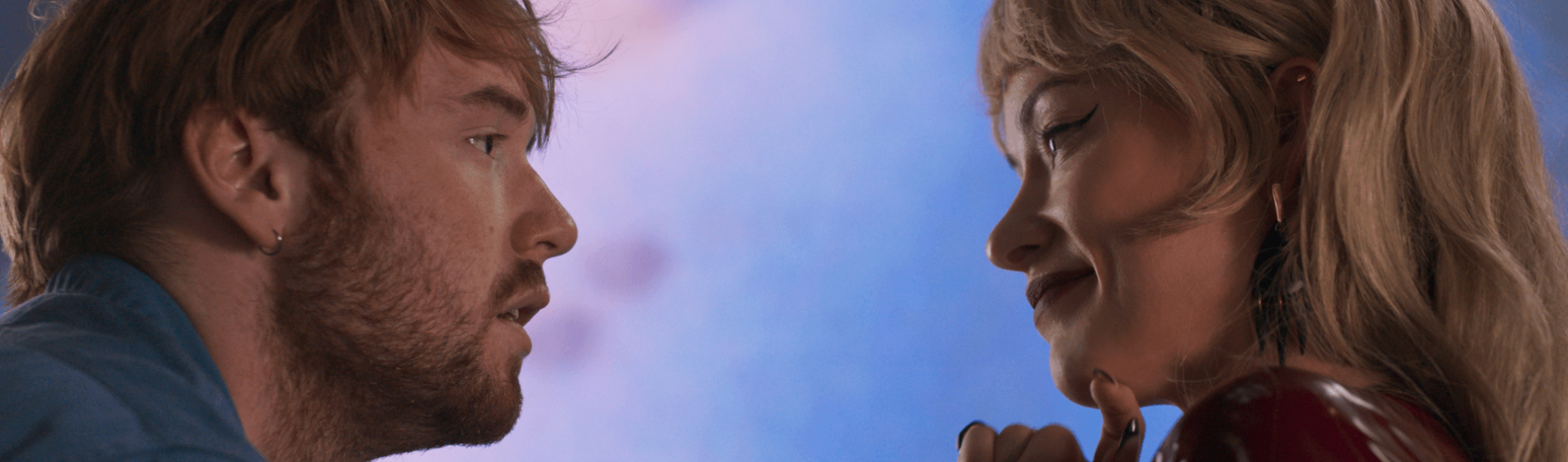


After spending most of the last decade in television, director Gregg Araki is back with his first film in 12 years, I Want Your Sex. Unsurprisingly, the filmmaker returns to the well of sexuality where he found his major successes during the late 1990s. The film’s two main characters, Erika (Olivia Wilde) and Elliot (Cooper Hoffman), encompass both sides of a debate that engages with contemporary themes of sex positivity, with Araki posing the pointed question, “Where has the horniness gone?”
“Contemporary art is a scam,” Erika exclaims early on. She’s explaining to her latest hire, Elliot, why his day-to-day job as an assistant in her art studio involves spitting gum onto a canvas to make the shape of a vagina. As an artist, she has had a long career of transgressive art and is well on her way to becoming an icon and advocate for sex positivity, not unlike Araki himself. Erika’s fresh-faced hire gives her the opportunity to pick the brain of a member of the younger generation who somehow does not want to have sex anymore. Her artistic output has been stifled by those audiences who would rather turn to porn for a quick fix than take the concept of sex and mould it into a genuine expression. Consequently, Erika’s studio is now full of sexual signifiers that can make a quick buck off of shock value alone.
Erika sits Elliot down on the sofa in her extravagant bungalow and interrogates why his generation seems so sexually repressed. He timidly answers that it’s about the limits of emotional security amidst a reality where personal communication is dictated by phones. Erika refuses to believe it and so gets Elliot to do a breathing exercise while she inserts a pink d**do into him. Erika’s defiant project of using Elliot here as her sexual plaything and muse is very similar to the Mel character in Nowhere, where she says sex should be doled out as much as possible “before we’re old and ugly and nobody wants to touch us anymore.” Mel’s sexual partner, Dark, is like Elliot, who becomes distraught when his desire for a romantic relationship is declined.
Araki’s films have always been about this push and pull between sexual liberty and personal vulnerability, and I Want Your Sex is at its best when the viewer can clearly see Araki’s personal philosophies slightly splitting at the seams. Since sexual intimacy does not necessitate exclusivity, the biological need for codependency becomes the bigger question. Araki follows that thread and goes on to demonstrate that it’s through taking these sexual risks that a young person can grow, which is made exponentially harder in 2026 given the repressed reality they inhabit.
Key casting decisions, like placing celebrities in notably muted roles, helps to create an overall cinematic vibe that defies viewers’ expectations. Charli XCX plays Elliot’s girlfriend, Minerva, who is only seen in bed studying for a medical school exam, in no mood to accept sexual overtures. The polar opposite of the pop star’s viral “brat” aesthetic. Johnny Knoxville and Daveed Diggs, both expressive personalities, are also in one-note roles as a grey-suit-wearing detective and bespectacled artistic advisor, respectively.
Conversely, it’s one decision of many that feels as if Araki wants audiences to react to the material rather than connect with it. Previously in the director’s career, his films have often felt like a warm hug. He has managed to unveil characters’ hardships while simultaneously engendering sympathy for them. When Erika and Elliot’s toxic workplace sexual adventures get more drastic here, I Want Your Sex becomes an absurdist comedy and foregoes delving any deeper into the discussion of sex positivity and whether it’s possible for it to make a comeback, which is a missed opportunity.
It also feels throughout like Araki is actively considering how his cinematic voice can have an impact after being gone from the big screen for so long. And while his authorship is still strong, disappointingly, his signature editing style of jump cuts between points of view has been replaced by the tired storytelling trappings of a flash-forward opener and an interrogation-framed narrative. That said, the filmmaker’s fearlessness when touching on taboo topics like BDSM and open sexual relationships has sorely been missed, not just from queer cinema but from any sex-comedy-adjacent filmmaking. So while I Want Your Sex may not be Araki at his strongest, the film asks important questions about how we all got to the point where we were too hesitant to talk about sex. But we will have to wait a bit longer for a film that serves up satisfying answers.
I Want Your Sex opens in theatres July 31.