When it was first announced that Lionsgate would be making Michael, a Michael Jackson biopic from the same producer as Bohemian Rhapsody, most people’s reaction was, “Why on earth are we doing this?” A reasonable question. For fans, it seemed obvious that there was no possible way to do this story justice. Not because Jackson’s story is so totemic that it cannot be told, but rather because the realities of his story don’t exactly lend themselves to flashy, celebratory Hollywood biopics. How on earth could they tackle this? Simple: just tell the good parts, end things in 1988, and hope that everyone is so caught up in the incredible music and dancing that they won’t think too hard about the fact that we’re just avoiding 21 years of Jackson’s life.
There’s a moment early in the film where a young Michael reads a Peter Pan storybook and looks longingly at the cherubic face of the famous ‘boy who would not grow up’. It’s just one of many on-the-nose moments from director Antoine Fuqua. Later in the film, Jackson will return to this same storybook and tell his chimp, Bubbles, a broad outline of J.M. Barrie’s story before talking wistfully about Neverland. To say that subtlety is not the film’s strong suit is an understatement. These scenes serve as a perfect representation of the film itself: a fairy-tale version of Michael Jackson’s life, with all the edges sanded down. It distills nuanced, complex moments into simple, colourful set pieces, not unlike a Little Golden Book adaptation of a more complex tale (like Peter Pan or Frankenstein).
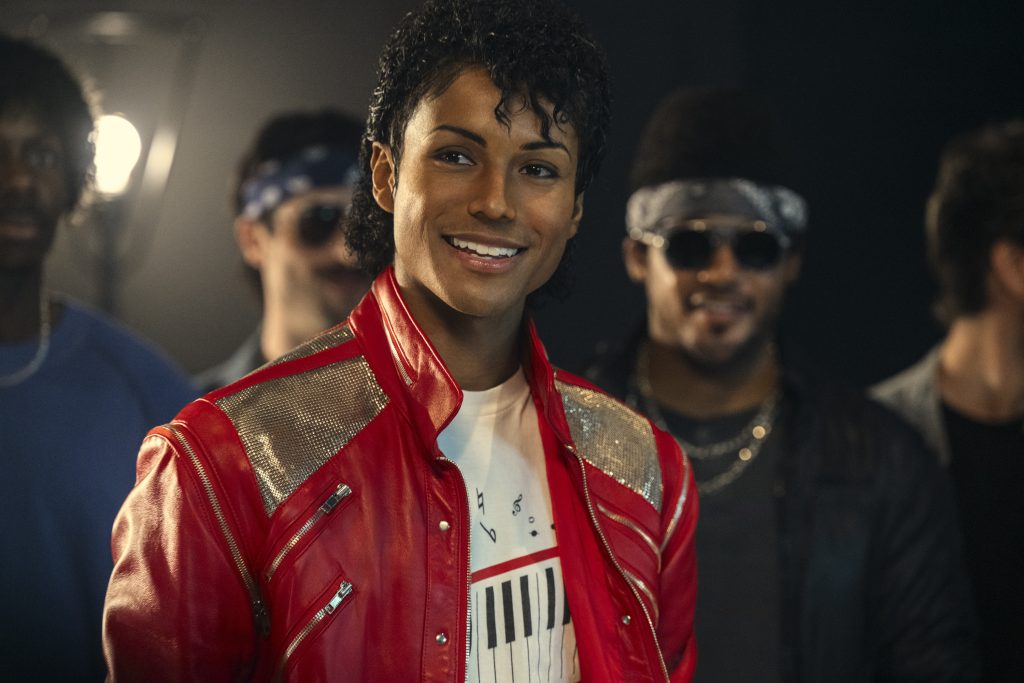
A lot of this comes down to John Logan’s (Skyfall, The Aviator) script, which paints a glossed-over version of the musician’s life, jumping from one key moment to the next. The film begins in Gary, Indiana, in the early ’60s, as the Jackson 5 are rehearsing for an upcoming performance—still months away from being discovered. We see a young Michael (Juliano Valdi) terrified of his father, Joe (Colman Domingo), yet with limitless talent. Next thing you know, we’re watching the group be discovered by a Motown talent scout (a much-too-brief appearance by Laura Harrier), then cutting hit singles for Barry Gordy (again, a too-brief appearance from Larenz Tate), and then performing at a county fair. Fast-forward to Michael releasing a hit solo record. Along the way, audiences get glimpses of Joe’s overbearing attitude and full-on abuse of his family, but the film never lingers. Why? Because we’ve got hit songs to hear!
Oh, look, there’s a beat about how Bubbles the chimp arrived! Then one where Michael is watching Vincent Price movies on TV, and hey, wait a second, maybe we should call the next album Thriller. Oh…and remember when Joe called young Michael “big nose” in the first act? Well, now he’s getting nose surgery. Did you know gang violence is bad? Well, if the Bloods and the Crips would just come to a dance rehearsal, we could change the world. Again, it’s every bad biopic cliché you could imagine, with all sorts of easter eggs peppered in for long-time Jackson fans, but it never dives deep enough to uncover anything new.
In many ways, it would have been preferable if Logan had taken the approach Lynn Nottage took with the vastly more effective MJ: The Musical, which centred its story around a specific event or moment in time and used it as a jumping-off point to various flashbacks. This narrative structure would still allow you to cover key moments in history without the feeling of constantly skimming through a series of greatest-hits moments.
That said, when those songs start, it’s hard not to dance in your seat. It’s easy, too, to get wrapped up in Jaafar Jackson’s portrayal of the King of Pop and overlook the film’s glaring flaws. Even I can’t help it. And yes, that’s an Off the Wall reference. Please forgive me.
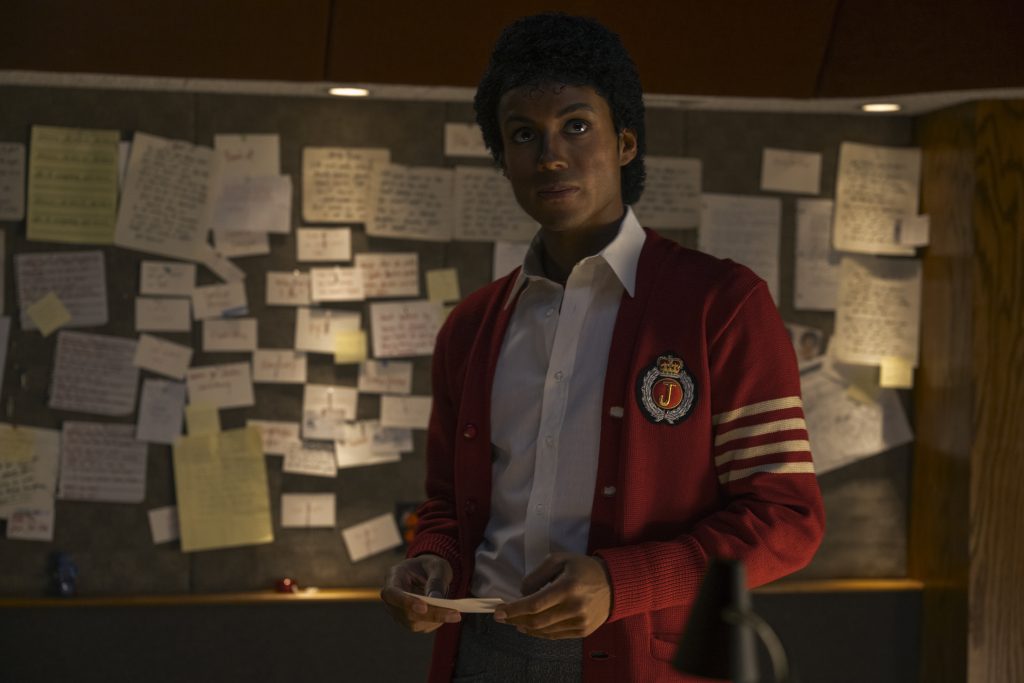
As the film’s star, the son of Jermaine Jackson (and nephew of Michael himself) is tasked with the near-impossible role of stepping into the icon’s patent leather loafers. From his first line of dialogue, it’s apparent how much he’s managed to sound like his uncle. When he begins to dance, he captures the essence of one of the most unique dancers of our lifetime. Sure, when you boil it down, he’s essentially doing an impression of Michael for two hours, but the actor does manage to imbue a sense of humanity to a figure who for decades has seemed otherworldly. It’s easily the most grounded portrayal in the film, and he still manages to be electrifying, too.
Some of the best scenes feature Michael alongside his longtime bodyguard, Bill Bray, portrayed by KeiLyn Durrel Jones (Succession), as he tries to figure out what he wants out of life. Or they catch him in the quieter moments of creative expression in his home studio, trying to find his creative voice. But there are not nearly enough of these engaging moments to be satisfying. Instead, the film makes room for a full-on recreation of the Thriller video.
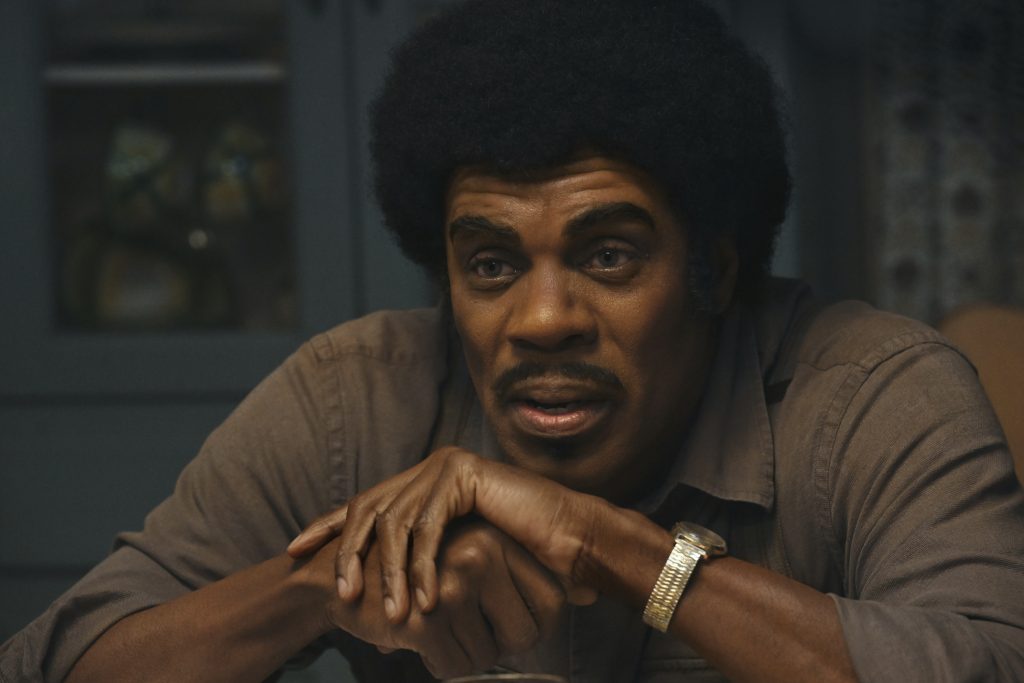
Conversely, we have Colman Domingo’s (Sing Sing, The Running Man) performance as Joseph “Joe” Jackson, which, while effective, makes him feel like a super villain. This is largely a result of the script, so you have to give Domingo credit for making something out of a one-dimensionally written role. In fact, the character of Joe is emblematic of everything wrong with the film; a lack of nuance in favour of broad strokes of caricature.
The supporting cast is equally broadly drawn. Nia Long (Boys ‘n the Hood, The Best Man) as Michael’s mother, Katherine, has little to do until the final act of the film, and even then, it’s a thin role. There are other members of the Jackson family there, too, at least the ones who are credited as executive producers. Janet is notably absent from the film, as is sister Rebbie, but don’t worry, we get to see Michael’s close personal relationship with LaToya (the sister he had a famous falling out with in the early ’90s). We get a few moments with Kendrick Sampson as Quincy Jones, too. Considering the impact Jones had on Jackson’s global success, he appears for far too short a time. Of course, we also get to hang out with Jackson’s long-time lawyer—and current executor of his estate—John Branca, played in the film by Miles Teller (Whiplash, Fantastic Four). A bonus for serious fans: Keep your eyes peeled for a brief depiction of Jackson’s engineer, Bruce Swedien, in the recording booth during the Off the Wall sessions.
What’s clear through it all is that this is not a film at all interested in unpacking Michael Jackson’s life. It is more concerned with celebrating the carefully constructed narrative in the wake of the star’s untimely passing. The reality is that audiences don’t care about Jackson’s lawyer, nor many other moments highlighted, but for whatever reason (and you can, cynic or not, likely come up with a host of them), there’s an emphasis on parts of his story that seem to be there for less-than-artistic or storytelling reasons.
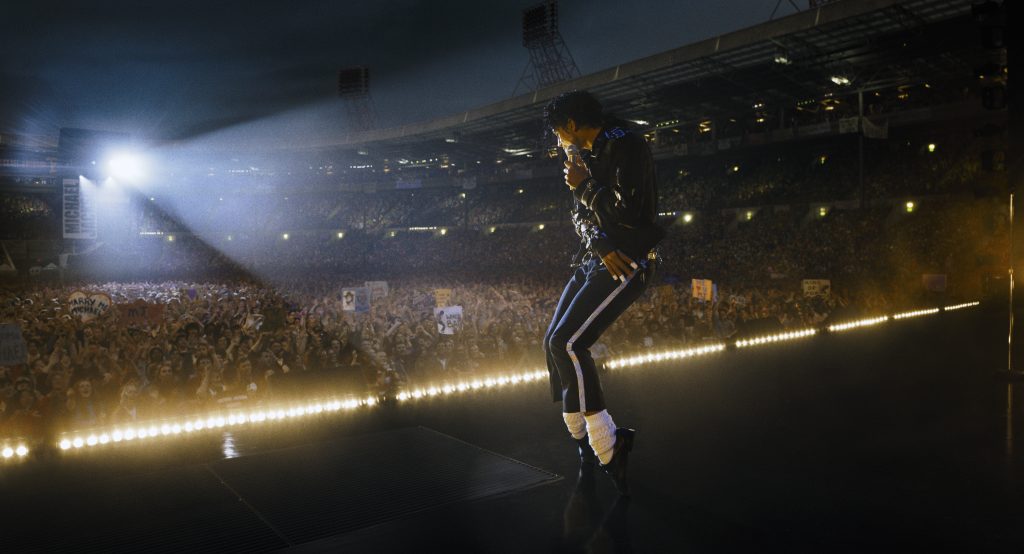
Director Antoine Fuqua (Training Day, The Equalizer) is certainly giving Michael his all, as is cinematographer Dion Beebe (Chicago, Collateral). The film looks great in IMAX, and the recreations of iconic Jackson short films and concerts are certainly impressive. With crystal clear imagery on the biggest screen imaginable and immersive surround sound, it is really like being there, and it’s hard not to admire the filmmaker’s attention to detail.
But, because the film has to cover so much ground, it moves at a breakneck pace. While the film thankfully avoids the usual bloated runtime of most biopics, it also means we rarely get much time to linger on any given moment before we’re moving on to the next beat, leaving us unable to become immersed in the story at all. Then, just like that, we’re already at 1988, and things are over. Ending it there means Michael’s credits roll conveniently ahead of the first allegations of abuse against the pop star. And it’s the film’s unwillingness (or, perhaps, legally binding inability) to actually unpack the darker, more complicated side of the Michael Jackson narrative that makes it feel like nothing more than a puff piece. But does it really end there? The film, perhaps unsurprisingly, ends with a tease of a second film.
There’s no denying that Michael is a deeply flawed film, and time will tell if it resonates with an audience of more than just Jackson fans (though, in the film’s favour, there are millions of those). It is meticulously crafted to serve as a reminder that Michael Jackson is and always will be the King of Pop, even if it’s not really interested in truly unpacking how he got there and what happened in between the bigger set pieces. For long-time fans of the gloved one, though, it’s an absolute Thriller; a greatest hits compilation of the first thirty years of his life, ending at the absolute zenith of Michael mania. For everyone else, it will offer a glossy portrayal of the life of one of the single most important, fascinating, and controversial figures in music history, showing us lots, but telling us nothing. It’s a missed opportunity, but a fun night out all the same. If you see it, see it big, and see it loud (single rhinestone glove optional).
Michael opens in theatres and IMAX on April 24.