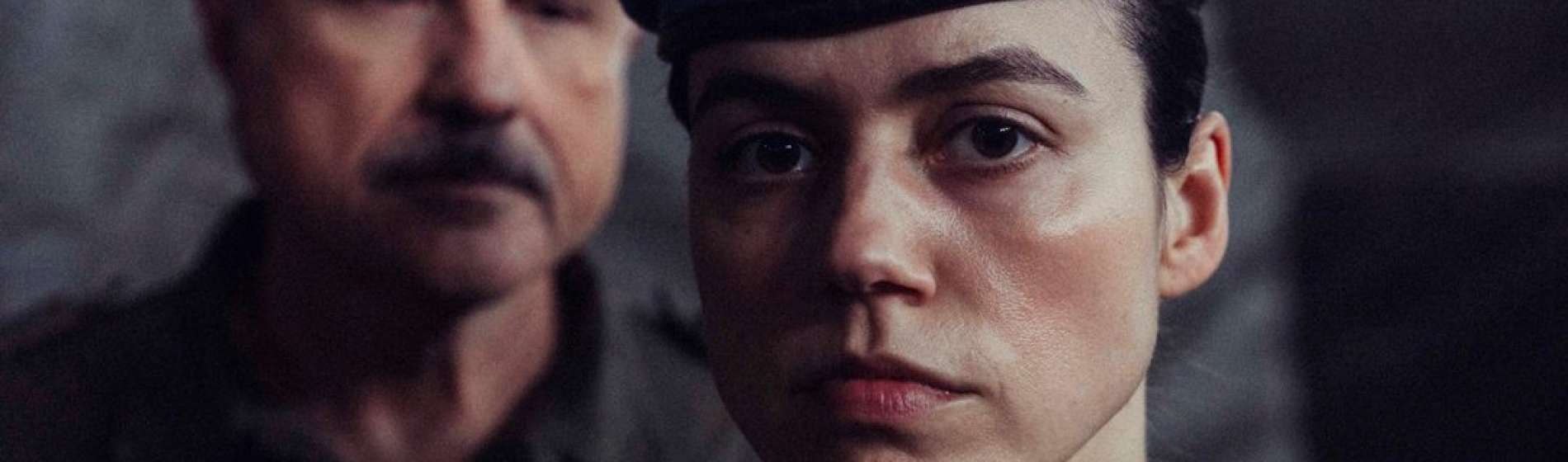



The fight for equal treatment in the military is far from over. Renewed calls to exclude women from serving their country only highlight how little progress has truly been made. A closer look at the debate reveals how the real issue is often obscured. Opponents argue that women lack the physical capability to serve alongside men, yet women have repeatedly proved otherwise. The deeper problem lies in the lack of acceptance and respect they face in the field. Out Standing follows the challenges faced by the first woman to join the Canadian Forces infantry.
Captain Sandra Perron (Nina Kiri) spent five years as a logistics officer – the closest she could get to field duty. When the infantry finally opened its doors to women, she was among the first to enlist. She radiates excitement, finally fulfilling her dream of following in her father’s military footsteps.
Perron understands the program’s demands and doesn’t ask for special treatment. However, the harassment from her fellow candidates is more taxing than the drills. Still, she doesn’t complain about the exercises or the persecution. With the support of Captain Pritchett (Vincent Leclerc) and a few more open-minded brothers-in-arms, Perron becomes the first woman to graduate and join “the Van Doos.” But the obstacles don’t stop there.
Using non-linear storytelling, the film weaves past and present together. It opens in 1995, with Perron facing an unexpectedly tough decision on patrol, one that breaks one of cinema’s cardinal rules. After returning from deployment, she’s drawn into a probe of Pritchett’s conduct. Known as a brutal instructor, he nonetheless helped Perron earn her comrades’ respect during training, even if his methods were unorthodox. Now, investigators question if he went too far to prove her mettle.
The inquiry leads to flashbacks from Perron’s training camp in 1991. Her choice to suffer in silence mirrors that of many women in male-dominated professions, where speaking up only seems to widen the target on their backs. Most of the vitriol comes from two cadets, but that’s probably just a way to focus the narrative.
The film is adapted from Perron’s 2017 memoir, Out Standing in the Field. Comparisons to Demi Moore’s G.I. Jane (1997) are inevitable. However, training to join the Canadian Forces’ infantry isn’t quite as gruelling as trying to enter one of the U.S. Navy’s most skilled combat units. Consequently, this film’s exercise sequences are not as punishing. But the commonality between the women’s experiences is the institutional sexism that stands in both their paths.
Director Mélanie Charbonneau skillfully crafts a narrative that does not portray Perron as a victim. The soldier passes all the same drills as her male counterparts, yet it’s clear her superiors bar her from patrols solely because of her gender. The final straw occurs while she’s overseas, when it becomes clear that letting her complete training was just lip service and they’ll never treat her equally.
Kiri delivers a powerful performance. Her determination to complete the program is palpable, and her physical commitment to the role is striking. She layers the portrayal with small, revealing expressions that capture her constant struggle between retaliation and restraint. Whether Perron handled the issues correctly is not as important as the fact that they persisted. Notably, Charbonneau makes sure audiences understand her perspective without judgment.
The film’s timing feels especially pertinent in today’s political climate. It offers a composed yet resonant depiction of events, while also reflecting on the role perspective plays in shaping these discussions.
Out Standing screened as part of the 2025 Toronto International Film Festival. Head here to get all our That Shelf TIFF coverage.