

Note: This review contains spoilers for 28 Years Later.
We are only days into 2026 and yet, the best horror movie of the year may have just dropped. 28 Years Later: The Bone Temple is a solidly satisfying sequel that builds on its predecessors with gusto, delivering not just a horror movie for the ages, but a spectacular showcase for Ralph Fiennes.
Releasing only seven months after franchise revival 28 Years Later, original director Danny Boyle passes the mantle to Nia DaCosta (Hedda) for The Bone Temple. Alex Garland once again pens a thoughtful script, picking up the story where last year’s film left off.
Spike (Alfie Williams) ran afoul of Sir Jimmy Crystal (Jack O’Connell) in the final moments of 28 Years Later. A life-changing encounter, Spike now finds himself locked in a waking nightmare with Sir Jimmy and his tracksuit-wearing gang of acolytes, whom he has christened his “Jimmys.” As truths about Sir Jimmy’s motives come to light for Spike, he quickly realizes that this gang carries more threats than those infected by the rage virus ever did.
Therein lies the true theme of 28 Years Later: The Bone Temple. Building on the groundwork laid in the previous film, this chapter is a dissection – literally and figuratively – of humanity. The infected may still be terrifying, but the living are the most dangerous threat of all. Underneath the brutality and gore is a story deeply concerned with what survives when civilization collapses, and that includes the good and the bad.
Although the story and arc had been laid by Boyle and Garland at the end of 28 Years Later, DaCosta is by no means a tool to be guided by Boyle. Her eye and influence is all over the film, from framing her actors in close-ups to wonderfully chaotic scenes of violence, fire and brimstone, proving she’s more than capable of carrying the franchise torch. She knows when to pull back and when it set everything on fire.
The cruelty on display comes not from the brainless zombies but from the living. They show less humanity than those reduced to fleshy shells of their living, breathing selves. Just as in 28 Years Later, Fiennes’ Dr. Kelson roots the story in humanity, showing us that it is possible to maintain empathy and kindness as the world falls apart.
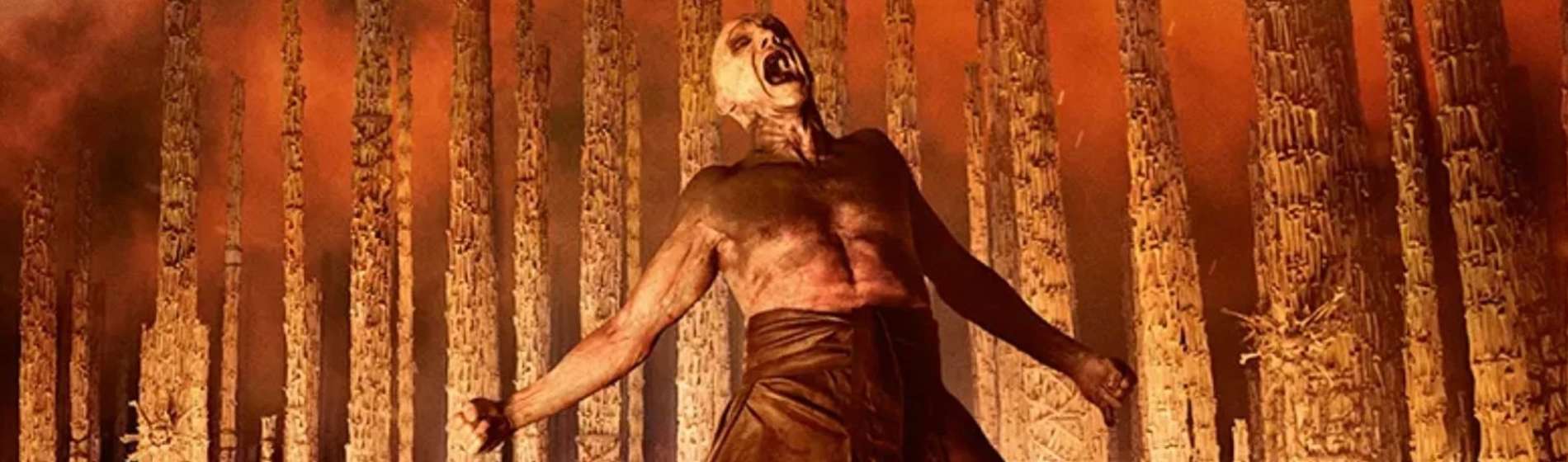
Undoubtedly the franchise’s most fascinating character, Dr. Kelson continues to spend his solitary existence in his ossuary as his “relationship” with infected alpha Samson (Chi Lewis-Perry) grows. One built on respect and scientific curiosity, Dr. Kelson discovers something previously intangible for the infected – not quite a cure, but a glimpse at the human being that once occupied the virus-ravaged brain. It’s a curiosity that brings all four of the previous films into a new understanding, paving the way for the next chapter (and a just-announced sequel).
The first meeting between Sir Jimmy and Dr. Kelson could be volatile, yet DaCosta films it with a steady camera and simple framing. It allows the tension and weight of the encounter to truly rest on the shoulders of the two great actors on screen.
O’Connell, whose appearance in the last movie is little more than a cameo, gets to let loose as Sir Jimmy. Cruel, twisted, demented, and arrogant, the actor is a horrific delight as he brings the character to life. It’s an over-the-top portrayal that never feels out of place. Boastful, he commands the screen and the audience’s attention just as he does his followers. At his every beck and call, the Jimmys are loyal to their titular leader and the promises he makes (which are best left to be revealed while watching the film). Among the Jimmys, Erin Kellyman as Jimmy Ink is dynamic, flip-flopping between sisterly care for Spike and unquestioning loyalty to Sir Jimmy’s cause. Her presence in the film adds a new layer of depth between compassion and cruelty often on display.
Much like 28 Years Later, Fiennes delivers an incredible tour de force performance. Fiennes has played every type of character imaginable in a lengthy career but he has not come close to anything like Dr. Kelson in The Bone Temple. As the bald, iodine-dyed Dr. Kelson, he lights up the screen. Delivering a performance that is as delightful as it is jaw-dropping, his fantastic turn will have viewers buzzing as the credits roll. His performance makes The Bone Temple infinitely re-watchable.
Still, 28 Years Later: The Bone Temple is a horror movie. True to form, it is graphic and gory. While the zombies are responsible for some of the bloodshed, the most brutal and bloodiest battles are at the hands of the humans. For anyone disappointed by the level of zombie violence in the last film, they likely won’t be with this outing.
It isn’t just a worthy continuation but a reminder of why Boyle and Garland’s franchise mattered in the first place. By shifting the horror away from the infected and towards the rot that festers inside those still living, this is a sequel that proves the franchise still has legs. Anchored by towering performances from Fiennes and O’Connell, and guided by a director unafraid to leave her own scars on the material, The Bone Temple proves this series still has terrifying, essential stories to tell.