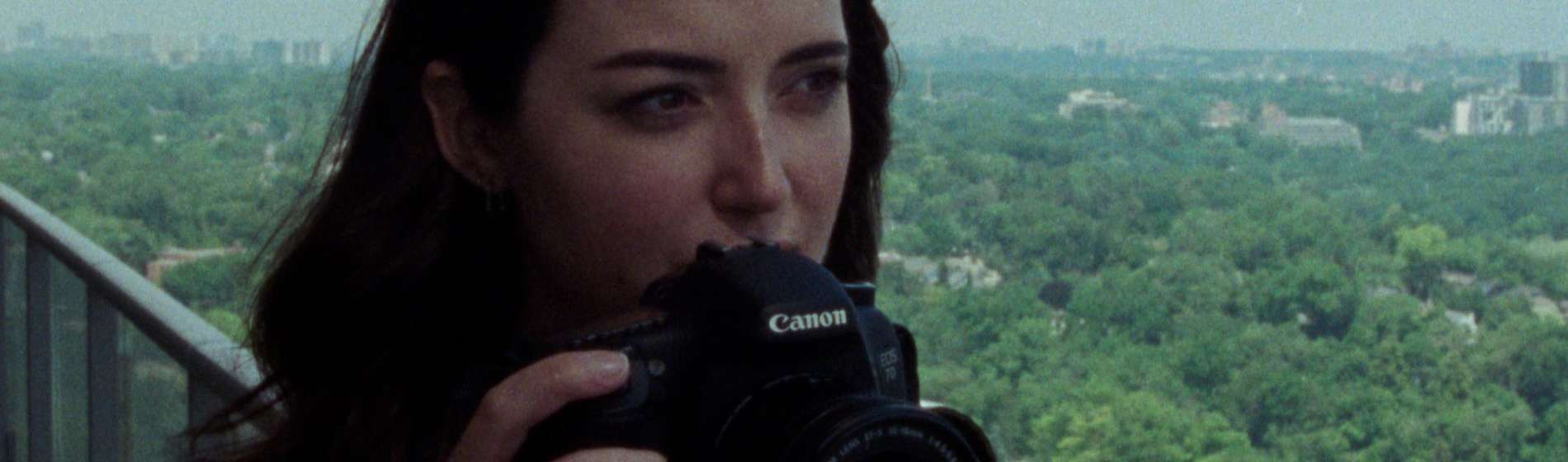


The city of Toronto has long been an elusive performer in mainstream cinema. Most of the time, its brutalist architecture and tall skyscrapers are understandably used as stand-ins for New York City or Chicago. In terms of using Toronto and unpacking the singular experience and energy, auteurs such as David Cronenberg and Atom Egoyan are typically among the select few one could turn to. Mississauga-born filmmaker Christopher Beaulieu’s feature film debut, Otium, puts downtown Toronto front and centre from the very first frame and creates his own unique interpretation of the city. The camera pans across the floor-to-ceiling windows of an elegant apartment, overlooking the Gardiner Expressway. The title card is shown against these roadways interlocking in an eerie tangle as an equally destabilizing droning score swoons.
Otium follows Hanna (Eliza Martin), a woman who commutes from Mississauga to downtown every day to photograph luxury apartments for a real estate platform and slowly realizes that nobody actually occupies them. The film echoes real concerns from local suburbanites who have a detached relationship to the big city. They may work there, but socio-economic forces push against any possibility of developing a relationship with the concrete skyline, something that impedes Hanna’s blossoming into adulthood.
Beaulieu is yet another young Canadian filmmaker continuing the grand tradition of crafting an accomplished, patient semi-autobiographical story. That Shelf’s Andrew Roberts was delighted to get to speak with him before his film’s Toronto premiere at the Future of Film Showcase.
Andrew Roberts: I love how this film looks. Was shooting on film something you were thinking about early on in the filmmaking process?
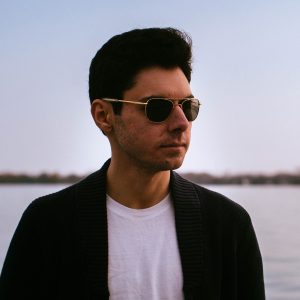 Christopher Beaulieu: Yeah. I shot my previous short on film, and I’m very invested in the medium. I have this very apocalyptic worldview of the future of filmmaking, so being able to retreat into these image-making technologies of the past gives me some comfort. If I really hate where the world is going, it’s like I can jump into the past [by] shooting on film.
This film could have very easily been shot on digital, but then it would just look like Airbnb photography.
Right, you would become part of the problem, and it would feel algorithmic.
Exactly. Shooting on film gives it a more gritty texture and also a texture of the past. If I’m thinking about Toronto and everything that our society is geared towards–you know, Boomers, basically. They own everything. We’re in their world as younger people. It made sense that, aesthetically, the world of the film exists in their world, in a space of “old imagery.”
You were born in Mississauga, which necessitates this distant relationship to downtown Toronto. I got the feeling in the film that Hanna was travelling to a different dimension every time she would take the GO train. What made you want to conjure that feeling?
It’s interesting because this is the first time the film is playing in Toronto, so this is the first time I’m getting questions specific to Toronto and Mississauga.
I was trying to convey that if people can’t afford to live in the city itself, Mississauga is not that far, but does that keep going? Does it become Hamilton? Does it then become further out? Are all these people who are trying to work in the city unable to [do so]?
I wanted to create a distance because I think it’s not just physical distance; it’s a distance from culture, and that becomes more apparent the more unaffordable it is to live in the city.
Toronto very rarely plays itself in cinema. Your film opens with the Gardiner Expressway, which, in my mind, has not been done since Cronenberg’s Crash. What were your influences when making your own interpretation of Toronto?
This is unrelated to Toronto, but a huge stylistic influence was Taxi Driver. That’s a film about isolation and transgression, so there are many references. Hanna has a military jacket as a stylistic reference.
More on a practical level, I was looking at the early films of Kazik Radwanski, Antoine Bourges, and Sofia Bohdanowicz. I looked to them because, as a filmmaker making my first feature, their early features are all smaller and funded with arts council grants. In terms of setting it in Toronto and making it visibly Toronto, I think the story is super specific to the city. It would be harder to separate it from that and create a generic North American space.
But we’ve played the film in France, and people still understood it. I feel like these economic situations are a worldwide thing.
The conversation between empty and active spaces is something that runs through the entire film. What went into capturing these spaces and slowly unravelling their differences?
That’s an interesting question. I had originally conceived of the film as having the city be entirely empty. Like whenever we would go out in public, it would just be Eliza.
Like a 28 Days Later situation.
Yeah. I had this idea that it would have a psychological effect when we never acknowledge the city being empty when you go outside. That is manifested in the film during the skate park scene at the end where everyone kind of disappears.
Specific to the skate park, they’re young people, they’re in a public space, and they vanish into thin air. I think I am trying to grapple with the idea that if we’re consistently making things not affordable, pushing people out, these kids can’t just vanish out of thin air as they do in the film. “Where do they end up?” is what the film is asking. I was trying to think about that in terms of full places and empty spaces.
The film possesses an intrinsic sense of doom, where Hanna never actually vocalizes her anxieties, apart from when she talks about her art. How did you think about growing tension throughout the film?
Something very deliberate in the film is that Hanna is spoken to more than she speaks. It’s very much reflective of me and how I am an internal person. So, I really wanted the film to be, for lack of a better term, a series of beatings on Hanna. The tension comes from how she’s consistently put in a worse position, and she’s not the type of person to respond to that.
If I can go back to Taxi Driver, it’s a world of violence, and therefore Travis Bickle’s transgression is violence. In the world of Otium, all of these transgressions are nebulous. If you can’t afford a place to live, there’s no direct villain. There’s no direct vector of attack. I think part of the tension is asking, “What is the response?” That’s why the end is left ambiguous about whether she’s breaking in or squatting.
You were able to get the support of Canadian, Ontario, and Toronto arts councils. How foundational was their support in terms of achieving your vision?
It helps to have funding. [Laughs.] We certainly couldn’t have made the film without it, and I’m in a super privileged position. In general, as a person who has gotten funding, there’s a double pressure for artists in the city or in Canada as well, where there’s less and less money being given out and more and more people applying. I got this funding three or four years ago when it might have been easier to get funding. I don’t know if I would be able to get the same funding if I applied again from scratch right now. All of that is to say I think it’s important that there is a strong public arts sector. I think this film is an example of the things that you can do, but it’s always a struggle to get funding.
The Future of Film Showcase platforms many young filmmakers. What advice do you have for anyone making their first feature since you have just made it to the other side of your own?
It’s a tricky question because things are always changing, and what works for me won’t necessarily work for others. I would say maybe the most helpful thing is to have a benchmark or filmmakers who you feel are in the position that you want to be in. Without being overly ambitious, look at someone you think you could be in that spot maybe five or ten years from now. Do research and look at the pathways they took to get there. It almost certainly won’t be the same pathway for you, but it helps to look at what a realistic vision of a career path for a filmmaker is.
Otium had its Toronto premiere at the Future of Film Showcase on July 26.
The interview has been edited for clarity and length.