


William Shakespeare lived and died more than four centuries ago, but his work continues to prove timeless. His plays remain a staple of high school English classes. Actors gain status by reciting his words on the stage. Shakespeare may even be one of the original creators of quotable dialogue beyond the context of the theatre. Some of his stage plays are so well known that the themes are recognizable even when the script or story are given a contemporary update. In Hamlet , the latest adaptation of the tragedy to grace our screens, filmmakers preserve the Bard’s words, but set the stage in modern-day London’s South Asian community.
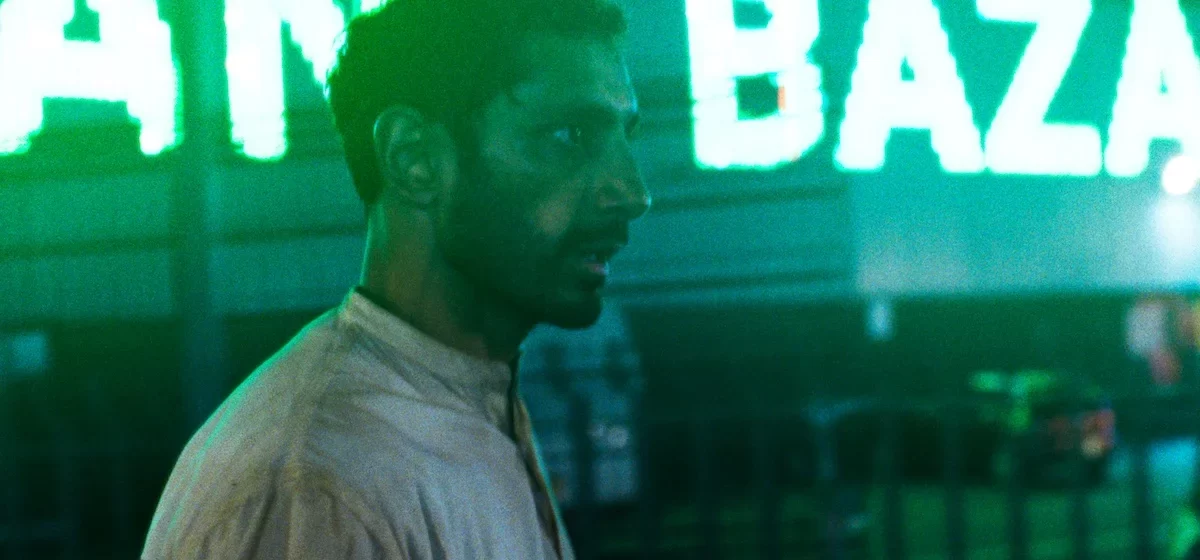
As we well know by now, Hamlet ( Riz Ahmed ) returns home for his father, the king’s, funeral. While overcome with grief, he learns his father’s brother, Claudius (Art Malik), is set to marry his mother, Gertrude (Sheeba Chaddha), and assume the crown. Hamlet is distraught and becomes convinced his uncle conspired to murder his father and take his place. His suspicions drive him mad, pushing away his love interest, Ophelia ( Morfydd Clark ), and best friend, Laertes ( Joe Alwyn ). Hamlet decides he will expose his uncle’s guilt with a play that depicts an assassination similar to his father’s death. Based on his uncle’s and mother’s reactions, Hamlet will know if they carried out the plot or not.
Most people will be aware that this story, like all Shakespearean tragedies, does not have a happy ending. That said, audiences may require a familiarity with the original source to fully understand the film as it’s presented. Initially, there is a lack of clarity because in their emotional states, the actors fail to enunciate their words. Early prose and verse can already be difficult to understand, but when the words all run together it can be nearly impossible. Although this issue remedies itself as the film progresses, others arise.
The film modernizes the narrative so it unfolds in present-day England. Unfortunately, they make less effort to contemporize the line delivery or match the dialogue with the context. The emphasis is on hitting all the beats rather than making sure the meaning remains intact. The result is occasional mismatches between what is being said, how it’s being said and where it’s being said. For instance, Hamlet delivers the infamous “to be or not to be” soliloquy while recklessly driving his car alone.
Similarly, the play designed to reveal Claudius’ guilt gets an exciting Bollywood-style update. However, the presentation becomes more abstract and the conspiracy to murder is less obvious. So it’s possible the meaning may be lost on those unfamiliar with the source material.
That said, Ahmed’s Hamlet is certainly impassioned. He plays the prince’s descent into madness with nuanced authenticity. But it is Clark’s Ophelia that is probably the film’s best performance. She perfectly captures the young woman’s spiral into despair and adds a realness to the doomed Ophelia, a character at the end of their rope. Both Clark and Ahmed feel well-versed in the dialogue, as does the rest of the key players (Chaddha, Malik, Alwyn, and Timothy Spall as Polonius), so it’s a shame their surroundings don’t always meet the dramatic moments created by such a seasoned cast.
Hamlet screened as part of the 2025 Toronto International Film Festival. Head here to get all our That Shelf TIFF coverage .