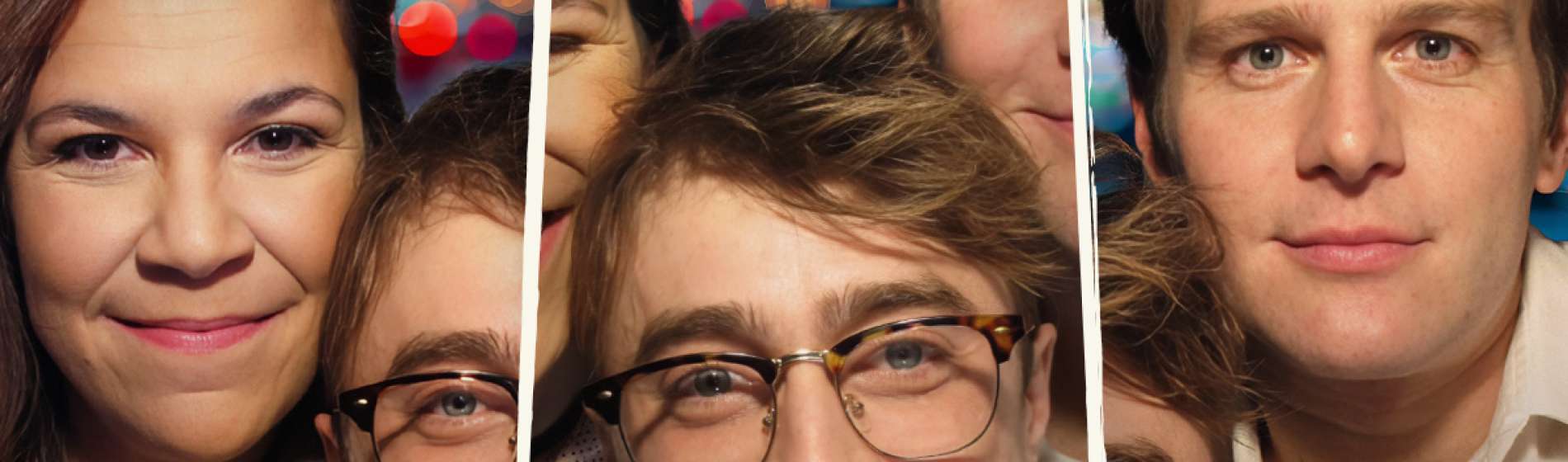


“Hey, old friend…”
In 2023, director Maria Friedman mounted the very first Broadway revival of Stephen Sondheim’s Merrily We Roll Along to great praise. This record-breaking production would go on to win multiple Tony Awards, including Best Revival of a Musical, and Best Actor and Best Featured Actor in a Musical—for Jonathan Groff and Daniel Radcliffe, respectively. It was heralded as one of the best productions of one of Sondheim’s most controversial works. Now, RadicalMedia (the same company responsible for bringing Hamilton to Disney+, and Come from Away to Apple TV) brings a filmed version of the stage musical to cinemas, also directed by Maria Friedman.
For the uninitiated (though it’s hard to imagine someone watching this without knowing what it is), Merrily We Roll Along is an adaptation of the 1934 play of the same name by Pulitzer-winning playwrights George S. Kaufman and Moss Hart ( You Can’t Take It With You) . It tells the story of three old friends—Franklin, Charley, and Mary—and charts their lives and careers from 1957 to 1977. What’s unique about the storytelling is that it is told in reverse chronology, starting with the friends at their absolute lowest, barely on speaking terms, and ends with them at their most youthful, full of promise and wonder.
The show is perhaps best remembered as one of Broadway’s greatest flops. Re-teaming the great Stephen Sondheim with longtime collaborators George Furth and Hal Prince, the original 1981 Broadway production was cast with almost entirely with teenagers (including a very young Jason Alexander), was critically panned, and closed after just sixteen performances. The great documentary Best Worst Thing That Ever Could Have Happened covers the creation and failure of the musical, and catches up with the production’s original cast.
It can be hard to review recordings of live theatre (or “pro-shots”) as “films” because they’re decidedly different from a traditional “film”. Yes, they tell a story through visual storytelling, but they also serve as documentation of a live performance; which makes them more akin to concert films or documentaries than actual narrative films.
So let’s start first with the show itself. It’s Sondheim, arguably the greatest American musical theatre composer of the twentieth century, so it’s unsurprising the songs are great. They will likely stick with you long after the show has concluded. But songs are only as good as your performers, so it helps that this particular version has some absolute heavyweights.
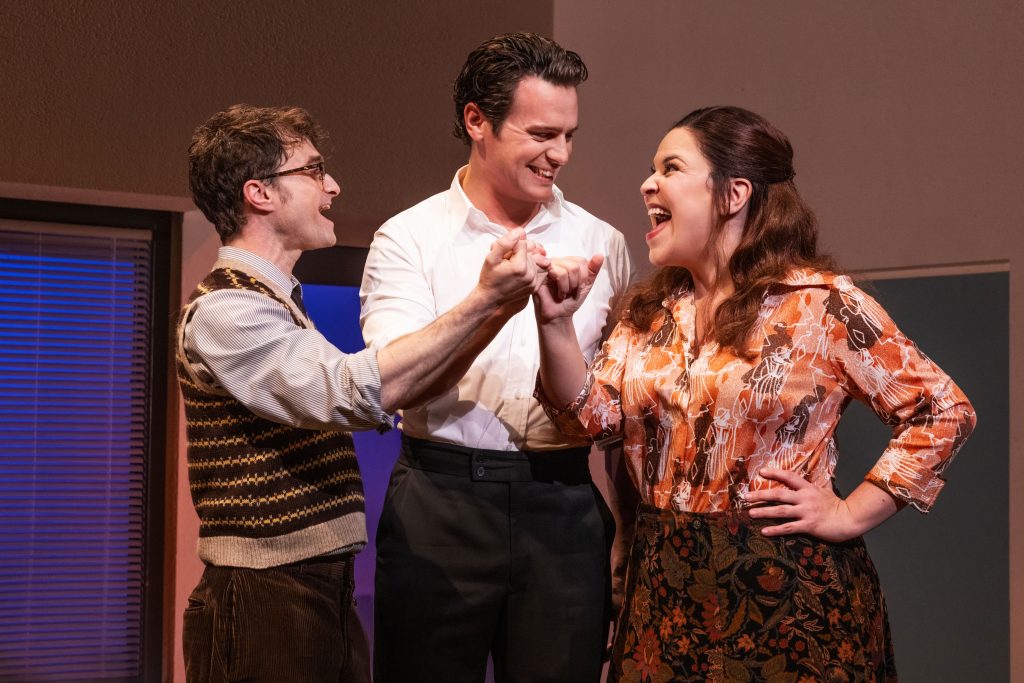
Jonathan Groff ( Frozen , Mindhunter ) plays Franklin Shepard, a brilliant composer who, over the course of the narrative, becomes the most successful of the three main characters, yet arguably the most unfulfilled. We see him go from wide-eyed optimist to toast of the town to a shell of his former self when he no longer composes but instead produces movies. He may be successful, but is he satisfied? And what has he given up along the way? Groff’s performance was widely lauded at the time, and it is easy to see why it led to a Tony Award win. The way in which he conveys so much with so little is impressive. In the opening number, we see his eyes literally well up with tears as the ensemble sings. He takes his natural charm and charisma and turns it up to 10 here, and even though his character makes a number of questionable choices, you cannot help but root for him. Ever since he first burst on the scene in Spring Awakening , he has become a big draw on stage and screen, and Merrily provides him with a perfect showcase for his triple-threat talent.
Then you have Lindsay Mendez ( All Rise ) as Mary Flynn, a wannabe writer-turned-critic-turned-washed-up-drunk. She happens to be in love with Frank, though that love will remain unrequited. What makes her character so interesting is that she’s the one whose story arc is most outwardly portrayed. Mendez does something quite remarkable then, aging in reverse throughout the show. Every time she comes on stage, you can literally feel the years peeled away from her, a little bit of cynicism washed away. Of the trio, it’s perhaps the least showy performance, but easily the most nuanced. I was not familiar with Mendez’s work prior to this, but it comes as no surprise that she was also nominated for a Tony for her performance here. She is absolutely a talent to watch.
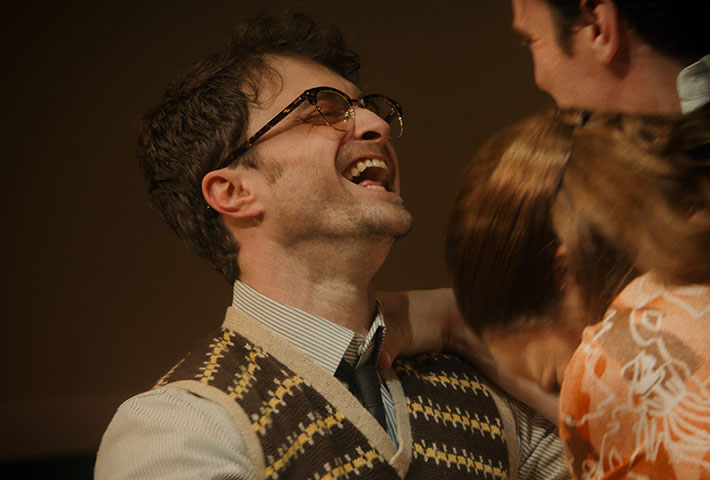
But it’s Daniel Radcliffe’s ( Harry Potter, The Woman in Black ) performance as playwright Charley Kringas that surprised me most. I was aware of his post-Potter stage career, but had never actually seen him in anything. Any reservations I had about seeing “Harry Potter sing and dance” were washed away within minutes. He gives the most impressive performance in the show. His first significant number, “Franklin Shepard, Inc.” is truly a sight to behold, as he rants and raves about his “best friend” and collaborator with true verbal dexterity and energy that I didn’t think possible. It’s not surprising that it gets the most extended applause break of the production, too. But it’s his utterly heartbreaking rendition of “Good Thing Going”, with Radcliffe fighting back tears the entire time, that completely won me over. Again, it should come as no surprise that he, too, was nominated for and won a Tony award for his performance.
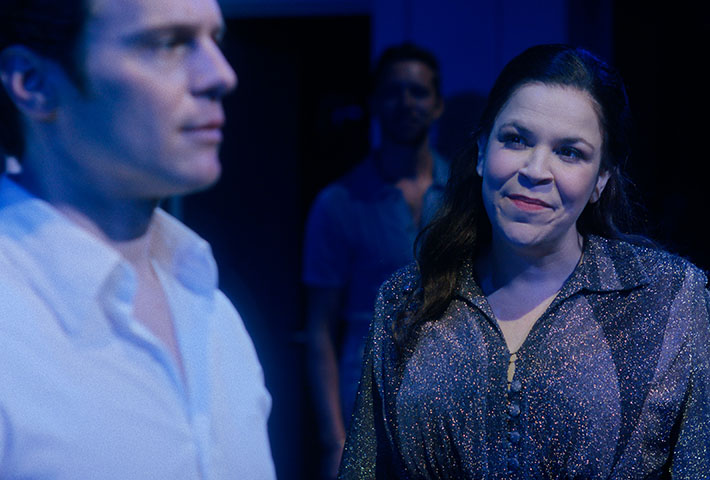
Director Maria Friedman manages to take the troubled source material and make it work. There isn’t a great deal of theatricality on display in Merrily We Roll Along— outside of the ensemble actors playing multiple minor roles—which allows the performances, and the songs, a chance to shine. Indeed, she handles the reverse-chronology narrative in a way that is never confusing, making the pay-off at the end of the show that much more impactful and heartbreaking.
Unfortunately, as strong as Friedman’s stage direction is, her skills as a filmmaker are less assured. Understanding the language of the medium and how to use it properly is key to ensuring the translation works. Much like the pro-shot performance of Hamilton , this filmed performance is also directed by the stage director. And, like Hamilton , Merrily ‘s on-screen version suffers from a director with limited experience filming live performances. It seems as though Friedman wanted this to feel more like a “film” than a “filmed performance”, and she, for the most part, strips away all the elements that reveal things to be a stage show. There are no swooping shots of the audience, no reverse shots during the performance to reveal the theatre during applause breaks, no intermission, and no curtain call. And yet, bizarrely, the audience is very clearly present, with applause and laughter left in the mix.
Friedman and cinematographer Sam Levy ( Frances Ha , Lady Bird ) opt to shoot most of the film in medium shots and close-ups, with relatively few masters, except to establish a scene. While this certainly can help bring you closer than you could ever be during a stage performance, it also leaves things feeling somewhat flat, and worse, at times confusing. We’ve all been told that film’s super power is the close-up, but if 60% of your shots are close-ups, it really neuters their effect. The film is also overly edited, with constant cuts where they don’t need to be. Dialogue scenes will frequently ping-pong between close-ups of whoever is speaking, rather than pulling back to let a conversation play out. It can be somewhat disorienting at times. The energy should come from the performers themselves; indeed, they have plenty to give. The editing needn’t be so frenetic and “MTV”-like. The camera work can also feel a bit unpolished at times; the opening number, in particular, features several shots where it feels like the camera wasn’t properly stabilized, and there are some serious blooming issues on certain camera angles.
The sound mix is also particularly disorienting. The dialogue and vocals are crystal clear , which you would think is a good thing, but at times it feels so clear that you almost feel like the actors are lip-syncing, or worse, being overdubbed in post. Krystal Joy Brown’s performance feels especially ADR’d, as if her microphone was broken during the shoot and they had to replace every line of her dialogue afterward. It gives off the vibes of the musical numbers on Glee , where things just aren’t quite meshing the way they should, and as a result, takes you out of the moment. None of the other filmed performances that I’ve watched over the years (and I’ve watched many) have had this issue, and it’s hard to know if it was a conscious choice to help the thing feel like it was shot as a real film and not as a staged performance, but it did feel problematic.
But aside from these technical issues, it’s hard not to be grateful that this film exists. Yes, the ephemerality of theatre is part of what makes it so special; no two performances are the same. But for theatre lovers who rarely get a chance to head down to Broadway to experience these special shows, films like this provide exceptional accessibility. Moreover, it’s so great to have such a special production documented and preserved for future generations.
Merrily We Roll Along may not be Sondheim’s best show. Still, it’s an unflinching look at the struggles of creativity, the balance of art versus commerce, and a heartbreaking portrait of friendship unravelling under the weight of it all. For fans of the theatre, this is an absolute must-see, and without question, the best musical you will see this year at the cinema.
“Here’s to us. Who’s like us? Damn few!”
Merrily We Roll Along opens in theatres on December 5.