



[nextpage title=”15 Knockoffs That Stole Ideas From Better Movies”]Have you ever found yourself looking at a movie poster and thinking to yourself that it looks familiar? Maybe a little too familiar? Well, chances are that you might be looking at a knock off. A movie that steals ideas from another (usually more successful) movie and then passes them off as their own.
Guardians of the Galaxy director James Gunn raised the question of what constitutes a knock off earlier this month when he threw some shade at a poster for 7 Guardians of the Tomb. The poster for the Kelsey Grammer-starring Chinese-Australian adventure film uses a similar font and design as the promotional materials for the Marvel franchise (in addition to sharing the word “guardians,” of course). Although the movie itself doesn’t seem to have much in common with Gunn’s films, the distributors of Tomb, which premieres in limited release this month are probably hoping some of the Galaxy box office success will rub off on them, too.
Legally speaking, the question of what constitutes plagiarism isn’t always as clear-cut as you might think, so not all of the movies on this list are examples of copyright infringement. Nevertheless, all of the movies on this list were either made with the hope of cashing in on the popularity of another movie, or straight-up stole a good chunk of their plot from another film.
Here are 15 knock offs that took ideas from better movies.
Mac and Me – ET: The Extra-Terrestrial
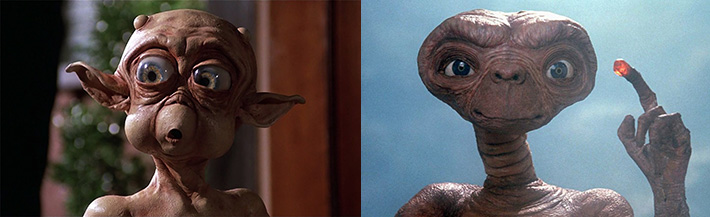
In 1982, a creepy-looking little alien landed on Earth and charmed the world with his taste for Reese’s Pieces and a strong desire to “go home.” Six years later, a film called Mac and Me decided to tell a similar story, but this time with sponsorship from McDonald’s. To be fair, producer RJ Louis actually wanted the film to benefit The Ronald McDonald House Charities, which is why he lobbied hard for McDonald’s to be involved in the film.
Unfortunately, the movie looked more like an advertisement for McDonald’s itself when it came out in 1988, possibly due to the jaw-dropping, Ronald McDonald-featuring musical dance number set inside a McDonald’s. Since then, the film has earned cult following, counting Paul Rudd as on of its most visible fans.
[/nextpage]
[nextpage title=”Lockout – Escape from New York”]
Lockout – Escape from New York
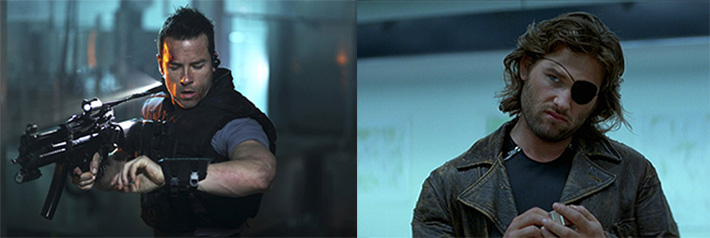
In the 1982 John Carpenter classic Escape from New York, the President of the United States is kidnapped and taken to a futuristic, dystopian Manhattan, which has been transformed into a maximum security prison. Snake Plissken (Kurt Russell), a former soldier and prisoner, is given 24 hours to find the president and escape with him.
The 2012 science fiction thriller Lockout features a similar plot, with Guy Pearce playing a prisoner who is offered freedom in exchange for saving the President’s daughter (Maggie Grace) from a maximum security jail… in space. Many critics commented on the similarities between this film and Escape from New York upon its release, including John Carpenter himself, who sued the film for plagiarising Escape and its sequel, Escape from LA. Carpenter’s lawsuit was successful, and French producer Luc Besson paid almost half a million dollars for the infraction.
Romancing the Stone/King Solomon’s Mines – Raiders of the Lost Ark
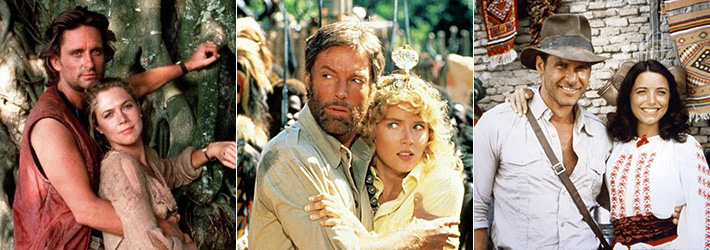
It’s fair to say that Allan Quatermain, an English adventurer in Africa who made his literary debut in 1885, probably influenced Steven Spielberg and George Lucas’s Indiana Jones films quite a bit, but the character wasn’t exactly a matinée idol before Raiders of the Lost Ark became a smash hit in 1981.
In the years following Raiders, other studios tried to cash in on its success by making their own problematic movies about adventurous white guys travelling though “exotic” locales, including King Solomon’s Mines, starring Richard Chamberlain as Allan Quatermain in “Darkest Africa,” and Robert Zemeckis’ Romancing the Stone, which stars Michael Douglas as an exotic bird smuggler searching for a giant emerald in the Colombian jungle. The latter film was so successful at copying the Raiders formula that Spielberg recruited Zemeckis for Back to the Future.
[/nextpage]
[nextpage title=”Dünyayı Kurtaran Adam (Turkish Star Wars) – Star Wars”]
Dünyayı Kurtaran Adam (Turkish Star Wars) – Star Wars
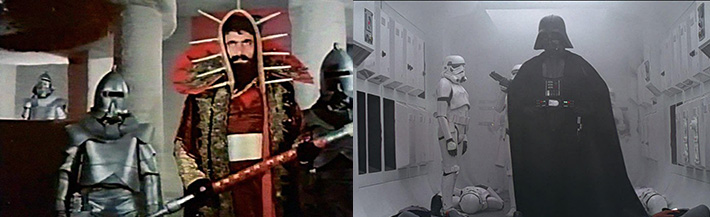
George Lucas’ Star Wars has been ripped off so many times and so many ways that it’s getting hard to count, from the original Battlestar Galactica miniseries to low budget affairs like Laserblast or The Shape of Things to Come. Likewise, the Turkish film industry is notable for ripping off Hollywood classics like The Wizard of Oz or Superman.
Even by those standards, Dünyayı Kurtaran Adam (better known as Turkish Star Wars) is pretty remarkable. This film doesn’t just steal its plot, or even character designs, from Star Wars, it steals actual footage from the film, along with Star Trek and Battlestar Galactica. Little seen, particularly outside of Turkey, the unlikely film never ran into legal trouble, and has since developed a cult following in the West for its imaginative repurposing of someone else’s intellectual property.
A Fistful of Dollars – Yojimbo
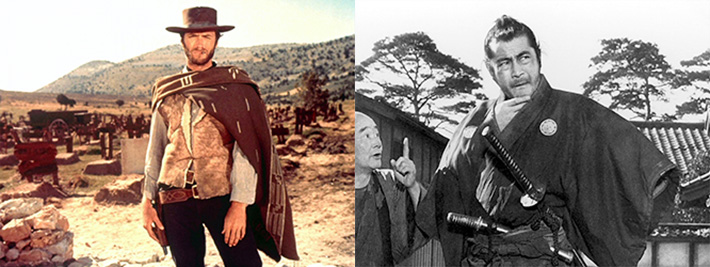
Remarkably, Clint Eastwood is still an active presence in Hollywood, most recently directing The 15:17 to Paris, which came out earlier this month. His first lead role, which launched him into stardom, came with A Fistful of Dollars, Sergio Leone’s 1964 spaghetti western, which is an unofficial remake of Akira Kurosawa’s Yojimbo.
Both films feature a silent man who arrives in a small town (Eastwood in Dollars, Toshiro Mifune in Yojimbo) and plays competing gangs and crime lords against each other. The case was complicated by the fact that Kurosawa’s film was potentially inspired by Dashiell Hammett’s novel Red Harvest, a western. The producers of Yojimbo noticed the similarities between Dollars and Yojimbo and sued Leone, with Kurosawa claiming that Leone made “a very fine fine, but it was my film.” The lawsuit was settled out of court.
[/nextpage]
[nextpage title=”Immortals – 300″]
Immortals – 300
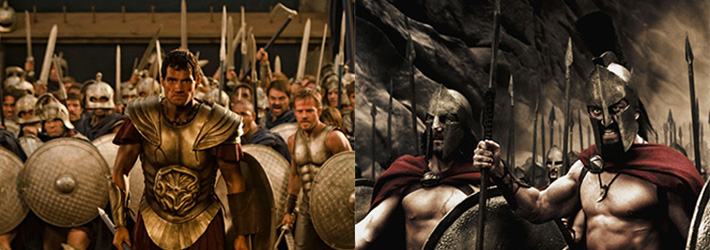
The Oscar-winning success of Gladiator reignited the moribund “sword and sandals” genre in the 2000s, spawning several less noteworthy films, like Troy or Alexander, that failed to succeed on the same level as Ridley Scott’s Roman epic. It was Zack Snyder’s 300 that provided a unique spin on the genre, with a hyper-stylized approach to violence and gore that galvanized audiences and raked in cash when it was released in 2007.
300 succeeded by forgoing the usual traits of the sword and sandals genre, like big outdoor location shoots and large numbers of extras, in favour of a studio-bound, CGI-assisted film that emulated the Frank Miller graphic novel that it was based on. It created a very distinctive and hyper-modern look, which might be why viewers had a sense of déjà vu when another film called Immortals came out in 2011, starring a pre-Superman Henry Cavill. To be fair, the film looks incredible, but it’s obvious that the film’s producers were hoping to recapture that 300 magic. Directed by Tarsem Singh, known best for his wildly original music videos, Immortals is a curiously derivative affair.
The Fast and The Furious – Point Break
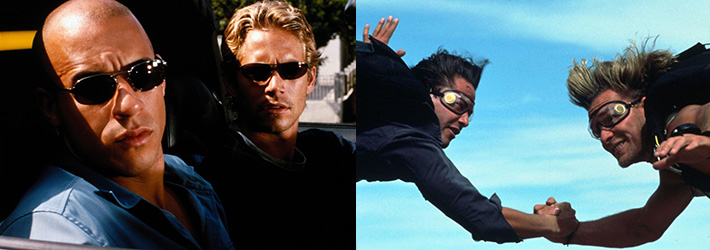
The Fast and the Furious is a rare case where the rip-off is better known and more successful than the original. Both of these films are about young, undercover law enforcement officers who infiltrate a California subculture that is connected to criminal activity. And in both films, the undercover agent falls in love and gets emotionally attached to the gang they’re supposed to bust. In Point Break, it’s surfers who rob banks and in The Fast & The Furious it’s street racers who rob trucks, but they both have the same basic plot.
But while Point Break is a well-liked movie with its own not-insignificant fan base, The Fast and the Furious is now a worldwide juggernaut. Eight films deep, the latest installment, The Fate of the Furious, earned over $540 million in its first weekend. A ninth film, obviously, is in development.
[/nextpage]
[nextpage title=”Critters – Gremlins”]
Critters – Gremlins
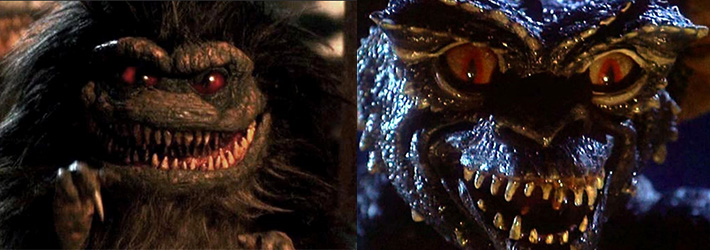
In 1984, a charming little creature called Gizmo hit big screen and turned a little horror movie called Gremlins into an instant success. Perhaps because of its relatively small scale, Gremlins spawned a number of knock offs over the next decade, including Ghoulies, Munchies and Hobgoblins.
The most notable of these knockoffs, however, was Critters. In this film, a group of small, furry aliens invade a Kansas town, going on killing spree. The film’s director denies any connection between the films, and says the script was rewritten to avoid similarities. This could be true, but the similarities between the films and their creatures are a little too strong to ignore.
Shark Tale – Finding Nemo
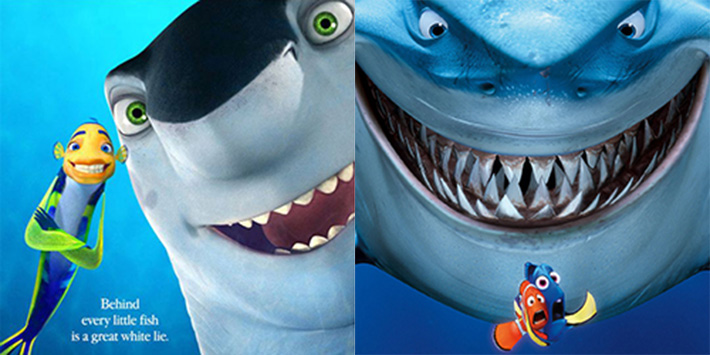
Hollywood has a habit of releasing similar movies with similar plotlines around the same time, often claiming that one of them was in production before the other got released. A Bug’s Life and Antz, Armageddon and Deep Impact, Paul Blart: Mall Cop and Observe & Report or Olympus Has Fallen and White House Down. Given how often this happens, one has to wonder how often these studios are saving face and how often they’re telling the truth.
Another similar situation is Shark Tale, an animated film from Dreamworks about life under the sea that was released merely a year after Disney and Pixar’s blockbuster hit Finding Nemo. While Shark Tale can’t match the quality of the Pixar film, it does have a few charms of its own, like filmmaker Martin Scorsese playing a bushy-eyebrowed blowfish bookkeeper.
[/nextpage]
[nextpage title=”The Hunger Games – Battle Royale”]
The Hunger Games – Battle Royale
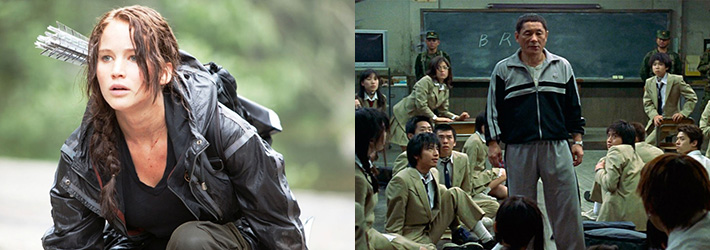
In The Hunger Games, a bunch of teenagers from a dystopian future are rounded up from their families and forced to fight against each other to the death on television in a sort of über-violent version of Survivor. It’s an irresistible premise, a young adult version of The Running Man or Death Race 2000, and the film’s box office was enormous. The only issue is Japanese film Battle Royale used pretty much the same premise in 2012.
Already a cult classic when The Hunger Games was released, Battle Royale has gained an even bigger following in the West in the years since the blockbuster young adult film started breaking box office records in 2012. Kinji Fukasaku’s film is more violent and less accessible than the teen-friendly Hunger Games franchise, but it’s also a more thought-provoking study of the role that violence plays in society.
Partner – Hitch

For decades, Bollywood has been blatantly ripping off Hollywood films, and not just the blockbusters. Even the more-or-less forgotten comedy My Cousin Vinnie from 1992 was remade in India as Banda Yeh Bindaas Hai. Jason Reitman’s Juno became Teree Sang. Christopher Nolan’s Memento became Ghajini.
But even by the standards of Bollywood, Partner is exception… because they got caught. The film, which borrowed liberally from Hitch, starring Will Smith as a dating expert, was threatened with a $30 million lawsuit, which would have been the first time that an international company sued a Bollywood company for copyright infringement. The lawsuit never came to pass, but Sony did acquire the film for international satellite broadcasting. In the following years, Hollywood has been more diligent about preventing Bollywood companies from stealing their intellectual property.
[/nextpage]
[nextpage title=”Lady Terminator – Terminator”]
Lady Terminator – Terminator
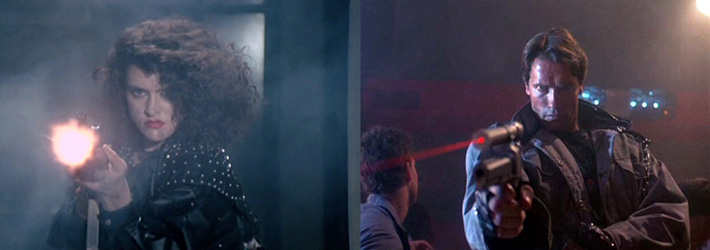
What if the Terminator… was a lady? Well, that happened in 2003’s Terminator 3: Rise of the Machines, but it happened first in the Indonesian science fiction action film Lady Terminator. This film, produced in 1989, rips off a good portion of its plot from James Cameron’s The Terminator, but it’s also baffling and, perhaps, imaginative in how the violence plays out.
Curiously, the film’s director and main cast all used “western” sounding names like Jalil Jackson (real name H. Tjut Djalil) and Barbara Anne Constable, suggesting that they were hoping to convince audiences that this was the real, Hollywood-produced deal. Anyway, in this version of the Terminator tale, the titular robot is a woman possessed by the Queen of the South Seas,
Alien vs Hunter – Alien vs Predator
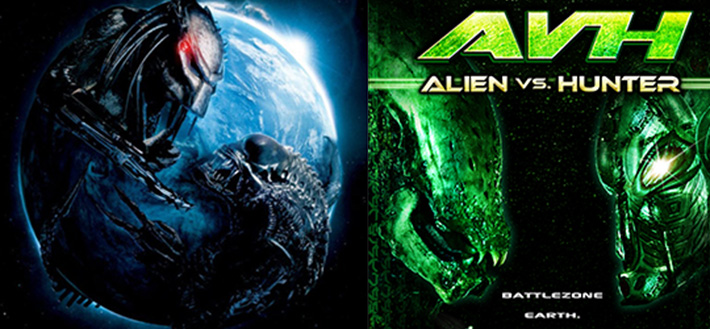
With all due respect to Ridley Scott, Ripley, the xenomorphs and crew, you can’t trademark the word “alien.” For the “mockbuster” kings at The Asylum, a production company that specializes in knocking off big blockbusters with titles like Transmorphers, Snakes on a Train, and The Da Vinci Treasure, this is an opportunity too big to ignore. That’s why AVH: Alien vs. Hunter was released on video just a week prior to the big screen debut of Alien vs. Predator: Requiem.
In the age of streaming and the death of video rentals, The Asylum primarily makes films for cable, and are best known for their five film deep Sharknado franchise. But in the 2000s, their business practices meant putting movies with oddly familiar titles on video shelves timed to piggyback off the advertising campaigns of Hollywood blockbusters. If you ever accidentally rented HG Wells’ War of the Worlds starring C. Thomas Howell instead of the Steven Spielberg’s War of the Worlds starring Tom Cruise, then you’ve been hoodwinked by The Asylum.
[/nextpage]
[nextpage title=”The Legend of Sarila – Frozen”]
The Legend of Sarila – Frozen

When it comes to fairy tales and folk tales on film, Disney has cornered the market. In the 1990s, several companies cashed in on the popularity of big budget Disney films by stocking bargain bins and Blockbuster shelves with movies like The Secret of the Hunchback of Notre Dame, The Secret of Mulan, or Young Pocahontas. This kind of cheap, animated knockoff continued in the early era of Netflix with movies like Chop Kick Panda or Tappy Toes, which both resembled big budget animated movies (Kung Fu Panda and Happy Feet, respectively).
One of these movies is The Legend of Sarila, an animated Canadian film that was picked up for American distribution by Phase 4 films and retitled Frozen Land, with a logo that closely resembled Disney’s Frozen. Film titles can’t be trademarked, but Disney sued Phase 4, which has also released films such as Alien Uprising and Uwe Boll’s Blubberella, for swiping its logo. Phase 4 settled out of court, made a payment to Disney, and promised to revert the film to its original title.
[/nextpage]
[nextpage title=”Empires of the Deep – Avatar”]
Empires of the Deep – Avatar
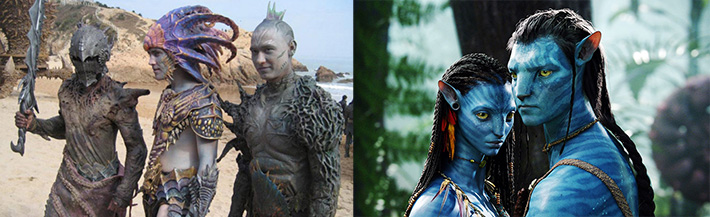
In 2009, James Cameron’s Avatar became the most financially successful movie ever made, raking in almost $2.8 billion worldwide, including a big chunk from the growing market of China. Chinese billionaire Jon Jiang decided that he wanted his own Avatar, and so he spent about $130 million on this enormous underwater adventure starring Olga Kurlyenko, best known as the “Bond girl” in Quantum of Solace.
The trailer for the film was roundly mocked when it came out in 2012, and the film has yet to be released, either in China or worldwide. The special effects look dated, the character designs are bizarre, and Kurylenko’s delivery of the film’s preposterous dialogue makes Sam Worthington look like a good actor. At the rate it’s going, we’ll probably get those continually delayed sequels to Avatar before Empires of the Deep sees the light of day.[/nextpage]